30+ Things to Do with a Hundred Chart

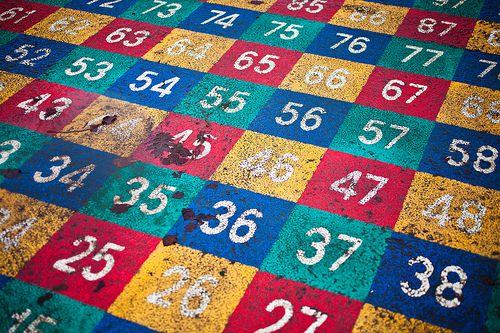
[Photo by geishaboy500 via Flickr (CC BY 2.0).]

Are you looking for creative ways to help your children study math? Even without a workbook or teacher’s manual, your kids can learn a lot about numbers. Just spend an afternoon playing around with a hundred chart (also called a hundred board or hundred grid).

My free 50-page PDF Hundred Charts Galore! printables file features 1–100 charts, 0–99 charts, bottom’s-up versions, multiple-chart pages, blank charts, game boards, and more. Everything you need to play the activities below and those in my new 70+ Things to Do with a Hundred Chart book.

Download Free “Hundred Charts Galore!” Printables

Shop for “70+ Things To Do with a Hundred Chart” Book

And now, let’s play…

Continue reading 30+ Things to Do with a Hundred Chart

Hit Me! (A Math Game)

Photo by paparutzi.

Math concepts: addition, subtraction, negative numbers, mental math, absolute value
Number of players: any number
Equipment: math cards (two decks may be needed for a large group)

Set Up

One player (the dealer) shuffles the math cards and deals one card face down for each player, beginning with the player on his left and proceeding in turn around the table. Then he deals one card face up beside each face down card.

Continue reading Hit Me! (A Math Game)

How to Teach Math to a Struggling Student

photo by MC Quinn via flickr (CC BY 2.0)

Paraphrased from a homeschool math discussion forum:

“Help! My daughter struggles with arithmetic. I guess she is like me: just not a math person. She is an outstanding reader. When we do word problems, she usually has no trouble. She’s a whiz at strategy games and beats her dad at chess every time. But numbers — yikes! When we play Yahtzee, she gets lost trying to add up her score. The simple basics of adding and subtracting confuse her.

“Since I find math difficult myself, it’s hard for me to know what she needs. What’s missing to make it click for her? She used to think math was fun and tested well above grade level, but I listened to some well-meaning advice and totally changed the way we were schooling. I switched from using workbooks and games to using Saxon math, and she got extremely frustrated. Now she hates math.”

Continue reading How to Teach Math to a Struggling Student

Subtracting Mixed Numbers: A Cry for Help

Photo by powerbooktrance.

Paraphrased from a homeschool math discussion forum:

“Help me teach fractions! My son can do long subtraction problems that involve borrowing, and he can handle basic fraction math, but problems like 9  -  5 \frac{2}{5} give him a brain freeze. To me, this is an easy problem, but he can’t grasp the concept of borrowing from the whole number. It is even worse when the math book moves on to 10 \frac{1}{4}  -  2 \frac{3}{7} .”

Several homeschooling parents replied to this question, offering advice about various fraction manipulatives that might be used to demonstrate the concept. I am not sure that manipulatives are needed or helpful in this case. The boy seems to have the basic concept of subtraction down, but he gets flustered and is unsure of what to do in the more complicated mixed-number problems.

The mother says, “To me, this is an easy problem” — and that itself is one source of trouble. Too often, we adults (homeschoolers and classroom teachers alike) don’t appreciate how very complicated an operation we are asking our students to perform. A mixed-number calculation like this is an intricate dance that can seem overwhelming to a beginner.

I will go through the calculation one bite at a time, so you can see just how much a student must remember. As you read through the steps, pay attention to your own emotional reaction. Are you starting to feel a bit of brain freeze, too?

Afterward, we’ll discuss how to make the problem simpler…

Continue reading Subtracting Mixed Numbers: A Cry for Help

Euclid’s Game on a Hundred Chart

Math concepts: subtraction within 100, number patterns, mental math
Number of players: 2 or 3
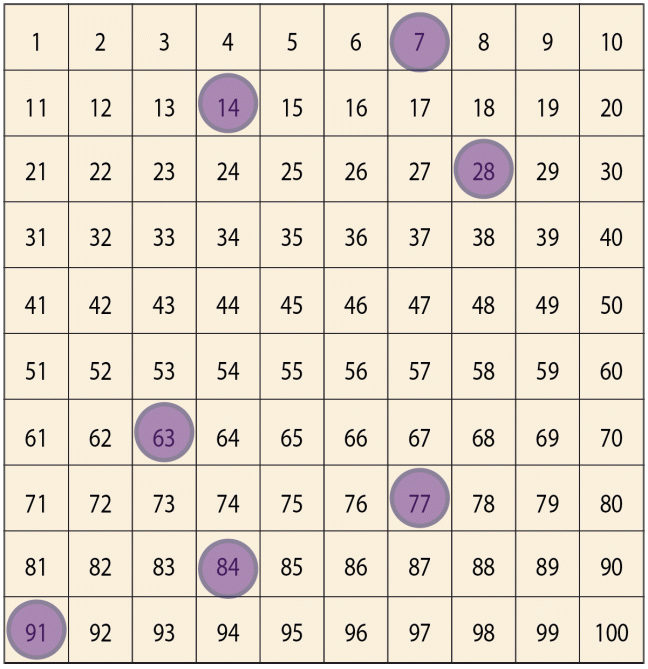
Equipment: printed hundred chart (also called a hundred board), and highlighter or translucent disks to mark numbers — or use this online hundred chart

Set Up

Place the hundred chart and highlighter where all players can reach them.

How to Play

  • Allow the youngest player choice of moving first or second; in future games, allow the loser of the last game to choose.
  • The first player chooses a number from 1 to 100 and marks that square on the hundred chart.
  • The second player chooses and marks any other number.
  • On each succeeding turn, the player subtracts any two marked numbers to find and mark a difference that has not yet been taken.
  • Play alternates until no more numbers can be marked.

Continue reading Euclid’s Game on a Hundred Chart

Game: Hundred Chart Nim

Photo by Håkan Dahlström via flickr.

Math concepts: addition and subtraction within 100, logical strategy
Number of players: 2 or 3
Equipment: printed hundred chart (also called a hundred board) and beans, pennies, or other tokens with which to mark numbers — or use this online hundred chart

Set Up

Place the hundred chart and a small pile of tokens where both players can reach them.

Continue reading Game: Hundred Chart Nim

Ben Franklin Math: Elementary Problem Solving 3rd Grade

The ability to solve word problems ranks high on any math teacher’s list of goals. How can I teach my students to solve math problems? I must help them develop the ability to translate “real world” situations into mathematical language.

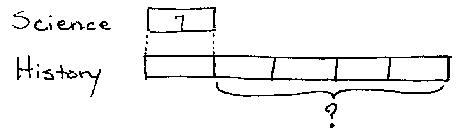
In two previous posts, I introduced the problem-solving tools algebra and bar diagrams. These tools help our students organize the information in a word problem and translate it into a mathematical calculation.

Working Math Problems with Poor Richard

This time I will demonstrate these problem-solving tools in action with a series of 3rd-grade problems based on the Singapore Primary Math series, level 3A. For your reading pleasure, I have translated the problems into the life of Ben Franklin, inspired by the biography Poor Richard by James Daugherty.

Continue reading Ben Franklin Math: Elementary Problem Solving 3rd Grade

Number Bonds, Number Rainbows

Basic bar diagram

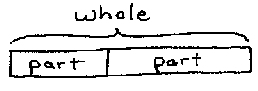
Many of us use the idea of number bonds with our young students. A number bond is a mental picture of the relationship between a number and the parts that combine to make it.

Now we have a new, colorful way to show these relationships, thanks to Maria at Homeschool Math Blog. If you teach math to young children, check this out:

Continue reading Number Bonds, Number Rainbows

Penguin Math: Elementary Problem Solving 2nd Grade

The ability to solve word problems ranks high on any math teacher’s list of goals. How can I teach my students to reason their way through math problems? I must help my students develop the ability to translate “real world” situations into mathematical language.

In a previous post, I analyzed two problem-solving tools we can teach our students: algebra and bar diagrams. These tools help our students organize the information in a word problem and translate it into a mathematical calculation.

Now I want to demonstrate these problem-solving tools in action with a series of 2nd grade problems, based on the Singapore Primary Math series, level 2A. For your reading pleasure, I have translated the problems into the universe of one of our family’s favorite read-aloud books, Mr. Popper’s Penguins.

UPDATE: Problems have been genericized to avoid copyright issues.

Continue reading Penguin Math: Elementary Problem Solving 2nd Grade