Math Makes Sense — Let’s Teach It That Way

I had forgotten this video, and then rediscovered it yesterday and loved it just as much as ever. Perhaps you’ll enjoy it, too — especially if you think of yourself as “not a math person.”

Annie Fetter is talking to classroom teachers, but her message is just as important for homeschoolers. Math is all about making sense. Let’s help our kids see it that way.

“Sense-making is the first mathematical practice for a reason. If we don’t do this one, the rest of them don’t matter. If we’re not doing this, our children are not going to learn mathematics.”

—Annie Fetter
Sense Making: It isn’t Just for Literacy Anymore

You can download the notes for Fetter’s updated session on sense-making and find several links to wonderful, thought-provoking posts on her blog:

How Can We Encourage Sense-Making?

Here are some ideas from Fetter’s updated notes, which expand on her comments in the video above:

  • Get rid of the question. Literally.
  • Ask students “What could the question be?”
  • Get rid of the question and the numbers.
  • Give the answer.
  • Or give several answers.
  • Ask about ideas, not answers.
  • Ask “Why?” or “How did you know?” or “How did you decide that?” or “Tell me more about that.”
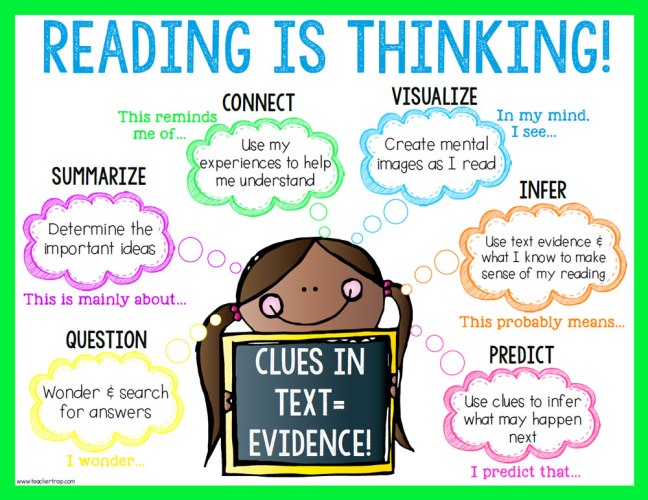
  • Use active reading strategies.

Get this free downloadable poster from Teacher Trap via Teachers Pay Teachers.

A Few Resources to Practice Sense-Making
In no particular order…

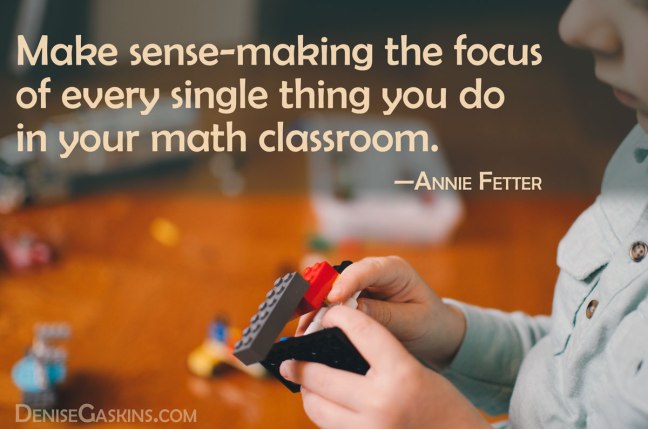
“I implore you, stop ‘cracking the math code.’ Make sense-making the focus of every single thing you do in your math classroom.”

—Annie Fetter
Sense Making: It isn’t Just for Literacy Anymore

And if you haven’t seen it before, don’t miss Annie Fetter’s classic video “Ever Wonder What They’d Notice?”

CREDITS: “Building a rocket ship” photo by Kelly Sikkema via Unsplash. “Reading is thinking” poster by Teacher Trap via Teachers Pay Teachers.
Mathematics Is Worthy

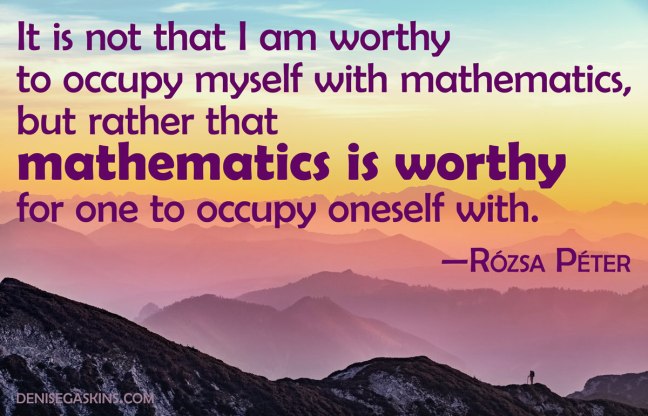
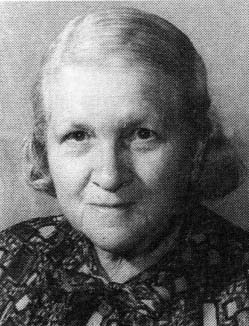
“When I began my college education, I still had many doubts about whether I was good enough for mathematics. Then a colleague said the decisive words to me: it is not that I am worthy to occupy myself with mathematics, but rather that mathematics is worthy for one to occupy oneself with.”

Rózsa Péter
Mathematics is beautiful
essay in The Mathematical Intelligencer

Rózsa Péter and the Curious Students

I would like to win over those who consider mathematics useful, but colourless and dry — a necessary evil…
 
No other field can offer, to such an extent as mathematics, the joy of discovery, which is perhaps the greatest human joy.
 
The schoolchildren that I have taught in the past were always attuned to this, and so I have also learned much from them.
 
It never would have occurred to me, for instance, to talk about the Euclidean Algorithm in a class with twelve-year-old girls, but my students led me to do it.
 
I would like to recount this lesson.
 
What we were busy with was that I would name two numbers, and the students would figure out their greatest common divisor. For small numbers this went quickly. Gradually, I named larger and larger numbers so that the students would experience difficulty and would want to have a procedure.
 
I thought that the procedure would be factorization into primes.
 
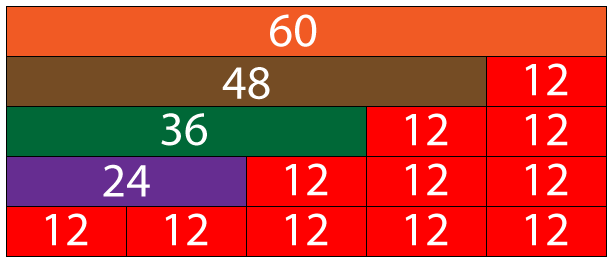
They had still easily figured out the greatest common divisor of 60 and 48: “Twelve!”
 
But a girl remarked: “Well, that’s just the same as the difference of 60 and 48.”


“That’s a coincidence,” I said and wanted to go on.
 
But they would not let me go on: “Please name us numbers where it isn’t like that.”
 
“Fine. 60 and 36 also have 12 as their greatest common divisor, and their difference is 24.”


Another interruption: “Here the difference is twice as big as the greatest common divisor.”
 
“All right, if this will satisfy all of you, it is in fact no coincidence: the difference of two numbers is always divisible by all their common divisors. And so is their sum.”
 
Certainly that needed to be stated in full, but having done so, I really did want to move on.
 
However, I still could not do that.
 
A girl asked: “Couldn’t they discover a procedure to find the greatest common divisor just from that?”


They certainly could! But that is precisely the basic idea behind the Euclidean Algorithm!
 
So I abandoned my plan and went the way that my students led me.
 

— Rózsa Péter
quoted at the MacTutor History of Mathematics Archive

For Further Exploration

Note: When the video narrator says “Greatest Common Denominator,” he really means “Greatest Common Divisor.”

CREDITS: “Pink toned thoughts on a hike” photo courtesy of Simon Matzinger on Unsplash.

Mindset for Learning Math

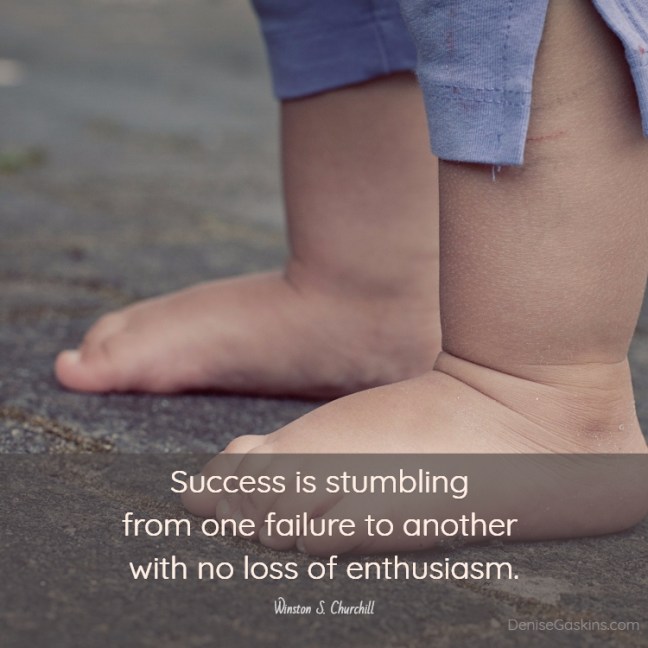
Playing with a new image editor, I came across this Winston Churchill quote. What a great description of how it feels to learn math!

If you have a student who struggles with math or is suffering from a loss of enthusiasm, check out Jo Boaler’s free online course on developing a mathematical mindset:

Or explore some of the playful activity ideas for all ages in her Week of Inspirational Math.

https://youtu.be/bxrPy1fjVU4&rel=0

How to Talk Math With Your Kids

A friend shared this video, and I loved it! From Kent Haines, a father who happens to also be a math teacher…

“I hope that this video helps parents find new ways of interacting with their kids on math topics.”

Kent Haines

More from Kent Haines

Advice and Examples of Talking Math with Kids

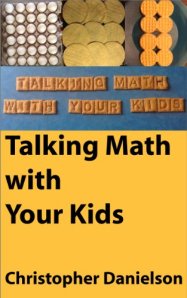
Danielson-Talking Math

If you enjoyed Kent’s video, you’ll love Christopher Danielson’s book and blog.

It’s a short book with plenty of great stories, advice, and conversation-starters. While Danielson writes directly to parents, the book will also interest grandparents, aunts & uncles, teachers, and anyone else who wants to help children notice and think about math in daily life.

“You don’t need special skills to do this. If you can read with your kids, then you can talk math with them. You can support and encourage their developing mathematical minds.
 
“You don’t need to love math. You don’t need to have been particularly successful in school mathematics. You just need to notice when your children are being curious about math, and you need some ideas for turning that curiosity into a conversation.
 
“In nearly all circumstances, our conversations grow organically out of our everyday activity. We have not scheduled “talking math time” in our household. Instead, we talk about these things when it seems natural to do so, when the things we are doing (reading books, making lunch, riding in the car, etc) bump up against important mathematical ideas.
 
“The dialogues in this book are intended to open your eyes to these opportunities in your own family’s life.”

— Christopher Danielson
Talking Math with Your Kids

 
* * *

This blog is reader-supported.

If you’d like to help fund the blog on an on-going basis, then please join me on Patreon for mathy inspiration, tips, and an ever-growing archive of printable activities.

If you liked this post, and want to show your one-time appreciation, the place to do that is PayPal: paypal.me/DeniseGaskinsMath. If you go that route, please include your email address in the notes section, so I can say thank you.

Which I am going to say right now. Thank you!

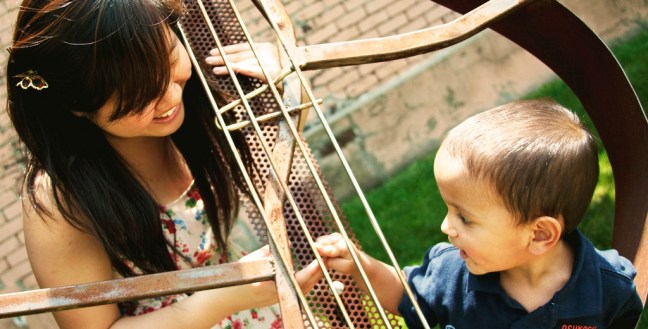
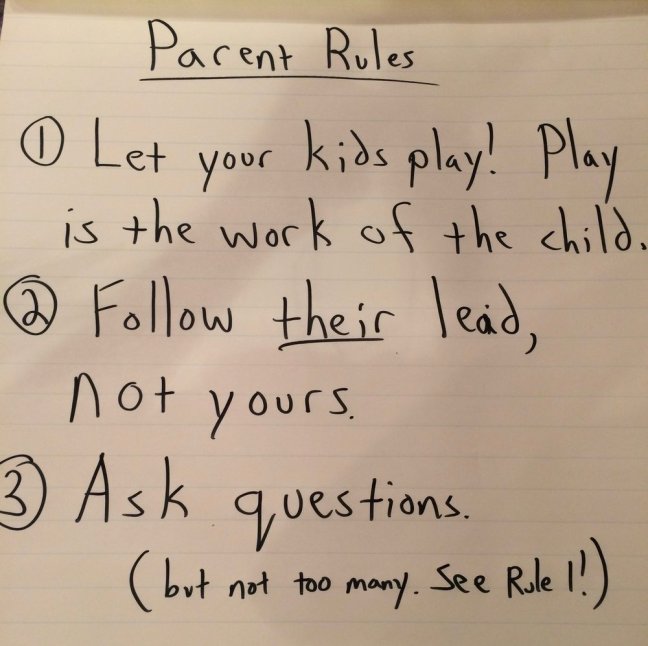
“How to Talk Math With Your Kids” copyright © 2017 by Denise Gaskins. “Kids Talk” photo (top) by Victoria Harjadi via Flickr (CC BY 2.0). “Parent Rules” by Kent Haines.

There Ain’t No Free Candy

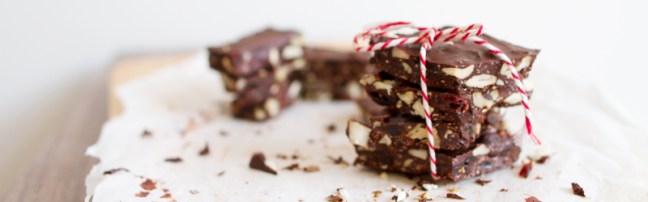
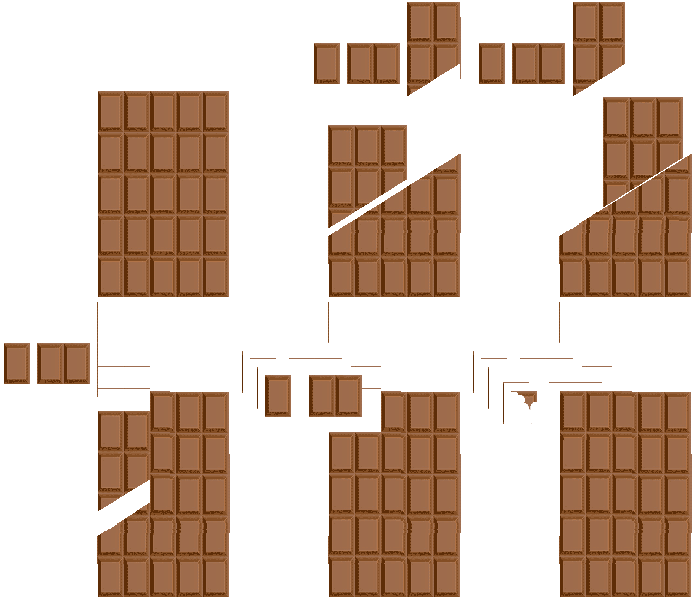
Ah, the infinite chocolate bar. If only it could work in real life! But can your children find the mistake? Where does the extra chocolate come from?

Here’s a hint: It’s related to this classic brainteaser. And here’s a video from Christopher Danielson (talkingmathwithkids.com), showing how the chocolate bar dissection really works.

Happy munchings!

CREDITS: Feature photo (top) by Yoori Koo via Unsplash. “Hershey Bar Math” video by Christopher Danielson via YouTube. The infinite chocolate gif went viral long ago, and I have no idea who was the original artist.

How To Break In Your New Math Journal

I love my new paperback math journal series. The books are sturdy, inexpensive, and fit nicely in my purse.

But as with any paperback book, these have one problem. How do I use them without cracking the spine?

When we exercise, we need to warm up our bodies with a bit of stretching to prevent injury. In the same way, we need to warm up a new book to protect it. The process is called “breaking it in.”

It only takes a few minutes to break in a paperback book:

https://youtu.be/3fN_odVFivw&rel=0

Step by Step

Never force the book but help it limber up gradually, and it will serve you well.

Because my journals are working books, I take the breaking-in process a bit further than shown in the video:

(1) Set the book on its back and follow the process above. Press down each cover, but not completely flat — let it bend at the fold line, about 1 cm from the actual spine. Then press a couple pages at a time, alternating front and back, down flat on each cover.

(2) Flip through the pages of the book forward and backward to limber them up.

(3) Repeat the steps of the video. This time, gently lean the main part of the book away from the part you are pressing down. Aim for a 130–140 degree angle.

(4) Flip through the pages again. For paperbacks, you can even roll the whole book back and forth a bit — gently curving the cover and pages almost as if you’re trying to fold the book in half — to encourage flexibility.

(5) Optional: Repeat the breaking-in process one more time. This time, fold each section back as close to 180 degrees as it will go.

And you’re done!

The pages will still curve in at the fold line, where they connect to the spine of the book. You want that because it makes the book strong. But now they’ll also open up to provide a nice, wide area for writing or math doodling.

Beauty in Math: A Fable

Have you ever wondered what mathematicians mean when they talk about a “beautiful” math proof?

“Beauty in mathematics is seeing the truth without effort.”

George Pólya

“There’s something striking about the economy of the counselor’s construction. He drew a single line, and that totally changed one’s vision of the geometry involved.

“Very often, there’s a simple introduction of something that’s not logically within the framework of the question — and it can be very simple — and it utterly changes your view of what the question really is about.”

Barry Mazur
The Moral of the Scale Fable

CREDITS: Castle photo (top) by Rachel Davis via Unsplash. “A Mathematical Fable” via YouTube. Story told by Barry Mazur. Animation by Pete McPartlan. Video by Brady Haran for Numberphile.

Visualizing Word Problems with Bar Model Diagrams

A friend emailed me, frustrated with her child’s math lesson on bar diagrams: “Why do they have to make it so complicated? Why can’t we just solve the blasted problem?”

I told her bar models themselves are not the goal. The real question for parents and teachers is:

  • What can you do when your child is stumped by a math word problem?

To solve word problems, students must be able to read and understand what is written. They need to visualize this information in a way that will help them translate it into a mathematical expression.

visualizing-word-problems

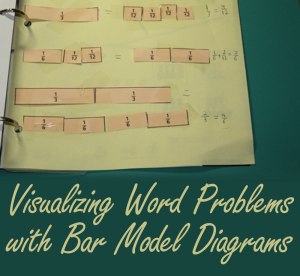
Bar model diagrams are one very useful tool to aid this visualization. These pictures model the word problem in a way that makes the solution appear almost like magic.

It is a trick well worth learning, no matter which math program you use.

Visualization

https://www.youtube.com/watch?v=HKsYDzQK8Zw

“Visualization is the brain’s ability to see beyond what the eyes can see, and we can develop visualization in many ways.”

The Bar Model Explained

https://www.youtube.com/watch?v=I6Ipio8JntU

“A bar model is a way to represent a situation in a word problem using diagrams — in particular, using rectangles.”

https://www.youtube.com/watch?v=i7LAHc1qvig

“This is one of the ideas that children learn in mathematics: the use of diagrams to represent quantities, especially quantities which are unknown.”

Word Problems from Literature

I’ve written a series of blog posts that explain bar model diagrams from the most basic through to solving multistep word problems. Check them out:

I’ve started working on a book about bar model diagrams, and I’d love to hear your input. Have you tried using them? Do they help your children? What questions do you have?

Update: My New Book

You can help prevent math anxiety by giving your children the mental tools they need to conquer the toughest story problems.

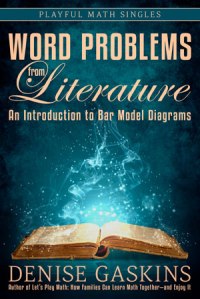
Check out Word Problems from Literature: An Introduction to Bar Model Diagrams—now available at all your favorite online bookstores!

And there’s a Student Workbook, too.

CREDITS: Videos and quotations from Dr. Yeap Ban Har’s YouTube channel. “Girl doing homework” photo (top) by ND Strupler and “math notebooking equal fractions” by Jimmie via Flickr (CC BY 2.0).

A Map of Mathematics

Pure mathematics, applied math, and more — all summarized in a single map! Watch the video by physicist and award-winning science writer Dominic Walliman:

https://youtu.be/OmJ-4B-mS-Y&rel=0

Walliman says, “To err is to human, and I human a lot. I always try my best to be as correct as possible, but unfortunately I make mistakes…”

  • Can you find three mistakes in the map?

Check your answers in the description on Walliman’s YouTube page.

If you enjoy this video, you can purchase the poster (or T-shirt, coffee mug, tote bag, etc.) at Red Bubble.

 
* * *

CREDITS: Map of Mathematics poster by Dominic Walliman via Flickr (CC BY-NC-ND 2.0).

This blog is reader-supported.

If you’d like to help fund the blog on an on-going basis, then please head to my Patreon page.

If you liked this post, and want to show your one-time appreciation, the place to do that is PayPal: paypal.me/DeniseGaskinsMath. If you go that route, please include your email address in the notes section, so I can say thank you.

Which I am going to say right now. Thank you!

“A Map of Mathematics” copyright © 2017 by Denise Gaskins.