Blog

Euclid’s Geometric Algebra

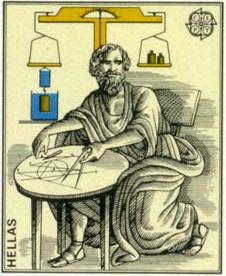
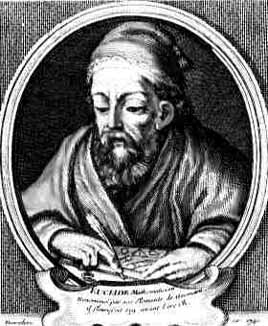
Picture from MacTutor Archives.

After the Pythagorean crisis with the square root of two, Greek mathematicians tried to avoid working with numbers. Instead, the Greeks used geometry to demonstrate mathematical concepts. A line can be drawn any length, so straight lines became a sort of non-algebraic variable.

You can see an example of this in The Pythagorean Proof, where Alexandria Jones represented the sides of her triangle by the letters a and b. These sides may be any length. The sizes of the squares will change with the triangle sides, but the relationship a^2 + b^2 = c^2 is always true for every right triangle.

Continue reading Euclid’s Geometric Algebra

If It Ain’t Repeated Addition, What Is It?

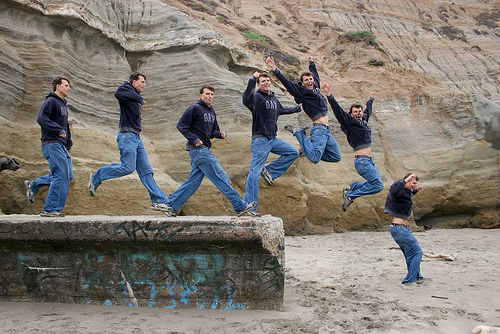
[Photo by SuperFantastic.]

Keith Devlin’s latest article, It Ain’t No Repeated Addition, brought me up short. I have used the “multiplication is repeated addition” formula many times in the past — for instance, in explaining order of operations. But according to Devlin:

Multiplication simply is not repeated addition, and telling young pupils it is inevitably leads to problems when they subsequently learn that it is not.

I found myself arguing with the article as I read it. (Does anybody else do that?) If multiplication is not repeated addition, then what in the world is it?

Continue reading If It Ain’t Repeated Addition, What Is It?

Math History on the Internet

[Image from the MacTutor Archive.]

The story of mathematics is the story of interesting people. What a shame it is that our children see only the dry remains of these people’s passion. By learning math history, our students will see how men and women wrestled with concepts, made mistakes, argued with each other, and gradually developed the knowledge we today take for granted.

In a previous article, I recommended books that you may find at your local library or be able to order through inter-library loan. Now, let me introduce you to the wealth of math history resources on the Internet.

Continue reading Math History on the Internet

Summer: Time to Sharpen Math Skills

[Photo by Vox Efx.]

School’s out — and what could be more fun in the lazy, hazy days of summer than to study math? Check out these articles from Maria Miller of Homeschool Math Blog:

How to Help a Student Who is Behind in Math

Keeping Your Math Skills Sharp Over The Summer

Continue reading Summer: Time to Sharpen Math Skills

Hooray for (Math) History

Photo by Benimoto.

John Napier foiled a thief with the aid of logic and a black rooster. For this and other acts of creative problem solving, his servants and neighbors suspected him of witchcraft.

What does this have to do with mathematics?

Math was Napier’s favorite hobby. He invented logarithms to help people handle large numbers easily, and he even created a calculator out of a chessboard. [See how it works: addition, subtraction, multiplication.]

Continue reading Hooray for (Math) History

Math Game: What Number Am I?

Photo by jaycoxfilm.

Math concepts: mental calculations, math vocabulary, and anything else you want to include
Number of players: any number, but I think it works best with two players who alternate asking questions
Equipment: imagination and, if necessary, scratch paper

Many years ago, I read a magazine article by mathematical music critic Edward Rothstein, wherein he described a game he invented for his daughter:

  • “What number am I? If you add me to myself, you get four.”

Rather than explaining the rules of the game, let me tell you a story…

Continue reading Math Game: What Number Am I?

Does Life Have You Swamped?


Photo by Niner.

My yard, my life! This was our front yard and driveway last weekend, as we rushed through our last-minute preparations for the County Fair. Niner, too old for 4-H, was determined to get her photos entered in the open competition before Saturday afternoon’s deadline. She rolled up her pants legs and waded through the drink, using her feet to feel out the edges of the driveway and marking the path with red-flagged fence posts so the Jeep could make it through.

Just in case you were wondering why there were no new posts this week.

The Mosaic Tile Mystery

Dear Alexandria Jones,

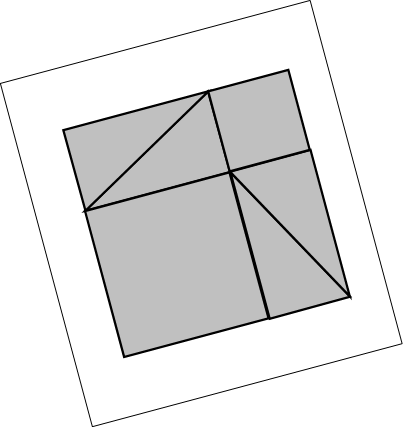
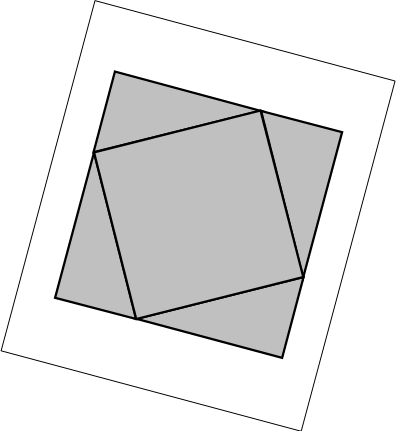
We continue to excavate the ancient building complex, which I believe may have been Pythagoras’s school. Yesterday, one of our digging crews uncovered a mosaic tile floor in the courtyard. The pattern of the tiles alternates between two square designs. (See enclosed sketches.)

During your family’s recent visit, you expressed an interest in the mathematical ideas of Pythagoras. Could you or your father offer us any insight into what these tile designs may represent?

I look forward to your response.

Sincerely,
Sofia Theano, Ph.D.
Crotone, Italy

Continue reading The Mosaic Tile Mystery

Hit Me! (A Math Game)

Photo by paparutzi.

Math concepts: addition, subtraction, negative numbers, mental math, absolute value
Number of players: any number
Equipment: math cards (two decks may be needed for a large group)

Set Up

One player (the dealer) shuffles the math cards and deals one card face down for each player, beginning with the player on his left and proceeding in turn around the table. Then he deals one card face up beside each face down card.

Continue reading Hit Me! (A Math Game)