Blog

Quotable: I Do Hate Sums

MrsLaTouche

I’ve been looking for quotes to put at the beginning of each chapter in my math games books. I found a delightful one by Mrs. LaTouche on the Mathematical Quotations Server, but when I looked up the original source, it was even better:

I am nearly driven wild with the Dorcas accounts, and by Mrs. Wakefield’s orders they are to be done now.

I do hate sums. There is no greater mistake than to call arithmetic an exact science. There are Permutations and Aberrations discernible to minds entirely noble like mine; subtle variations which ordinary accountants fail to discover; hidden laws of Number which it requires a mind like mine to perceive.

For instance, if you add a sum from the bottom up, and then again from the top down, the result is always different.

Again if you multiply a number by another number before you have had your tea, and then again after, the product will be different. It is also remarkable that the Post-tea product is more likely to agree with other people’s calculations than the Pre-tea result.

Try the experiment, and if you do not find it as I say, you are a mere sciolist*, a poor mechanical thinker, and not gifted as I am, with subtle perceptions.

Of course I find myself not appreciated as an accountant. Mrs. Wakefield made me give up the book to [my daughter] Rose and her governess (who are here), and was quite satisfied with the work of those inferior intellects.

— Maria Price La Touche
The Letters of A Noble Woman
London: George Allen & Sons, 1908

*sciolist: (archaic) A person who pretends to be knowledgeable and well informed. From late Latin sciolus (diminutive of Latin scius ‘knowing’, from scire ‘know’) + -ist.

Math Teachers at Play # 77 via Math = Love

MTaP77

Math Teachers at Play is a traveling collection of math tidbits — games, lesson ideas, and more — from around the Internet. It moves around from month to month, and the August edition is now posted at Math = Love blog. What a fun list of math posts to browse!

Welcome to the 77th edition of the Math Teachers at Play Blog Carnival! I’m super excited to be hosting this carnival because I’ve been reading it for years! Yes, I am that crazy person who started reading math teacher blogs as a high school junior. I think you are going to enjoy going through the submissions. I know I found several new-to-me blogs to add to my RSS reader! …

Click here to go read the whole carnival.

Fractions: 1/5 = 1/10 = 1/80 = 1?

[Feature photo is a screen shot from the video “the sausages sharing episode,” see below.]

Fractions: 1/5 = 1/10 = 1/80 = 1?

How in the world can 1/5 be the same as 1/10? Or 1/80 be the same as one whole thing? Such nonsense!

No, not nonsense. This is real-world common sense from a couple of boys faced with a problem just inside the edge of their ability — a problem that stretches them, but that they successfully solve, with a bit of gentle help on vocabulary.

Here’s the problem:

  • How can you divide eight sausages evenly among five people?

Think for a moment about how you (or your child) might solve this puzzle, and then watch the video below.

What Do You Notice?

Continue reading Fractions: 1/5 = 1/10 = 1/80 = 1?

Fraction Game: My Closest Neighbor

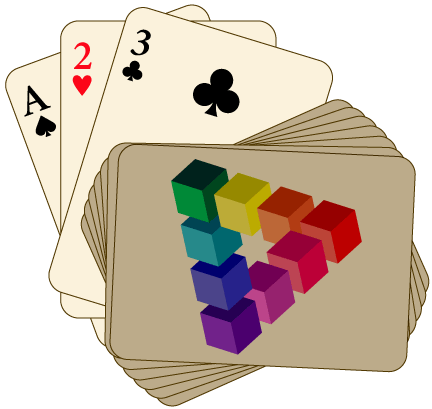
[Feature photo above by Jim Larrison, and antique playing cards below by Marcee Duggar, via Flickr (CC BY 2.0).]

I missed out on the adventures at Twitter Math Camp, but I’m having a great time working through the blog posts about it. I prefer it this way — slow reading is more my speed. Chris at A Sea of Math posted a wonderful game based on one of the TMC workshops. Here is my variation.

Math concepts: comparing fractions, equivalent fractions, benchmark numbers, strategic thinking.

Players: two to four.

Equipment: two players need one deck of playing cards, three or four players need a double deck.

Continue reading Fraction Game: My Closest Neighbor

Math Teachers at Play #76

76[Feature photo (above) by U.S. Army RDECOM. Photo (right) by Stephan Mosel. (CC BY 2.0)]

On your mark… Get set… Go play some math!

Welcome to the 76th edition of the Math Teachers At Play math education blog carnival — a smorgasbord of links to bloggers all around the internet who have great ideas for learning, teaching, and playing around with math from preschool to pre-college.

By tradition, we start the carnival with a puzzle in honor of our 76th edition. But if you would like to jump straight to our featured blog posts, click here to see the Table of Contents.

Continue reading Math Teachers at Play #76

Playing With Math — the Book

body_Book_cover_for_upload

Update: The crowdfunding campaign is now closed and the book is in the final stages. It should be headed to the printer soon. Check the Playing With Math homepage for publication and ordering information.


There are only a few days left to reserve your copy of Playing With Math: Stories from Math Circles, Homeschoolers, and Passionate Teachers. I don’t have time to finish the review I hoped to write, so instead I’ll share some of my favorite quotes from the book:

What do mathematicians do? We play with math. What are little kids doing when they’re thinking about numbers, shapes, and patterns? They’re playing with math. You may not believe it yet, but you can have fun playing with math, too.

— Sue VanHattum, editor

We had a discussion at the end of the club on how we are all confused now, but pleasantly so, and how important it is to rejoice in confusion and to be comfortable with it. Adults often strive very hard to get rid of any and all possible traces of confusion for kids, making things dreadfully boring.

— Maria Droujkova, after a math circle exploration of infinity

All it talkes to do mathematics is opportunity, a frustrating problem, and a bit of stubbornness.

— Ellen Kaplan, math circle leader

Our own school experiences can make it hard for us to teach without being tempted to “help them master” a concept that they may or may not be ready to master. What we never learned in school was the concept of playing around with math, allowing ideas to “percolate,” so to speak, before mastery occurs, and that process may take time.

— Julie Brennan, homeschooler

Continue reading Playing With Math — the Book

Quotable: Math Connections

ConnectedGearsJoBoaler

It turns out that the people who do well in math are those who make connections and see math as a connected subject. The people who don’t do well are people who see math as a lot of isolated methods.

— Jo Boaler
Math Connections

If you or your children struggle with math, Boaler’s non-profit YouCubed.org may help you recover your joy in learning.

Math(s) Teachers At Play #75 via CavMaths

[Feature photo above “Sconic Sections” by Lenore Edman and “75” by R/DV/RS via Flickr (CC BY 2.0).]
75

The monthly math education blog carnival Math Teachers at Play features games, lessons, puzzles, activities, and teaching tips from classroom teachers, homeschoolers, and self-educated learners around the Internet world. Check out the 20 posts of mathematical fun in the June edition:

Math(s) Teachers At Play #75 via CavMaths

Hello, and welcome to the 75th issue of the Math(s) Teachers at Play Blog Carvinal! For those of you who are unaware, a “blog carnival” is a periodic post that travels from blog to blog and has a collection of posts on a certain topic.

This is the first time I’ve hosted a carnival and there were some excellent submissions. I enjoyed reading them all and have discovered some new blogs. I have also input some posts I’ve seen this month which I thought were excellent too…

Click here to go read Math(s) Teachers At Play #75 via CavMaths.

Playing With Math: Stories from Math Circles, Homeschoolers, and Passionate Teachers

body_Book_cover_for_upload

Update: The crowdfunding campaign is now closed and the book is in the final stages. It should be headed to the printer soon. Check the Playing With Math homepage for publication and ordering information.


There’s a problem: Most people don’t like math. Why is that? Perhaps it has something to do with the way math is taught in school. As a teacher to my own kids and mentor to homeschooling parents, I’ve been fighting math anxiety for decades.

This book is one part of the solution.

Playing With Math: Stories from Math Circles, Homeschoolers, and Passionate Teachers features more than thirty authors who tell delightful stories of learning to appreciate math and of sharing their enthusiasm with their communities, families, or students. After every chapter is a puzzle, game, or activity to get you and your kids playing with math, too.

You can read a couple of excerpts at PlayingWithMath.org:

Continue reading Playing With Math: Stories from Math Circles, Homeschoolers, and Passionate Teachers

Reblog: Calculus Tidbits

[Feature photo above by Olga Lednichenko via Flickr (CC BY 2.0).]

This week I have a series of quotes about calculus from my first two years of blogging. The posts were so short that I won’t bother to link you back to them, but math humor keeps well over the years, and W. W. Sawyer is (as always) insightful.

I hope you enjoy this “Throw-back Thursday” blast from the Let’s Play Math! blog archives:


Finding the Limit

Eldest daughter had her first calculus lesson last night: finding the limit as delta-t approached zero. The teacher found the speed of a car at a given point by using the distance function, calculating the average speed over shorter and shorter time intervals. Dd summarized the lesson for me:

“If you want to divide by zero, you have to sneak up on it from behind.”


Harmonic Series Quotation

This kicked off my week with a laugh:

Today I said to the calculus students, “I know, you’re looking at this series and you don’t see what I’m warning you about. You look and it and you think, ‘I trust this series. I would take candy from this series. I would get in a car with this series.’ But I’m going to warn you, this series is out to get you. Always remember: The harmonic series diverges. Never forget it.”

—Rudbeckia Hirta
Learning Curves Blog: The Harmonic Series
quoting Alexandre Borovik


So You Think You Know Calculus?

Rudbeckia Hirta has a great idea for a new TV blockbuster:


Common Sense and Calculus

Sawyer-MathDelight

And here’s a quick quote from W. W. Sawyer’s Mathematician’s Delight:

If you cannot see what the exact speed is, begin to ask questions. Silly ones are the best to begin with. Is the speed a million miles an hour? Or one inch a century? Somewhere between these limits. Good. We now know something about the speed. Begin to bring the limits in, and see how close together they can be brought.

Study your own methods of thought. How do you know that the speed is less than a million miles an hour? What method, in fact, are you unconsciously using to estimate speed? Can this method be applied to get closer estimates?

You know what speed is. You would not believe a man who claimed to walk at 5 miles an hour, but took 3 hours to walk 6 miles. You have only to apply the same common sense to stones rolling down hillsides, and the calculus is at your command.