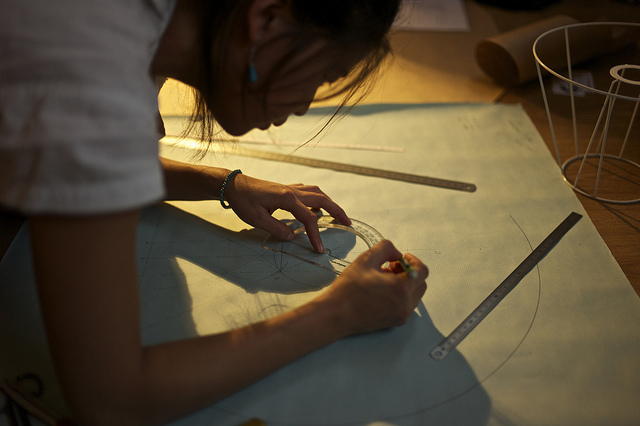
Reblog: Patty Paper Trisection

[Feature photo above by Michael Cory via Flickr (CC BY 2.0).]

trisection2

I hear so many people say they hated geometry because of the proofs, but I’ve always loved a challenging puzzle. I found the following puzzle at a blog carnival during my first year of blogging. Don’t worry about the arbitrary two-column format you learned in high school — just think about what is true and how you know it must be so.

I hope you enjoy this “Throw-back Thursday” blast from the Let’s Play Math! blog archives:


trisection

One of the great unsolved problems of antiquity was to trisect any angle using only the basic tools of Euclidean geometry: an unmarked straight-edge and a compass. Like the alchemist’s dream of turning lead into gold, this proved to be an impossible task. If you want to trisect an angle, you have to “cheat.” A straight-edge and compass can’t do it. You have to use some sort of crutch, just as an alchemist would have to use a particle accelerator or something.

One “cheat” that works is to fold your paper. I will show you how it works, and your job is to show why …


[Click here to go read Puzzle: Patty Paper Trisection.]

More Than One Way To Find the Center of a Circle

[Feature photo above by hom26 via Flickr.]

My free time lately has gone to local events and to book editing. I hope to put up a series of blog posts sometime soon, based on the Homeschool Math FAQs chapter I’m adding to the paperback version of Let’s Play Math. [And of course, I’ll update the ebook whenever I finally publish the paperback, so those of you who already bought a copy should be able to get the new version without paying extra.]

But in the meantime, as I was browsing my blog archives for an interesting “Throw-Back Thursday” post, I stumbled across this old geometry puzzle from Dave Marain over at MathNotations blog:

Is it possible that AB is a chord but NOT a diameter? That is, could circle ABC have a center that is NOT point O?

Jake shows Jack a piece of wood he cut out in the machine shop: a circular arc bounded by a chord. Jake claimed that the arc was not a semicircle. In fact, he claimed it was shorter than a semicircle, i.e., segment AB was not a diameter and arc ACB was less than 180 degrees.

Jack knew this was impossible and argued: “Don’t you see, Jake, that O must be the center of the circle and that OA, OB and OC are radii.”

Jake wasn’t buying this, since he had measured everything precisely. He argued that just because they could be radii didn’t prove they had to be.

Which boy do you agree with?

  • Pick one side of the debate, and try to find at least three different ways to prove your point.

If you have a student in geometry or higher math, print out the original post (but not the comments — it’s no fun when someone gives you the answer!) and see what he or she can do with it.

Dave offers many other puzzles to challenge your math students. While you are at his blog, do take some time to browse past articles.

Reblog: The Handshake Problem

[Feature photo above by Tobias Wolter (CC-BY-SA-3.0) via Wikimedia Commons.]

Seven years ago, our homeschool co-op held an end-of-semester assembly. Each class was supposed to demonstrate something they had learned. I threatened to hand out a ten question pop quiz on integer arithmetic, but instead my pre-algebra students voted to perform a skit.

I hope you enjoy this “Throw-back Thursday” blast from the Let’s Play Math! blog archives:


If seven people meet at a party, and each person shakes the hand of everyone else exactly once, how many handshakes are there in all?

In general, if n people meet and shake hands all around, how many handshakes will there be?

Cast

1-3 narrators
7 friends (non-speaking parts, adjust to fit your group)

Props

Each friend will need a sheet of paper with a number written on it big and bold enough to be read by the audience. The numbers needed are 0, 1, 2, 3, … up to one less than the number of friends. Each friend keeps his paper in a pocket until needed.

[Click here to go read Skit: The Handshake Problem.]

Pi Day Roundup

WhyPi

[Feature photo above by Nicolo’ Canali De Rossi.]

Math holiday alert: March 14th is Pi Day. But why limit ourselves to a single day? Playing with math should be a year-round adventure! Here are some ideas to help you celebrate…

Pi Day Posts on Let’s Play Math! Blog

DragonOfPi

Continue reading Pi Day Roundup

Playing with Pinterest: New Math Boards

Do you like Pinterest? I’ve enjoyed exploring the site lately, so I set up a few boards where I can pin the goodies I find. It may take awhile before I get all the old games and posts from this blog loaded up, so save the links and come back often…

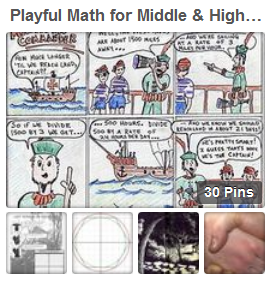
Playful Math Games & Activities

Middle-High School

As our children (and their parents!) play around with mathematical ideas and the relationships between them, we develop deep understanding that is strong enough to support future learning. Playful math links include math games, activities, and interesting lesson plans.

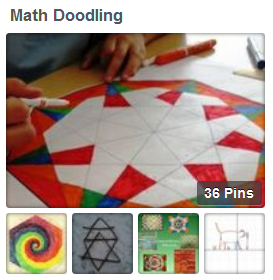
Math Doodling

Math Doodling

Making abstract math visual: Math doodles let us see and experiment with a wide range of mathematical structures — and even to feel them, if we include hands-on 3D doodles in clay or other media. Links include art projects, geometry constructions, and physical models to explore.

Math Teaching Tips & Resources

Math Teaching Tips

A variety of math teaching ideas for homeschool families or classroom teachers. Learning mathematics is more than just answer-getting: help your students make conceptual connections. These links are more “schooly” than on the other boards, and they include conceptual lessons that build your own understanding of mathematics as well as that of your students. And math notebooking resources, too.

MTaP Math Education Blog Carnival Archive

MTaP archive

Since early 2009, the Math Teachers at Play (MTaP) blog carnival has offered tips, tidbits, games, and activities for students and teachers of preschool through pre-college mathematics. Now published once a month, the carnival welcomes entries from parents, students, teachers, homeschoolers, and just plain folks. If you like to learn new things and play around with ideas, you are sure to find something of interest.

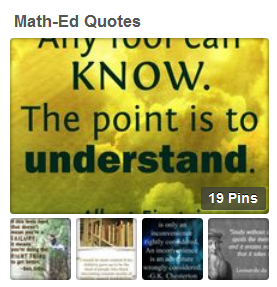
Math-Ed Quotes

Math-Ed Quotes

Inspiration for homeschooling parents and classroom teachers. This is where I’m posting my Wednesday Wisdom quotes.

And that’s the end of my Pinterest boards (so far).

What are some of your favorite Pinterest sites? Please share a link in the comments!

The Linear Inequality Adventures of Ohio Jones

Ohio Jones 1

Last week, Kitten and I reached her textbook’s chapter on graphing linear equations, and a minor mistake with negative numbers threw her into an “I can’t do it!” funk. It’s not easy teaching a perfectionist kid.

Usually her mood improves if we switch to a slightly more advanced topic, and luckily I had saved these worksheets on my desktop, waiting for just such an opportunity. Today’s lesson:

  • Some fun(ish) worksheets
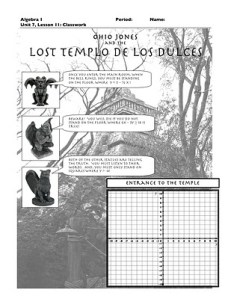
    “For tomorrow, students will be graphing systems of inequalities, so I decided to create a little Ohio Jones adventure (Indiana’s lesser known brother)…”

I offered to give her a hint, but she wanted to try it totally on her own. It took her about 40 minutes to work through the first few rooms of the Lost Templo de los Dulces and explain her solutions to me. I’m sure she’ll speed up with experience.

So far, she’s enjoying it much more than the textbook lesson. It’s fascinating to me how the mere hint of fantasy adventure can change graphing equations from boring to cool. Thanks, Dan!

2014 Mathematics Game

2014-Calendar

[Feature photo above by Artis Rams (CC BY 2.0) via flickr. Title background (right) by Dan Moyle (CC BY 2.0) via flickr]

Have you made a New Year’s resolution to spend more time with your family this year, and to get more exercise? Problem-solvers of all ages can pump up their (mental) muscles with the Annual Mathematics Year Game Extravaganza!

For many years mathematicians, scientists, engineers and others interested in mathematics have played “year games” via e-mail and in newsgroups. We don’t always know whether it is possible to write expressions for all the numbers from 1 to 100 using only the digits in the current year, but it is fun to try to see how many you can find.

Math Forum Year Game Site

Rules of the Game

Use the digits in the year 2014 to write mathematical expressions for the counting numbers 1 through 100. The goal is adjustable by age: Young children can start with looking for 1-10, or 1-25.

  • You must use all four digits. You may not use any other numbers.
  • Solutions that keep the year digits in 2-0-1-4 order are preferred, but not required.
  • You may use +, -, x, ÷, sqrt (square root), ^ (raise to a power), ! (factorial), and parentheses, brackets, or other grouping symbols.
  • You may use a decimal point to create numbers such as .2, .02, etc., but you cannot write 0.02 because we only have one zero in this year’s number.
  • You may use the overhead-bar (vinculum), dots, or brackets to mark a repeating decimal.
  • You may create multi-digit numbers such as 10 or 201 or .01, but we prefer solutions that avoid them.
  • You may use a double factorial, but we prefer solutions that avoid them. n!! = the product of all integers from 1 to n that have the same parity (odd or even) as n.

[Note to students and teachers: If you want to take part in the Math Forum Year Game, be warned that they do not allow repeating decimals.]

Click here to continue reading.

Multiplication Models Card Game

multfrac-300Update: An expanded version of this post is featured in my book Multiplication & Fractions: Math Games for Tough Topics, available now at your favorite online book dealer.

Homeschooling parents know that one of the biggest challenges for any middle-elementary math student is to master the multiplication facts. It can seem like an unending task to memorize so many facts and be able to pull them out of mental storage in any order on demand.

Too often, we are tempted to stress the rote aspect of such memory work, which makes our children lose their focus on what multiplication really means. Before practicing the times table facts, make sure your student gets plenty of practice recognizing and using the common models for multiplication.

To help your children see what multiplication looks like in real life, explore the multitude of Multiplication Models collected at the Natural Math website. Or sign up for their Multiplication Explorers Online Course.

You may want to pick up this poster and use it for ideas as you play the Tell Me a (Math) Story game. Word problems are important for children learning any new topic in math, because they give children a mental “hook” on which to hang the abstract number concepts.

And for extra practice, you can play my free card game…

Click here to continue reading.

2013 Advent Math from Nrich

Click the images below to visit the Advent calendars, and your children can play with math every day until Christmas! You may also enjoy:

Primary Advent Calendar

“This Advent Calendar has a new activity for each day in the run-up to Christmas. All the activities are based on the theme of Planet Earth.”

advent1

Secondary Advent Calendar

“Behind each door of the Advent Calendar is one of our favourite activities with videos. Watch and enjoy!”

advent2

Pondering Large Numbers

[Feature photo above by Paolo Camera (CC BY 2.0) via Flickr.]

Half of our students were missing from this month’s homeschool teen math circle, but I challenged the three who did show up to wrap their brains around some large numbers. Human intuition serves us well for the numbers we normally deal with from day to day, but it has a hard time with numbers outside our experience. We did a simple yet fascinating activity.

First, draw a line across a page of your notebook. Label one end of the line $20 (the amount of money I had in my purse), and mark the other end as $1 trillion (rough estimate of the US government’s yearly overspending, the annual deficit):

large-numbers-baseline

  • Where on that line do you think $1 million would be?

Go ahead, try it! The activity has a much greater impact when you really do it, rather than just reading. Don’t try to over-think this, just mark wherever it feels right to you.

The kids were NOT eager to commit themselves, but I waited in silence until everyone made a mark.

  • Okay, now, where do you think $1 billion would be?

This was a bit easier. Once they had committed to a place for a million, they went about that much farther down the line to mark a billion.

Continue reading Pondering Large Numbers