The (Mathematical) Trouble with Pizza

Photo by George Parrilla via flickr.

Kitten complained that some math programs keep repeating the same kind of problems over and over, with bigger numbers: “They don’t get any harder, they just get longer. It’s boring!”
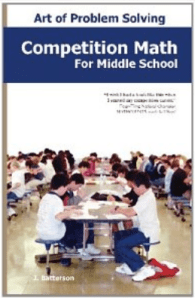
So we pulled out the Counting lessons in Competition Math for Middle School. [Highly recommended book!] Kitten doesn’t like to compete, but she enjoys learning new ideas, and Batterson’s book gives her plenty of those, well organized and clearly explained.

Today’s topic was the Fundamental Counting Principle. It was review, easy-peasy. The problems were too simple, until…

Pizzas at Mario’s come in three sizes, and you have your choice of 10 toppings to add to the pizza. You may order a pizza with any number of toppings (up to 10), including zero. How many choices of pizza are there at Mario’s?

[The book said 9 toppings, but I was skimming/paraphrasing aloud and misread.]

  • Can you figure out the answer?

Continue reading The (Mathematical) Trouble with Pizza

Hyperbolic Crochet Coral Reef

Wow! And to think, I was proud of myself for finishing a crochet afghan. Once.

For More Details

Try It Yourself

Chain several. Leave straight to work in rows, or connect into a loop. Single crochet until your patience runs out, increasing every nth stitch (add an extra sc in the same place). Experiment with different colors and patterns. This pdf will give you more ideas.

The more frequently you increase, the frillier your hyperbolic plane will be, while a less-frequent increase makes it easier for students to see the structure. Daina Taimina recommends a 12:13 ratio (increase after every 12th stitch) for classroom use.

Hat tip: 2010 MAA Found Math Gallery, Week 45, and authentic arts by jenny hoople for the pdf.

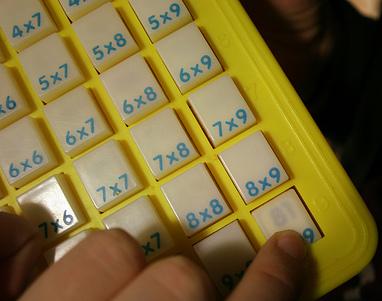
Game: Times Tac Toe

Photo by jma.work via flickr.

I’ve been working on a book of math games for homeschoolers and other teachers. I hope to get it published later this year, but the editing drags on. Would anybody like to draw the illustrations?

Meanwhile, here’s a 2-player game your students may enjoy…

Set Up

Print out a blank times table chart and place it between the players. Each player will need a colored marker, and the colors must be different enough to be easily distinguished.

Remove the jokers and kings from a deck of poker-style playing cards, but leave the jacks (= 11) and queens (= 12). Shuffle the deck, and place the stack face down as a draw pile.

Continue reading Game: Times Tac Toe

2011 Mathematics Game

[Photo from Wikipedia.]

Two of the most popular New Year’s Resolutions are to spend more time with family and friends, and to get more exercise. The 2011 Mathematics Game is a chance to do both at once.

So grab a partner, slip into your workout clothes, and pump up those mental muscles!

Here are the rules:

Use the digits in the year 2011 to write mathematical expressions for the counting numbers 1 through 100.

  • All four digits must be used in each expression. You may not use any other numbers except 2, 0, 1, and 1.
  • You may use the arithmetic operations +, -, x, ÷, sqrt (square root), ^ (raise to a power), and ! (factorial). You may also use parentheses, brackets, or other grouping symbols.
  • You may use a decimal point to create numbers such as .1, .02, etc.
  • Multi-digit numbers such as 20 or 102 may be used, but preference is given to solutions that avoid them.

Bonus Rules
You may use the overhead-bar (vinculum), dots, or brackets to mark a repeating decimal.

You may use multifactorials:

  • (n!)! = a factorial of a factorial, which is not the same as a multifactorial
  • n!! = a double factorial = the product of all integers from 1 to n that have the same parity (odd or even) as n
  • n!!! = a triple factorial = the product of all integers from 1 to n that are equal to n mod 3

[Note to teachers: The bonus rules are not part of the Math Forum guidelines. They make a significant difference in the number of possible solutions, however, and they should not be too difficult for high school students or advanced middle schoolers.]

Continue reading 2011 Mathematics Game

Graph-It Game

[Photo by Scott Schram via Flickr.]

For Leon’s Christmas gift, Alex made the Graph-It game. She wrapped a pad of graph paper and wrote up the instructions:

To play Graph-It, one person designs a picture made by connecting points on a coordinate graph. He reads the points to the other player, who tries to reproduce the picture.

Continue reading Graph-It Game

Renée’s Platonic Mobile

Alexandria Jones struggled to think of a Christmas gift that a one-month-old baby could enjoy, but finally she got an idea.

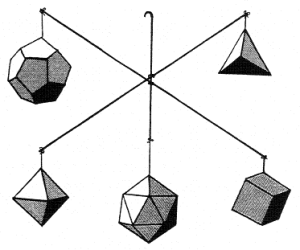
She cut empty cereal boxes to make regular polygons: 6 squares, 12 regular pentagons, and 32 equilateral triangles. Using small pieces of masking tape, she carefully formed the five Platonic solids. Then she mixed flour and water into a runny paste. She tore an old newspaper into small strips and soaked them in the paste. She covered each solid with a thin layer of paper.

Continue reading Renée’s Platonic Mobile

A Football Puzzle

[Photo by rdesai.]

The MIT Mathmen got the ball on their own 20-yard line for the last drive of the game. They were down by 2 points, so they needed at least a field goal to win the game.

If quarterback Zeno and his offense advanced the ball halfway to the opposing team’s end zone on each play…

Continue reading A Football Puzzle

Logic Games at Blogging 2 Learn

http://www.wpclipart.com/money/. Per the licen...
Image via Wikipedia

For the rest of NaBloPoMo (National Blog Posting Month), my other blog is featuring a logic game or puzzle every day. So far, I’ve shared three of my online favorites:

And there’s plenty more fun to come. Drop in every day until December to see a new puzzle or game: