The Math Student’s Manifesto

[Feature photo above by Texas A&M University (CC BY 2.0) via Flickr.]

Note to Readers: Please help me improve this list! Add your suggestions or additions in the comment section below…

What does it mean to think like a mathematician? From the very beginning of my education, I can do these things to some degree. And I am always learning to do them better.

(1) I can make sense of problems, and I never give up.

  • I always think about what a math problem means. I consider how the numbers are related, and I imagine what the answer might look like.
  • I remember similar problems I’ve done before. Or I make up similar problems with smaller numbers or simpler shapes, to see how they work.
  • I often use a drawing or sketch to help me think about a problem. Sometimes I even build a physical model of the situation.
  • I like to compare my approach to the problem with other people and hear how they did it differently.

Continue reading The Math Student’s Manifesto

2015 Mathematics Game

[Feature photo above by Scott Lewis and title background (right) by Carol VanHook, both via Flickr (CC BY 2.0, text added).]

2015YearGame

Did you know that playing games is one of the Top 10 Ways To Improve Your Brain Fitness? So slip into your workout clothes and pump up those mental muscles with the Annual Mathematics Year Game Extravaganza!

For many years mathematicians, scientists, engineers and others interested in math have played “year games” via e-mail. We don’t always know whether it’s possible to write all the numbers from 1 to 100 using only the digits in the current year, but it’s fun to see how many you can find.

Math Forum Year Game Site

Rules of the Game

Use the digits in the year 2015 to write mathematical expressions for the counting numbers 1 through 100. The goal is adjustable: Young children can start with looking for 1-10, middle grades with 1-25.

  • You must use all four digits. You may not use any other numbers.
  • Solutions that keep the year digits in 2-0-1-5 order are preferred, but not required.
  • You may use +, -, x, ÷, sqrt (square root), ^ (raise to a power), ! (factorial), and parentheses, brackets, or other grouping symbols.
  • You may use a decimal point to create numbers such as .2, .02, etc., but you cannot write 0.02 because we only have one zero in this year’s number.
  • You may create multi-digit numbers such as 10 or 201 or .01, but we prefer solutions that avoid them.

My Special Variations on the Rules

  • You MAY use the overhead-bar (vinculum), dots, or brackets to mark a repeating decimal. But students and teachers beware: you can’t submit answers with repeating decimals to Math Forum.
  • You MAY NOT use a double factorial, n!! = the product of all integers from 1 to n that have the same parity (odd or even) as n. Math Forum allows these, but I’ve decided I prefer my arithmetic straight.

Click here to continue reading.

December Advent Math from Nrich

[Feature photo (above) by Austin Kirk via Flickr (CC BY 2.0).]

Click on the pictures below to explore a mathy Advent Calendar with a new game, activity, or challenge puzzle for each day during the run-up to Christmas. Enjoy!

Advent Calendar 2014 – Primary

adventprimary

Advent Calendar 2014 – Secondary

adventsecondary

Reblog: Calculus Tidbits

[Feature photo above by Olga Lednichenko via Flickr (CC BY 2.0).]

This week I have a series of quotes about calculus from my first two years of blogging. The posts were so short that I won’t bother to link you back to them, but math humor keeps well over the years, and W. W. Sawyer is (as always) insightful.

I hope you enjoy this “Throw-back Thursday” blast from the Let’s Play Math! blog archives:


Finding the Limit

Eldest daughter had her first calculus lesson last night: finding the limit as delta-t approached zero. The teacher found the speed of a car at a given point by using the distance function, calculating the average speed over shorter and shorter time intervals. Dd summarized the lesson for me:

“If you want to divide by zero, you have to sneak up on it from behind.”


Harmonic Series Quotation

This kicked off my week with a laugh:

Today I said to the calculus students, “I know, you’re looking at this series and you don’t see what I’m warning you about. You look and it and you think, ‘I trust this series. I would take candy from this series. I would get in a car with this series.’ But I’m going to warn you, this series is out to get you. Always remember: The harmonic series diverges. Never forget it.”

—Rudbeckia Hirta
Learning Curves Blog: The Harmonic Series
quoting Alexandre Borovik


So You Think You Know Calculus?

Rudbeckia Hirta has a great idea for a new TV blockbuster:


Common Sense and Calculus

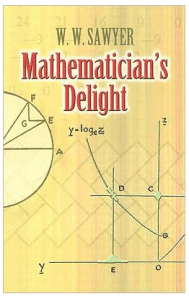
Sawyer-MathDelight

And here’s a quick quote from W. W. Sawyer’s Mathematician’s Delight:

If you cannot see what the exact speed is, begin to ask questions. Silly ones are the best to begin with. Is the speed a million miles an hour? Or one inch a century? Somewhere between these limits. Good. We now know something about the speed. Begin to bring the limits in, and see how close together they can be brought.

Study your own methods of thought. How do you know that the speed is less than a million miles an hour? What method, in fact, are you unconsciously using to estimate speed? Can this method be applied to get closer estimates?

You know what speed is. You would not believe a man who claimed to walk at 5 miles an hour, but took 3 hours to walk 6 miles. You have only to apply the same common sense to stones rolling down hillsides, and the calculus is at your command.

More Than One Way To Find the Center of a Circle

[Feature photo above by hom26 via Flickr.]

My free time lately has gone to local events and to book editing. I hope to put up a series of blog posts sometime soon, based on the Homeschool Math FAQs chapter I’m adding to the paperback version of Let’s Play Math. [And of course, I’ll update the ebook whenever I finally publish the paperback, so those of you who already bought a copy should be able to get the new version without paying extra.]

But in the meantime, as I was browsing my blog archives for an interesting “Throw-Back Thursday” post, I stumbled across this old geometry puzzle from Dave Marain over at MathNotations blog:

Is it possible that AB is a chord but NOT a diameter? That is, could circle ABC have a center that is NOT point O?

Jake shows Jack a piece of wood he cut out in the machine shop: a circular arc bounded by a chord. Jake claimed that the arc was not a semicircle. In fact, he claimed it was shorter than a semicircle, i.e., segment AB was not a diameter and arc ACB was less than 180 degrees.

Jack knew this was impossible and argued: “Don’t you see, Jake, that O must be the center of the circle and that OA, OB and OC are radii.”

Jake wasn’t buying this, since he had measured everything precisely. He argued that just because they could be radii didn’t prove they had to be.

Which boy do you agree with?

  • Pick one side of the debate, and try to find at least three different ways to prove your point.

If you have a student in geometry or higher math, print out the original post (but not the comments — it’s no fun when someone gives you the answer!) and see what he or she can do with it.

Dave offers many other puzzles to challenge your math students. While you are at his blog, do take some time to browse past articles.

Reblog: The Case of the Mysterious Story Problem

[Feature photo above by Carla216 via flickr (CC BY 2.0).]

Seven years ago, I blogged a revision of the first article I ever wrote about homeschooling math. I can’t even remember when the original article was published — years before the original (out of print) editions of my math books.

I hope you enjoy this “Throw-back Thursday” blast from the Let’s Play Math! blog archives:


Case-of-the-Mysterious-Story-Problem
I love story problems. Like a detective, I enjoy sifting out clues and solving the mystery. But what do you do when you come across a real stumper? Acting out story problems could make a one-page assignment take all week.

You don’t have to bake a pie to study fractions or jump off a cliff to learn gravity. Use your imagination instead. The following suggestions will help you find the clues you need to solve the case…

[Click here to go read the original post.]

Alexandria Jones and the Strange Attractor

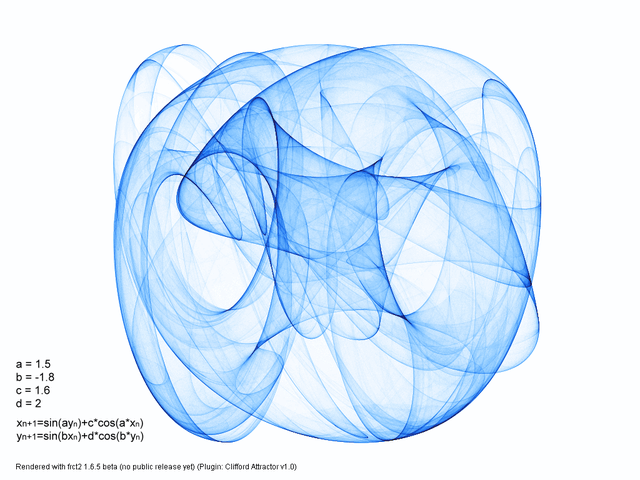
[Feature photo above: Clifford Attractor by Yami89 (public domain) via Wikimedia Commons.]

Alexandria Jones collapsed onto the couch with a dramatic sigh. Her father, the world-famous archaeologist Dr. Fibonacci Jones, glanced up from his newspaper and rolled his eyes.

“I don’t even want to hear about it,” he said.

Alex’s brother Leonhard was playing on the floor, making faces at the baby. He looked up at Alex and grinned.

“I’ll take the bait,” he said. “What happened?”

“Mom called my bedroom a Strange Attractor.”

“Oh? What does it attract?”

“I don’t know. Mostly books and model horses. But what’s so strange about that?”

The Mathematics of Chaos

Animation of a double compound pendulum showing chaotic behaviour.

Dr. Jones laughed and put down his paper. “Strange attractor is a technical term from the branch of mathematics called dynamical systems analysis — often called chaos theory.”

“So my bedroom is a math problem?”

“No. I think Mom meant your bedroom was chaos.”

“Oh.” Alex looked like she might pout, then she shrugged. “I guess she’s right, at that. So what is a strange attractor, really?”

“Well, when scientists first drew graphs of classical, non-chaotic systems — like a planet’s orbit or the flight of a football — it was surprising how often they got an ellipse or parabola or some similar curve,” Dr. Jones explained. “For some reason, nature seemed to be attracted to the shapes of classical geometry.”

Click here to continue reading.

The Linear Inequality Adventures of Ohio Jones

Ohio Jones 1

Last week, Kitten and I reached her textbook’s chapter on graphing linear equations, and a minor mistake with negative numbers threw her into an “I can’t do it!” funk. It’s not easy teaching a perfectionist kid.

Usually her mood improves if we switch to a slightly more advanced topic, and luckily I had saved these worksheets on my desktop, waiting for just such an opportunity. Today’s lesson:

  • Some fun(ish) worksheets
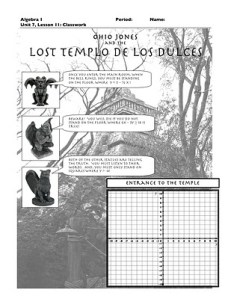
    “For tomorrow, students will be graphing systems of inequalities, so I decided to create a little Ohio Jones adventure (Indiana’s lesser known brother)…”

I offered to give her a hint, but she wanted to try it totally on her own. It took her about 40 minutes to work through the first few rooms of the Lost Templo de los Dulces and explain her solutions to me. I’m sure she’ll speed up with experience.

So far, she’s enjoying it much more than the textbook lesson. It’s fascinating to me how the mere hint of fantasy adventure can change graphing equations from boring to cool. Thanks, Dan!

Pondering Large Numbers

[Feature photo above by Paolo Camera (CC BY 2.0) via Flickr.]

Half of our students were missing from this month’s homeschool teen math circle, but I challenged the three who did show up to wrap their brains around some large numbers. Human intuition serves us well for the numbers we normally deal with from day to day, but it has a hard time with numbers outside our experience. We did a simple yet fascinating activity.

First, draw a line across a page of your notebook. Label one end of the line $20 (the amount of money I had in my purse), and mark the other end as $1 trillion (rough estimate of the US government’s yearly overspending, the annual deficit):

large-numbers-baseline

  • Where on that line do you think $1 million would be?

Go ahead, try it! The activity has a much greater impact when you really do it, rather than just reading. Don’t try to over-think this, just mark wherever it feels right to you.

The kids were NOT eager to commit themselves, but I waited in silence until everyone made a mark.

  • Okay, now, where do you think $1 billion would be?

This was a bit easier. Once they had committed to a place for a million, they went about that much farther down the line to mark a billion.

Continue reading Pondering Large Numbers