Elementary Problem Solving: Review

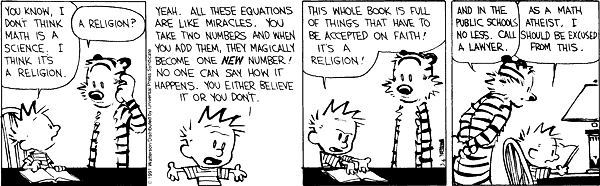
[Bill Watterson identifies the trouble with math problems, through the eyes of Calvin and Hobbes.]

It’s time to revive and (hopefully!) finish my long-neglected series on solving word problems in elementary mathematics. I’ve been having fun making up the problems, so now I just have to write the posts. Coming up soon:

Since it has been more than two years since the last entry, however, I wanted to take a few minutes to recap our progress so far and to refer new readers back to the original posts:

Continue reading Elementary Problem Solving: Review

Do Your Students Understand Division?

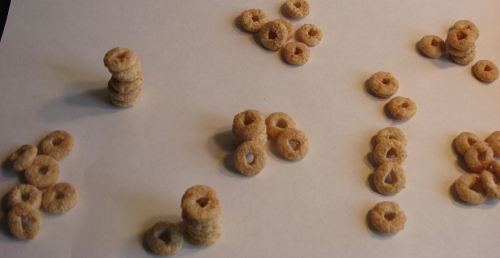
Cheerios by sixes
[I couldn’t find a good picture illustrating “division.” Niner came to my rescue and took this photo of her breakfast.]

I found an interesting question at Mathematics Education Research Blog. In the spirit of Liping Ma’s Knowing and Teaching Elementary Mathematics, Finnish researchers gave this problem to high school students and pre-service teachers:

We know that:
498 \div 6 = 83
How could you use this relationship (without using long-division) to discover the answer to:
491\div6=?
[No calculators allowed!]

The Finnish researchers concluded that “division seems not to be fully understood.” No surprise there!

Check out the pdf report for detailed analysis.

Continue reading Do Your Students Understand Division?

How to Solve Math Problems

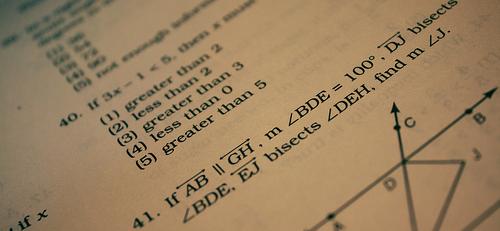
[Photo by Aaron Escobar. This post is a revision and update of How to Solve Math Problems from October, 2007.]

HowToSolveIt2

What can you do when you are stumped by a math problem? Not just any old homework exercise, but one of those tricky word problems that can so easily confuse anyone?

The difference between an “exercise” and a “problem” will vary from one person to another, even within a single class. Even so, this easy to remember, 4-step approach can help students at any grade level. In my math classes, I give each child a copy to keep handy:

[Note: Page 1 is the best for quick reference, especially with elementary to middle school children. Page 2 lists the steps in more detail, for the teacher or for older students.]

Continue reading How to Solve Math Problems

Can You Read the Flu Map?

swine-flu-map-with-circles
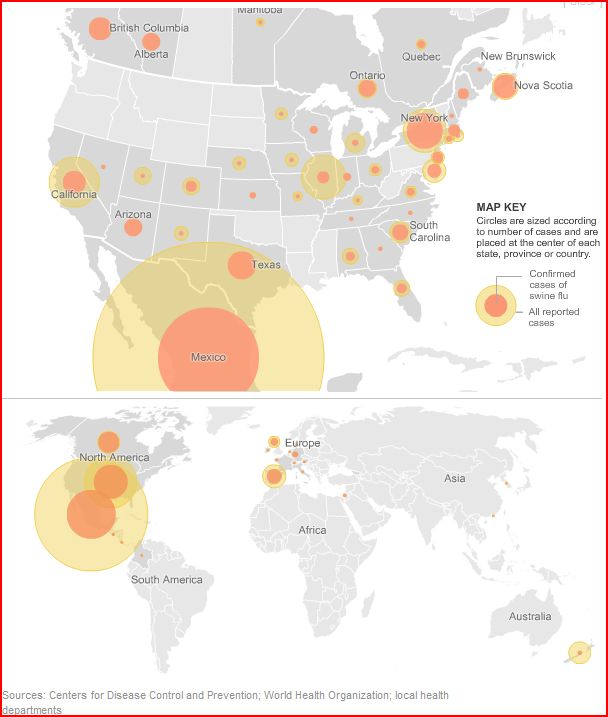
[Map as of early afternoon on May 4th, found at the NY Times.]

Compare the dark circles (confirmed cases) for Mexico, New York and Nova Scotia in the top part, or Mexico and the U.S. in the lower part of the map. It’s easy to see which has more cases of the flu — but how many more? Which would you guess is the closest estimate:

Mexico : New York : Nova Scotia

  • = 7:3:2 or 20:5:3 or 16:2:1?

U.S. : Mexico

  • = 1:2 or 2:5 or 3:7?

Continue reading Can You Read the Flu Map?

Kids’ Project: More Math Calendars?

tulips-by-kuzeytac[Photo by Kuzeytac.]

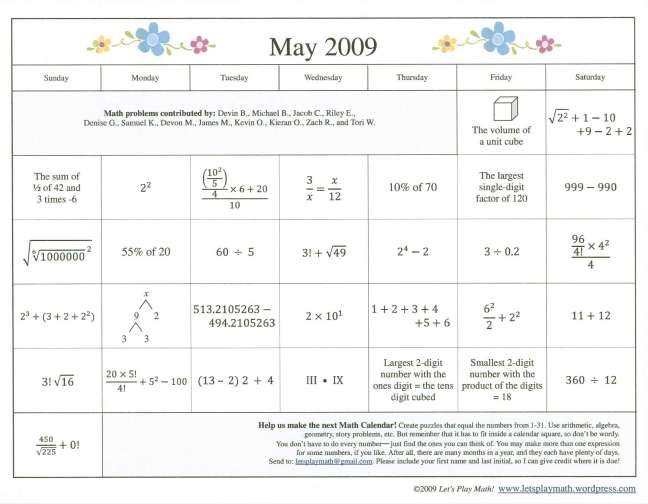
Several people enjoyed the April calendar and asked if there would be a May version. Unfortunately, my homeschool co-op classes are out until next fall, so I don’t have enough kids to make up problems for me. But if your children would like to send in some puzzles, I will be glad to put another calendar together. If we get enough participation, we could have calendars every month for the rest of the year!

Continue reading Kids’ Project: More Math Calendars?

Buddy-Style Math: Doing Homework Without Tears

My daughter Kitten strongly dislikes math when forced to do it on her own, so I am trying to get back into the habit of doing “Buddy-Style Math” with her. We take turns working the problems in her workbook: mine, hers, mine, hers, and so on down the page. We work each problem out loud, explaining how we got the answer and checking each other as we go.

In a way, it is like Charlotte Mason-style narration applied to math, since my daughter has to process her thoughts in order to explain how she worked the problem, which fixes the math concepts more deeply in her mind.

Continue reading Buddy-Style Math: Doing Homework Without Tears

April Math Calendar

april-math-calendar

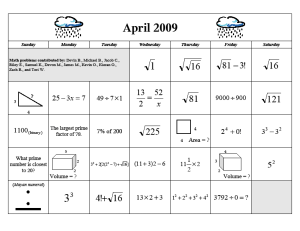
My homeschool co-op classes had a lot of fun creating this April calendar to hand out at our end-of-semester party on Friday. It’s not as easy to read as a traditional calendar — it is more like a puzzle. The expression in each square simplifies to that day’s date, so families can treat each day like a mini-review quiz: “Do you remember how to calculate this?”

Download your own copy:

If you’ve been wanting to start your own math club, you will find plenty of helpful ideas here:

Update

Check out my May Math Calendar post for more ideas about how to use these puzzles.

 
* * *

This blog is reader-supported.

If you’d like to help fund the blog on an on-going basis, then please join me on Patreon for mathy inspiration, tips, and an ever-growing archive of printable activities.

If you liked this post, and want to show your one-time appreciation, the place to do that is PayPal: paypal.me/DeniseGaskinsMath. If you go that route, please include your email address in the notes section, so I can say thank you.

Which I am going to say right now. Thank you!

“April Math Calendar” copyright © 2009 by Denise Gaskins.

Math Warm-Up: Today Is February 4×3×2×1

[Feature photo above by Tom@HK.]

One of my favorite warm-up exercises for Math Club is “Today is ______.” Each student invents one or more mathematical expressions for today’s date and writes his or her favorite on the board for all to admire. Answers range from lazy (24×1 — at least it’s an excuse to talk about identity elements) to unnecessarily repetitive (1+1+1+…), but we usually get a few gems as well.

Continue reading Math Warm-Up: Today Is February 4×3×2×1