Pre-Algebra Picture Puzzles

Balance problem

Maria at Homeschool Math Blog has posted a fun set of worksheets:
Pan balance problems to teach algebraic reasoning.

Princess Kitten, at nearly 9yo, keeps telling me, “I hate math, but I like algebra.” So I printed all four pages for her to try. These get pretty complicated, and the 2-variable problems had her flummoxed for awhile. But after an explanation and bit of pouting (I think she hates math because she’s such a perfectionist that she can’t bear to get something wrong, even the first time), she came back and conquered the toughest ones.

Fraction Models, and a Card Game

Fraction cards

Models give us a way to form and manipulate a mental image of an abstract concept, such as a fraction. There are three basic ways we can imagine a fraction: as partially-filled area or volume, as linear measurement, or as some part of a given set. Teach all three to give your students a well-rounded understanding.

When teaching young students, we use physical models — actual food or cut-up pieces of construction paper. Older students and adults can firm up the foundation of their understanding by drawing many, many pictures. As we move into abstract, numbers-only work, these pictures remain in our minds, an always-ready tool to help us think our way through fraction problems.

Continue reading Fraction Models, and a Card Game

In the News: Teaching Math

Here are a couple of interesting articles about teaching math:

Good Stories, Good Math

Math Trek (Nov. 10, 2007) — Spinning a good yarn may seem to have little to do with mathematics, but a new study suggests otherwise. Preschoolers who tell stories that include many different perspectives do better in math two years later than those who stick to one simple perspective. The researchers believe that the study may highlight a deep connection between mathematical ability and narrative skills… [Hat tip: Wild About Math!]

Gesturing Helps Grade School Children Solve Math Problems

ScienceDaily (Nov. 5, 2007) — Are math problems bugging your kids? Tell them to talk back — using their hands. Psychologists at the University of Chicago report that gesturing can help kids add new and correct problem-solving strategies to their mathematical repertoires. What’s more, when given later instruction, kids who are told to gesture are more likely to succeed on math problems…

Continue reading In the News: Teaching Math

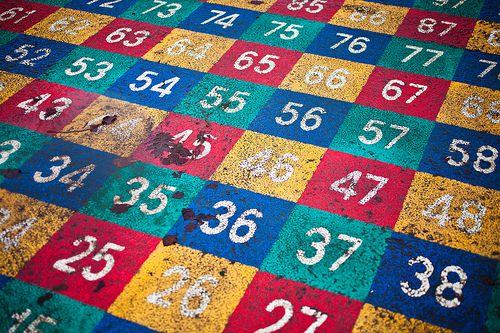
Game: Hundred Chart Nim

Photo by Håkan Dahlström via flickr.

Math concepts: addition and subtraction within 100, logical strategy
Number of players: 2 or 3
Equipment: printed hundred chart (also called a hundred board) and beans, pennies, or other tokens with which to mark numbers — or use this online hundred chart

Set Up

Place the hundred chart and a small pile of tokens where both players can reach them.

Continue reading Game: Hundred Chart Nim

How Shall We Teach Fractions?

How did you fare on the Frustrating Fractions Quiz? With so many apparent inconsistencies, we can all see why children (and their teachers) get confused. And yet, fractions are vital to our children’s test scores — and scores are important to college admissions officers. What is a teacher to do? Must we tell our children, “Do it this way, and don’t ask questions”?

Parents and teachers are tempted to wonder if the struggle is worth it. After all, how often do you divide by a fraction in your adult life? If only we could skip the hard stuff…

Continue reading How Shall We Teach Fractions?

Quiz: Those Frustrating Fractions

[Photo by jimmiehomeschoolmom.]

Fractions confuse almost everybody. In fact, fractions probably cause more math phobia among children (and their parents) than any other topic before algebra. Middle school textbooks devote a tremendous number of pages to teaching fractions, and still many students find fractions impossible to understand. Standardized tests are stacked with fraction questions.

Fractions are a filter, separating the math haves from the luckless have nots. One major source of difficulty with fractions is that the rules do not seem to make sense. Can you explain these to your children?

Start with an easy one…

Question #1

If you need a common denominator to add or subtract fractions…

  • Why don’t you need a common denominator when you multiply?

Continue reading Quiz: Those Frustrating Fractions

Ben Franklin Math: Elementary Problem Solving 3rd Grade

The ability to solve word problems ranks high on any math teacher’s list of goals. How can I teach my students to solve math problems? I must help them develop the ability to translate “real world” situations into mathematical language.

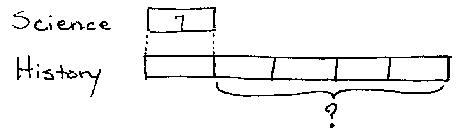
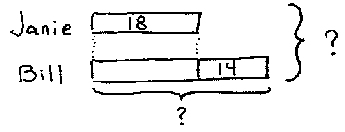
In two previous posts, I introduced the problem-solving tools algebra and bar diagrams. These tools help our students organize the information in a word problem and translate it into a mathematical calculation.

Working Math Problems with Poor Richard

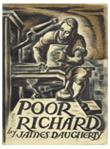
This time I will demonstrate these problem-solving tools in action with a series of 3rd-grade problems based on the Singapore Primary Math series, level 3A. For your reading pleasure, I have translated the problems into the life of Ben Franklin, inspired by the biography Poor Richard by James Daugherty.

Continue reading Ben Franklin Math: Elementary Problem Solving 3rd Grade

Penguin Math: Elementary Problem Solving 2nd Grade

The ability to solve word problems ranks high on any math teacher’s list of goals. How can I teach my students to reason their way through math problems? I must help my students develop the ability to translate “real world” situations into mathematical language.

In a previous post, I analyzed two problem-solving tools we can teach our students: algebra and bar diagrams. These tools help our students organize the information in a word problem and translate it into a mathematical calculation.

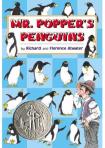
Now I want to demonstrate these problem-solving tools in action with a series of 2nd grade problems, based on the Singapore Primary Math series, level 2A. For your reading pleasure, I have translated the problems into the universe of one of our family’s favorite read-aloud books, Mr. Popper’s Penguins.

UPDATE: Problems have been genericized to avoid copyright issues.

Continue reading Penguin Math: Elementary Problem Solving 2nd Grade

Writing to Learn Math

2009 Challenge - Day 72: Pencil
Image by ☼zlady via Flickr

Have you considered experimenting with writing in your math class this year? It seems that math journals are a growing fad, and for good reason:

Writing is how we think our way into a subject and make it our own.

William Zinsser
Writing to Learn

Math journal entries can be as simple as class notes, or they can be research projects that take hours of experimentation and pondering. Students may use the journal to store their thoughts as they work several days to solve a challenge problem of the week, or they might jot down quick reflections about what they learned in today’s math class.

Continue reading Writing to Learn Math

Elementary Problem Solving: The Tools

[This article begins a series rescued from my old blog. Moving has been a long process, but I’m finally unpacking the last cardboard box! To read the entire series, click here: elementary problem solving series.]

Most young students solve story problems by the flash of insight method: When they read the problem, they know almost instinctively how to solve it. This is fine for problems like:

There are 7 children. 2 of them are girls. How many boys are there?

As problems get more difficult, however, that flash of insight becomes less reliable, so we find our students staring blankly at their paper or out the window. They complain, “I don’t know what to do. It’s too hard!”

We need to give our students a tool that will help them when insight fails.

Continue reading Elementary Problem Solving: The Tools