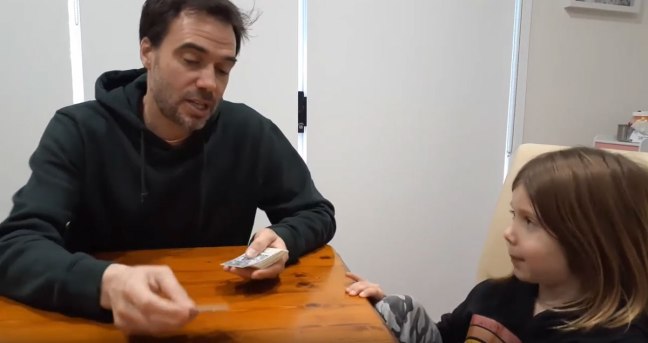
Michael and Nash have been creating and posting new math games with astonishing regularity throughout the pandemic. Their YouTube channel is a great resource for parents who want to play math with elementary-age children.
Today’s entry: Closest to Ten, a quick game for addition and subtraction fluency with a tiny bit of multiplication potential.
And here’s one of my favorites for older players: Factor Triangles, a card game for 2-digit multiplication.
Check out their channel, and have fun playing math with your kids!
If you haven’t seen the meme going around, this is a palindrome week because the dates (written American style and with the year shortened to ’19) are the same when reversed.
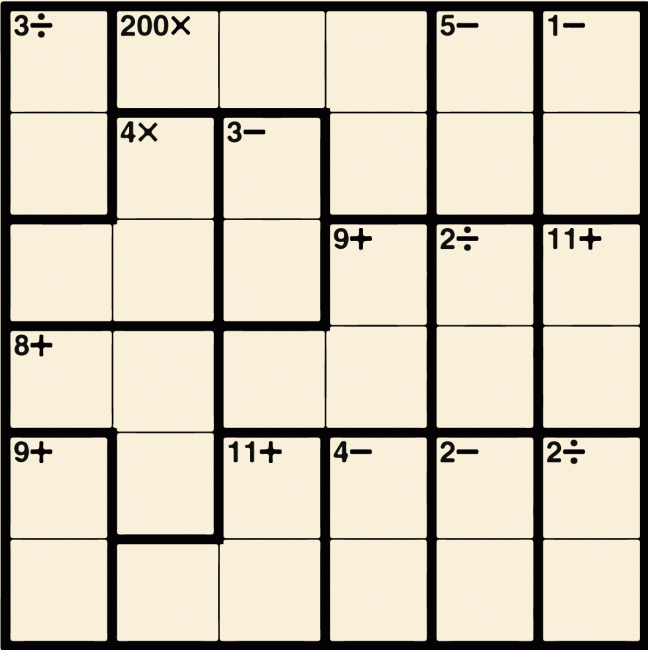
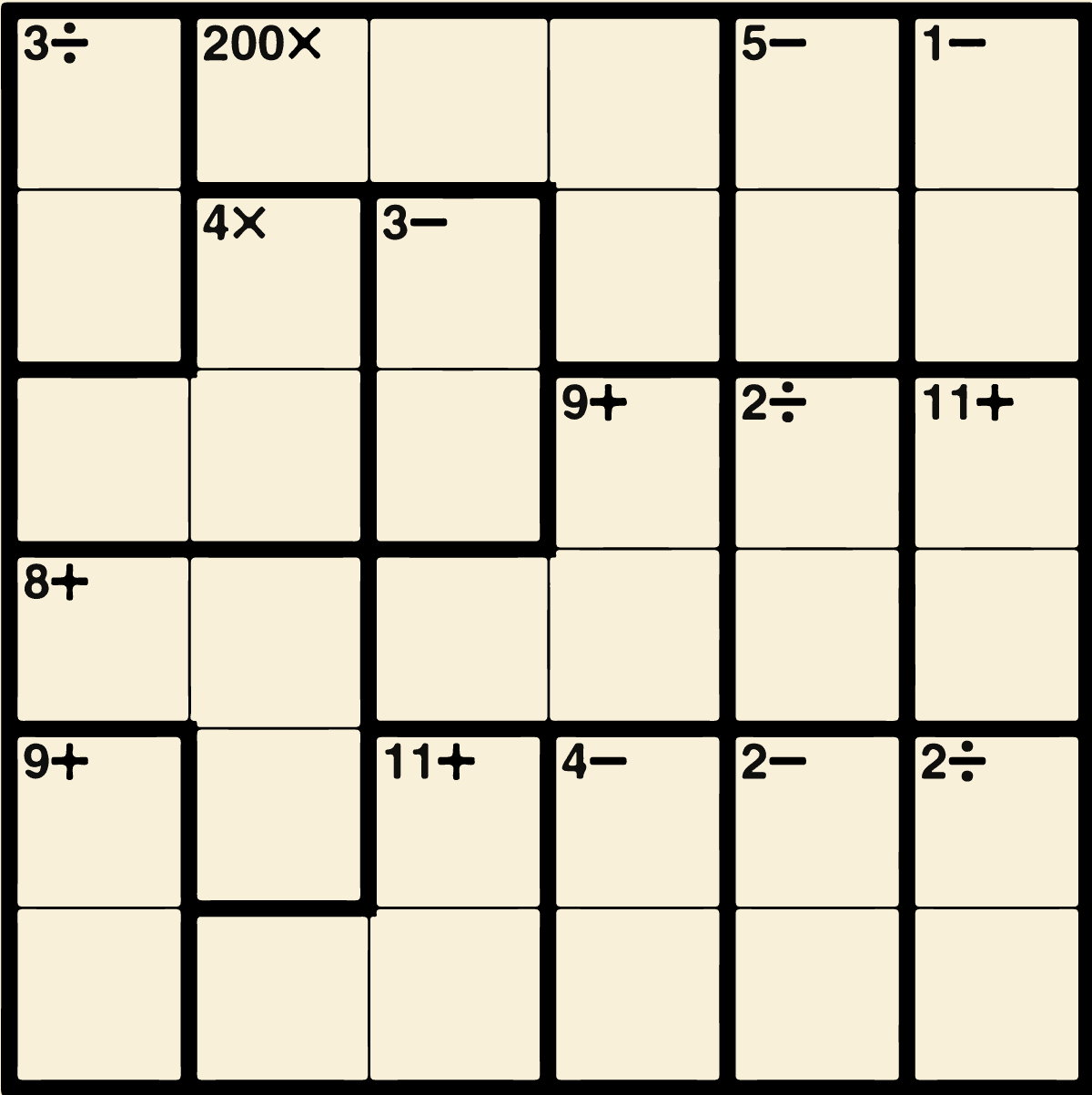
Here’s a math puzzle for palindrome week — or any time you want to play with math:
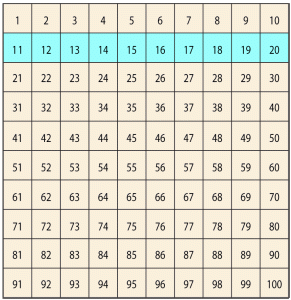
Print a 100 chart.
Choose a color code.
Play!
What do you think: Will all numbers eventually turn into palindromes?
For easy printing, right-click to open the image above in a new tab.
Place the numbers from 1 to 6 into each row and column. None of the numbers may repeat in any row or column. Within the black “cages,” the numbers must add, subtract, multiply, or divide to give the answer shown.
This fall, my homeschool co-op math class will play with math journaling.
But my earlier dot-grid notebooks were designed for adults. Too thick, too many pages. And the half-cm dot grid made lines too narrow for young writers.
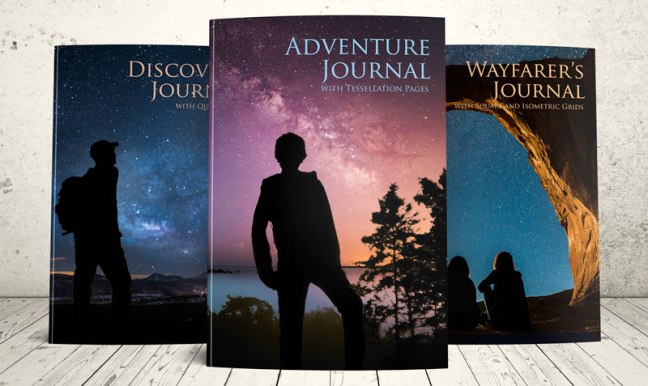
So I created a new series of paperback dot-grid journals for my elementary and middle school students.
I’m sure we’ll use several of these activities in my homeschool co-op math class this fall.
Noticing and Wondering
Learning math requires more than mastering number facts and memorizing rules. At its heart, math is a way of thinking.
So more than anything else, we need to teach our kids to think mathematically — to make sense of math problems and persevere in figuring them out.
Help your children learn to see with mathematical eyes, noticing and wondering about math problems.
Whenever your children need to learn a new idea in math, or whenever they get stuck on a tough homework problem, that’s a good time to step back and make sense of the math.
Kids can write their noticings and wonderings in the math journal. Or you can act as the scribe, writing down (without comment) everything child says.
For more tips on teaching students to brainstorm about math, check out these online resources from The Math Forum:
Problem-solving is a habit of mind that you and your children can learn and grow in. Help your kids practice slowing down and taking the time to fully understand a problem situation.
Puzzles Are Math Experiments
Almost anything your child notices or wonders can lead to a math experiment.
For example, one day my daughter played an online math game…
A math journal can be like a science lab book. Not the pre-digested, fill-in-the-blank lab books that some curricula provide. But the real lab books that scientists write to keep track of their data, and what they’ve tried so far, and what went wrong, and what finally worked.
Here are a few open-ended math experiments you might try:
Explore Shapes
Pick out a 3×3 set of dots. How many different shapes can you make by connecting those dots? Which shapes have symmetry? Which ones do you like the best?
What if you make shapes on isometric grid paper? How many different ways can you connect those dots?
Limit your investigation to a specific type of shape. How many different triangles can you make on a 3×3 set of dots? How many different quadrilaterals? What if you used a bigger set of dots?
Explore Angles
On your grid paper, let one dot “hold hands” with two others. How many different angles can you make? Can you figure out their degree without measuring?
Are there any angles you can’t make on your dot grid? If your paper extended forever, would there be any angles you couldn’t make?
Does it make a difference whether you try the angle experiments on square or isometric grid paper?
Explore Squares
How many different squares can you draw on your grid paper? (Don’t forget the squares that sit on a slant!) How can you be sure that they are perfectly square?
Number the rows and columns of dots. Can you find a pattern in the corner positions for your squares? If someone drew a secret square, what’s the minimum information you would need to duplicate it?
Does it make a difference whether you try the square experiments on square or isometric grid paper?
I’d love to hear your favorite math explorations or journaling tips!
Please share in the comments section below.
* * *
P.S.: Do you have a blog? If you’d like to feature a math journal review and giveaway, I’ll provide the prize. Send a message through my contact form or leave a comment below, and we’ll work out the details.
This blog is reader-supported.
If you’d like to help fund the blog on an on-going basis, then please head to my Patreon page.
If you liked this post, and want to show your one-time appreciation, the place to do that is PayPal: paypal.me/DeniseGaskinsMath. If you go that route, please include your email address in the notes section, so I can say thank you.
My son can’t stand long division or fractions. We had a lesson on geometry, and he enjoyed that — especially the 3-D shapes. If we can just get past the basics, then we’ll have time for the things he finds interesting. But one workbook page takes so long, and I’m sick of the drama. Should we keep pushing through?
Those upper-elementary arithmetic topics are important. Foundational concepts. Your son needs to master them.
Eventually.
But the daily slog through page after page of workbook arithmetic can wear anyone down.
Many children find it easier to focus on math when it’s built into a game.
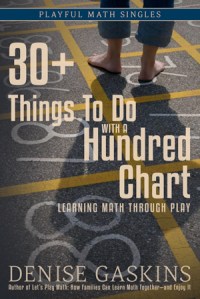
My hundred chart list began many years ago as seven ideas for playing with numbers. Over the years, it grew to its current 30+ activities.
Now, in preparing the new book, my list has become a monster. I’ve collected almost 70 ways to play with numbers, shapes, and logic from preschool to middle school. Just yesterday I added activities for fraction and decimal multiplication, and also tips for naming complex fractions. Wow!
Gonna have to edit that cover file…
In the “Advanced Patterns” chapter, I have a section on math debates. The point of a math debate isn’t that one answer is “right” while the other is “wrong.” You can choose either side of the question — the important thing is how well you support your argument.
Here’s activity #69 in the current book draft.
Have a Math Debate: Adding Fractions
When you add fractions, you face a problem that most people never consider. Namely, you have to decide exactly what you are talking about.
For instance, what is one-tenth plus one-tenth?
1/10 of 100
Well, you might say that:
of one hundred chart
+ of the same chart
= of that hundred chart
But, you might also say that:
of one chart
+ of another chart
= of the pair of charts
That is, you started off counting on two independent charts. But when you put them together, you ended up with a double chart. Two hundred squares in all. Which made each row in the final set worth of the whole pair of charts.
So what happens if you see this question on a math test:
+ = ?
If you write the answer “”, you know the teacher will mark it wrong.
Today we have a guest post — an exclusive tale by Sasha Fradkin and Allison Bishop, authors of the new math storybook Funville Adventures. Enjoy!
Funville Adventures is a math-inspired fantasy that introduces children to the concept of functions, which are personified as magical beings with powers.
Each power corresponds to a transformation such as doubling in size, rotating, copying, or changing color. Some Funvillians have siblings with opposite powers that can reverse the effects and return an object to its original state, but other powers cannot be reversed.
In this way, kids are introduced to the mathematical concepts of invertible and non-invertible functions, domains, ranges, and even functionals, all without mathematical terminology.
We know about Funville because two siblings, Emmy and Leo, were magically transported there after they went down an abandoned slide.
When they came back, Emmy and Leo shared their adventures with their friends and also brought back the following manuscript written by their new friend Blake.
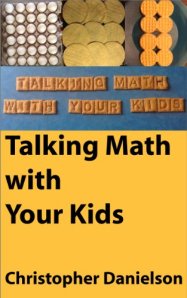
It’s a short book with plenty of great stories, advice, and conversation-starters. While Danielson writes directly to parents, the book will also interest grandparents, aunts & uncles, teachers, and anyone else who wants to help children notice and think about math in daily life.
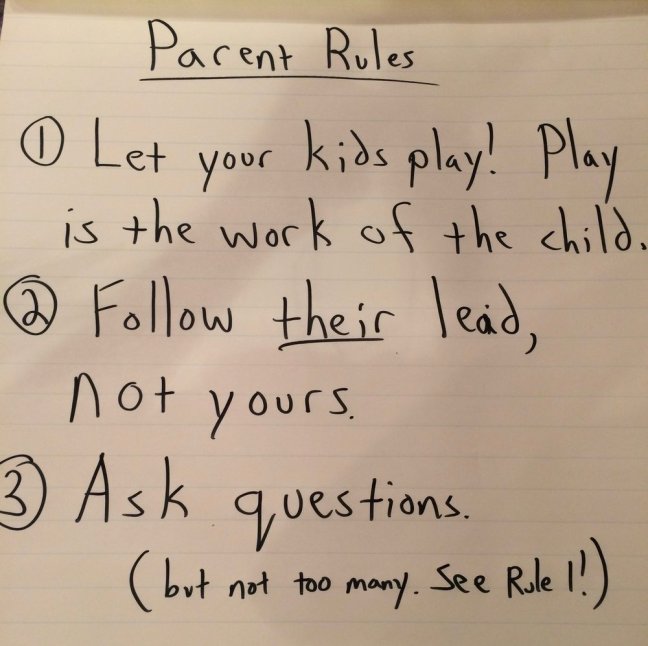
“You don’t need special skills to do this. If you can read with your kids, then you can talk math with them. You can support and encourage their developing mathematical minds.
“You don’t need to love math. You don’t need to have been particularly successful in school mathematics. You just need to notice when your children are being curious about math, and you need some ideas for turning that curiosity into a conversation.
“In nearly all circumstances, our conversations grow organically out of our everyday activity. We have not scheduled “talking math time” in our household. Instead, we talk about these things when it seems natural to do so, when the things we are doing (reading books, making lunch, riding in the car, etc) bump up against important mathematical ideas.
“The dialogues in this book are intended to open your eyes to these opportunities in your own family’s life.”
If you’d like to help fund the blog on an on-going basis, then please join me on Patreon for mathy inspiration, tips, and an ever-growing archive of printable activities.
If you liked this post, and want to show your one-time appreciation, the place to do that is PayPal: paypal.me/DeniseGaskinsMath. If you go that route, please include your email address in the notes section, so I can say thank you.





 I’d love to hear your favorite math explorations or journaling tips!

 of one hundred chart
 of that hundred chart
 of the pair of charts
 of the whole pair of charts.

 Denise Gaskins' Let's Play Math