Tova Brown continues to examine Hilbert’s Hotel Paradox, pondering infinite sets of infinite sets.
As the proprietor of an infinitely large hotel, you pride yourself on welcoming everyone, even when the rooms are full. Your hotel becomes very popular among infinite sports teams, as a result.
Recruitment season presents a challenge, however, when many infinite teams arrive at once. How many infinite teams can stay in a single infinite hotel?
Tova Brown explores the second part of Hilbert’s Hotel Paradox. What’s infinity plus infinity?
Running an infinite hotel has its perks. Even when the rooms are full you can always find space for new guests, so you proudly welcome everyone who appears at your door.
When two guests arrive at once, you make room. When ten guests arrive, you accommodate them easily. When a crowd of hundreds appears, you welcome them all.
Tova Brown’s introduction to Hilbert’s Hotel Paradox, a riddle about the nature of infinity…
Once upon a time, there was a hotel with an infinite number of rooms. You might be thinking this is impossible, and if so you’re right. A hotel like this could never exist in the real world.
But fortunately we’re not talking about the real world, we’re talking about math. And when we do math we can make up whatever rules we want, just to see what happens.
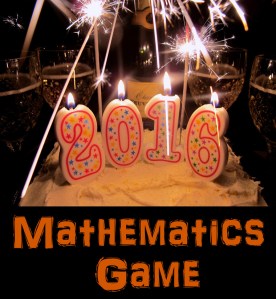
Have you made a New Year’s resolution to spend more time with your family this year, and to get more exercise? Problem-solvers of all ages can pump up their (mental) muscles with the Annual Mathematics Year Game Extravaganza. Please join us!
For many years mathematicians, scientists, engineers and others interested in math have played “year games” via e-mail. We don’t always know whether it’s possible to write all the numbers from 1 to 100 using only the digits in the current year, but it’s fun to see how many you can find.
Use the digits in the year 2016 to write mathematical expressions for the counting numbers 1 through 100. The goal is adjustable: Young children can start with looking for 1-10, middle grades with 1-25.
You must use all four digits. You may not use any other numbers.
Solutions that keep the year digits in 2-0-1-6 order are preferred, but not required.
You may use a decimal point to create numbers such as .2, .02, etc., but you cannot write 0.02 because we only have one zero in this year’s number.
You may create multi-digit numbers such as 10 or 201 or .01, but we prefer solutions that avoid them.
My Special Variations on the Rules
You MAY use the overhead-bar (vinculum), dots, or brackets to mark a repeating decimal. But students and teachers beware: you can’t submit answers with repeating decimals to Math Forum.
You MAY use a double factorial, n!! = the product of all integers from 1 to n that have the same parity (odd or even) as n. I’m including these because Math Forum allows them, but I personally try to avoid the beasts. I feel much more creative when I can wrangle a solution without invoking them.
You know you’re a math teacher when you see a penny in the parking lot, and your first thought is, “Cool! A free math manipulative.”
My homeschool co-op math students love doing math with pennies. They’re rather heavy to carry to class, but worth it for the student buy-in.
This month, I’m finishing up the nearly 150 new illustrations for the upcoming paperback edition of my Let’s Play Math book. I’m no artist, and it’s been a long slog. But a couple of the graphics involved pennies—so when I saw that penny on the ground, it made me think of my book.
And thinking of my book made me think it would be fun to share a sneak peek at coming attractions…
The Penny Square: An Example of Real Mathematics
Real mathematics is intriguing and full of wonder, an exploration of patterns and mysterious connections. It rewards us with the joy of the “Aha!” feeling. Workbook math, on the other hand, is several pages of long division by hand followed by a rousing chorus of the fraction song: “Ours is not to reason why, just invert and multiply.”
Real math is the surprising fact that the odd numbers add up to perfect squares (1, 1 + 3, 1 + 3 + 5, etc.) and the satisfaction of seeing why it must be so.
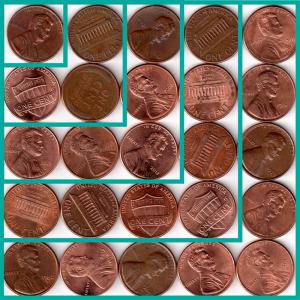
Did your algebra teacher ever explain to you that a square number is literally a number that can be arranged to make a square? Try it for yourself:
Gather a bunch of pennies—or any small items that will not roll away when you set them out in rows—and place one of them in front of you on the table. Imagine drawing a frame around it: one penny makes a (very small) square. One row, with one item in each row.
Now, put out three more pennies. How will you add them to the first one in order to form a new, bigger square? Arrange them in a small L-shape around the original penny to make two rows with two pennies in each row.
Set out five additional pennies. Without moving the current four pennies, how can you place these five to form the next square? Three rows of three.
Then how many will you have to add to make four rows of four?
Twenty-five is a square number, because we can arrange twenty-five items to make a square: five rows with five items in each row.
Each new set of pennies must add an extra row and column to the current square, plus a corner penny where the new row and column meet. The row and column match exactly, making an even number, and then the extra penny at the corner makes it odd.
Can you see that the “next odd number” pattern will continue as long as there are pennies to add, and that it could keep going forever in your imagination?
The point of the penny square is not to memorize the square numbers or to get any particular “right answer,” but to see numbers in a new way—to understand that numbers are related to each other and that we can show such relationships with diagrams or physical models. The more relationships like this our children explore, the more they see numbers as familiar friends.
The Penny Birthday Challenge: Exponential Growth
A large jar of assorted coins makes a wonderful math toy. Children love to play with, count, and sort coins.
Add a dollar bill to the jar, so you can play the Dollar Game: Take turns throwing a pair of dice, gathering that many pennies and trading up to bigger coins. Five pennies trade for a nickel, two nickels for a dime, etc. Whoever is the first to claim the dollar wins the game.
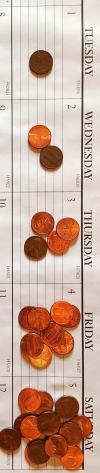
Or take the Penny Birthday Challenge to learn about exponential growth: Print out a calendar for your child’s birthday month. Put one penny on the first day of the month, two pennies on the second day, four pennies on the third day, etc. If you continued doubling the pennies each day until you reach your child’s birthday, how much money would you need?
Warning: Beware the Penny Birthday Challenge! Those pennies will add up to dollars much faster than most people expect. Do not promise to give the money to your child unless the birthday comes near the beginning of the month.
A Penny Holiday Challenge
The first time I did pennies on a calendar with my homeschool co-op class was during December, so we called it the Penny Christmas Challenge:
How many pennies would you need to cover all the days up to the 25th?
I told the kids that if their grandparents asked what gift they wanted for Christmas, they could say, “Not much. Just a few pennies…”
The Penny Square, Dollar Game, and Penny Birthday Challenge are just three of the myriad math tips and activity ideas in the paperback edition of Let’s Play Math: How Families Can Learn Math Together and Enjoy It. Coming in early 2016 to your favorite online bookstore…
Believe in yourself.
When we believe in our potential for growth, our brains respond differently from those who believe their ability is fixed.
Struggle and mistakes are really important.
The brain ponders a mistake and fires a spark, even if we don’t notice it consciously. Our students need to be challenged — work that is too easy stifles growth.
Speed is not important.
When we emphasize speed, we discourage deep thinking. And the stress due to time pressure can cause mental blocks, making performance worse.
There is a huge elephant standing in most math classrooms, it is the idea that only some students can do well in math. Students believe it, parents believe and teachers believe it. The myth that math is a gift that some students have and some do not, is one of the most damaging ideas that pervades education in the US and that stands in the way of students’ math achievement.
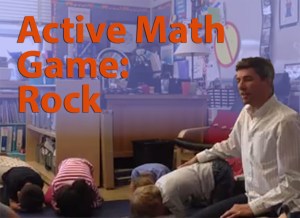
Gordon Hamilton of Math Pickle posted Rock – Low unique number game for grades K–2. If you have a set of active kids and a few minutes to spare, give it a try!
Teacher calls out numbers consecutively, starting at 0.
When a student hears their number being called they immediately raise a hand. When the teacher tags the hand, they stand up.
If more than one hand was raised, those students lose. They become your helpers, tagging raised hands.
If only one hand was raised, that child wins the round.
“Each game takes about 45 seconds,” Hamilton says. “This is part of the key to its success. Children who have not learned the art of losing are quickly thrown into another game before they have a chance to get sad.”
The experience of mathematics should be profound and beautiful. Too much of the regular K-12 mathematics experience is trite and true. Children deserve tough, beautiful puzzles.
What are the best numbers to pick? Patrick Vennebush hosted on online version of the game at his Math Jokes 4 Mathy Folks blog a few years back, though we didn’t have to bend over into rocks—which is a good thing for some of us older folks.
If you’d like to help fund the blog on an on-going basis, then please join me on Patreon for mathy inspiration, tips, and an ever-growing archive of printable activities.
If you liked this post, and want to show your one-time appreciation, the place to do that is PayPal: paypal.me/DeniseGaskinsMath. If you go that route, please include your email address in the notes section, so I can say thank you.
Interrupt your regular math programming to try this fantastic math doodling investigation!
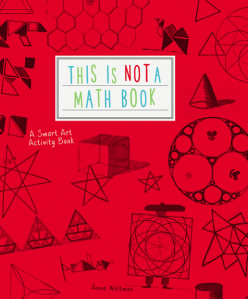
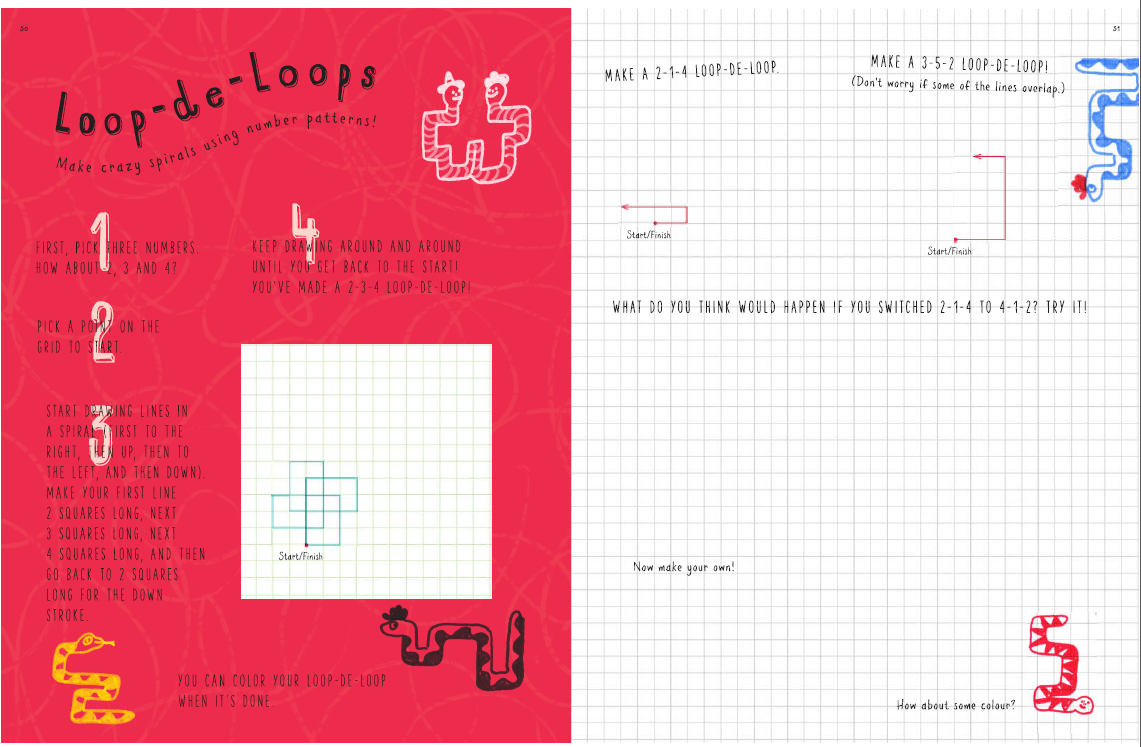
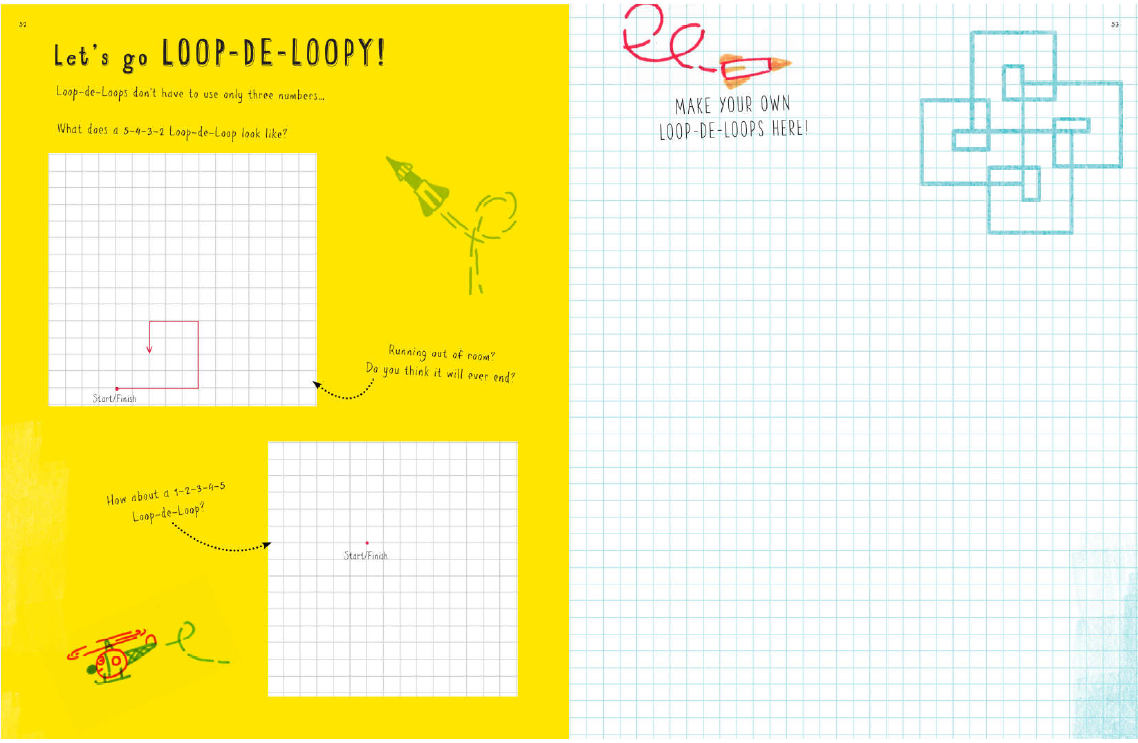
Anna Weltman wrote a math/art book. It’s great fun for all ages, full of fantastic mathematical explorations — including spirolateral math doodles.
How to Get Started
To make a spirolateral, you first pick a short series of numbers (1, 2, 3 is a traditional first set) and an angle (90° for beginners). On graph paper, draw a straight line the length of your first number. Turn through your chosen angle, and draw the next line. Repeat turning and drawing lines, and when you get to the end of your number series, start again at the first number.
Some spirolaterals come back around to the beginning, making a closed loop. Others never close, spiraling out into infinity—or at least, to the edge of your graph paper.
For Further Reading
Mike Lawler and sons explore Loop-de-Loops: Part 1, and Part 2.
Anna Weltman appeared on Let’s Play Math blog once before, with the game Snugglenumber. And she’s a regular contributor to the wonderful Math Munch blog.
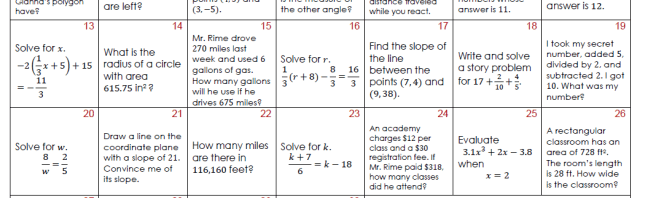
There are no explicit instructions about process being more important than the answer on these, so you’ll need to stress that in class.
I remind students that everyone already knows the answer to each of the questions, and that one of the things we’re practicing is explaining our reasoning…
Enjoy!
And if anyone else has a math review calendar to share, for any grade level, please add your link in the comment section below.
 Tova Brown continues to examine Hilbert’s Hotel Paradox, pondering infinite sets of infinite sets.





 Denise Gaskins' Let's Play Math
