Monday is Square Root Day

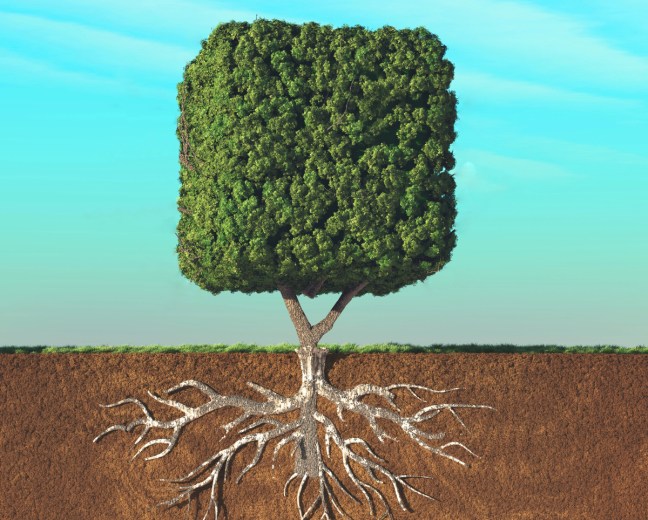
square tree with roots

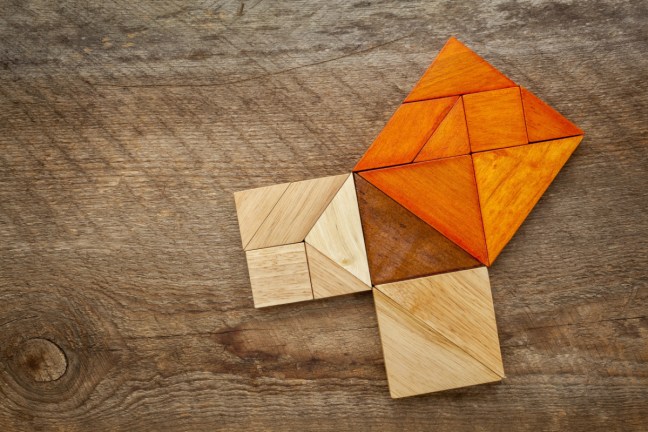
On May 5, we celebrate one of the rarest math holidays: Square Root Day, 5/5/25.

Here are a few ideas for playing math with squares and roots.

What is a Square Root?

Five is the square root of twenty-five, which means it is the number we can “square” (multiply times itself) to get 25.

The root is the base number from which the square grows. In physical terms, it is the side of the square.

Imagine a straight segment of length 5, perhaps a stick or a piece of chalk. Now lay that segment down and slide it sideways for a distance equal to its length. Drag the stick across sand, or pull the chalk across paper or a slate.

Notice how this sideways motion transforms the one-dimensional length into a two-dimensional shape, a square.

The area of this shape is the square of its root: 5 × 5 = 25.

What do you think would happen if you could drag the square through a third dimension, or drag that resulting shape through a fourth dimension?
How many shapes do you suppose might grow from that original root of 5?

Continue reading Monday is Square Root Day

FAQ: Real Math for Early Learners

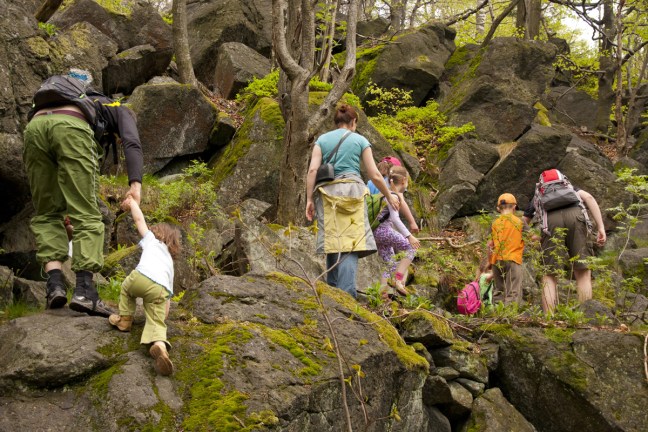
photo of family hiking a rocky trail

“I love your image of math as a nature walk. My children are ready to start their homeschooling journey, and I want to put them on the right track from the beginning. How can I help them think about math and problem-solving without using a textbook?”

The most difficult part of teaching our children real math is to change our own way of thinking about the subject you’ve already taken that step, so it looks like your family’s learning journey is off to a great start.

[For readers who are wondering what I mean by math as a nature walk, check out this post. You may also enjoy my article on natural learning: Math with Young Children.]

Continue reading FAQ: Real Math for Early Learners

If Not Methods: Dividing Fractions

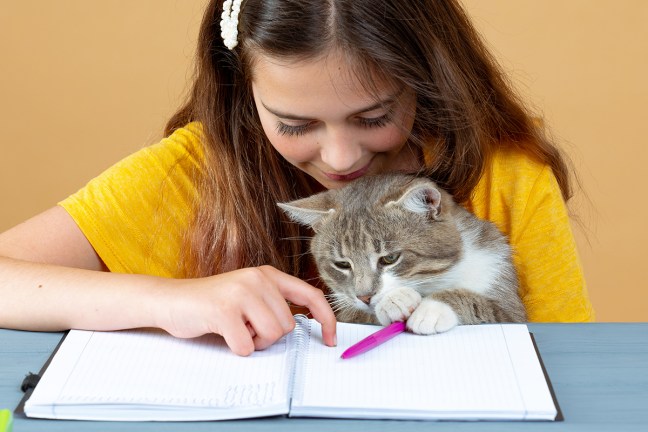
Mother and daughter working together on math homewrok

As I said in an earlier post, we don’t want to give our children a method because that acts as a crutch to keep them from making sense of math.

But what if our children get stumped on a tough fraction calculation like 1 1/2 ÷ 3/8?

Continue reading If Not Methods: Dividing Fractions

Middle School Math Proof

Homeschool Memories…

Kitten (my daughter) and I sat on the couch sharing a whiteboard, passing it back and forth as we took turns working through our prealgebra book together.

The chapter on number theory began with some puzzles about multiples and divisibility rules.

Continue reading Middle School Math Proof

FAQ: Memorizing the Math Facts

It came up again this week, one of the most frequently asked questions about homeschooling math:

“I believe it’s important for children to memorize the math facts, but my kids are struggling with mental math. How can I help them master these important number relationships?”

We all want our children to own the math facts, those basic relationships between small numbers that form the foundation of all arithmetic.

But I don’t think emphasizing memorization will develop the sort of fluency your children need.

The human brain remembers what it thinks about, so we want children using their brains and thinking as deeply as possible about number relationships from as many different perspectives as we can get, noticing patterns, finding connections, making sense of the math.

Continue reading FAQ: Memorizing the Math Facts

Living Books for Math

What is a “living book”? English education reformer Charlotte Mason introduced this term for any book that brings the reader directly into contact with the major ideas that have fascinated humans across the ages.

We know that reading aloud helps build our children’s love for books. But did you know it works for math as well?

And that it can transform the parent’s attitude as well as the child’s?

A playful math book fleshes out the bones of abstract math,
brings it alive,
makes it human, relatable,
interesting to readers of all ages,
opening our eyes to the wonderful world of big ideas,
where concepts meet and topics intertwine
in a beautifully intricate dance
of understanding.

We live in an age of abundance, with more new creative math books being published every year, so many that I can’t keep track of them all, not to mention the older classics, some out of print, that can still be found in public libraries.

Here are a few of my favorite books of playful, living math, both old and new:

Continue reading Living Books for Math

The Colors-of-Fall Carnival: Playful Math #160

Welcome to the 160th edition of the Playful Math Education Blog Carnival — a smorgasbord of delectable tidbits of mathy fun. It’s like a free online magazine devoted to learning, teaching, and playing around with math from preschool to high school.

Bookmark this post, so you can take your time browsing.

There’s so much playful math to enjoy!

By tradition, we start the carnival with a puzzle/activity in honor of our 160th edition. But if you’d rather jump straight to our featured blog posts, click here to see the Table of Contents.

Try This Puzzle/Activity

Appropriately for an October carnival, 160 is an evil number.

A number is evil if it has an even number of ones in binary form. Can you find the binary version of 160? (Hint: Exploding Dots.)

160 is also a polyiamond number. If you connect 9 equilateral triangles side-to-side, a complete set of 9-iamond shapes would have 160 pieces.

But sets that large can be overwhelming. Try playing with smaller sets of polyiamonds. Download some triangle-dot graph paper and see how many different polyiamond shapes you can make.

What do you notice? Does it make you wonder?

What designs can you create with your polyiamonds?


Photo by Daiga Ellaby on Unsplash

Click here for all the mathy goodness!

Get a Weekly Dose of Playful Math

Our leaves haven’t started to turn yet, but summer’s on the wane, farmers are busy with harvest, and the back-to-school rush has calmed down into a daily routine.

But if you’re like me, you keep tweaking that routine, constantly looking for the perfect balance for your family or classroom. I especially love to discover easy ways to add more playful math to our schedule.

So here’s a collection of sites that offer fresh math resources on a weekly or monthly basis throughout the school year.

Which one will you try?

KenKen Classroom

Every week, they’ll email you a set of free KenKen arithmetic puzzles for all ages. As the challenge level subtly shifts week to week, students develop their math and logical thinking skills without even knowing it.

Subscribe ❯

Pose an interesting math problem. How can you figure it out? What else could you do? How many different ways can you find? Which strategy do you like best for this problem?

Follow Pam Harris on your favorite social media site to get a new problem every Wednesday.

Choose a Problem ❯

The Parallel Universe

Dr Simon Singh, author of the No. 1 bestseller Fermat’s Last Theorem and The Simpsons and Their Mathematical Secrets has created a set of weekly maths challenges – just 15-30 minutes of interesting, fun and challenging tidbits of mystery and history, activities and oddities, puzzles and problems.

Help students expand their mathematical horizons beyond the school curriculum and build strong mathematical thinking skills. Stretch your brain every week!

Learn More ❯

Playful Math: Getting Students To Write Their Own

To wrap up our week of exploring the resources from Word Problems from Literature, let’s talk about getting students to write their own math.

Check in on the Kickstarter

First up, I’m sharing an excerpt from the Word Problems Student Workbook. The “Story Problem Challenge” is one of my favorite math club activities.

Following that, you’ll find an amazing online mathemagical adventure for middle school: The Arithmetiquities. It’s great fun, and a great inspiration for students to create their own math stories.

Have fun writing math with your kids!

The Story Problem Challenge

What do you get when you cross a library book or favorite movie with a math worksheet? A great alternative to math homework!

The rules are simple:

(1) Choose a worksheet calculation to be the basis for your word problem.

(2) Solve the calculation.

(3) Consider where these numbers could make sense in your book or movie universe. How might the characters use math? What sort of things would they count or measure? Do they use money? Do they build things, or cook meals, or make crafts? Do they need to keep track of how far they have traveled? Or how long it takes to get there?

(4) Write your story problem.

To make the game easier, you may change the numbers to make a more realistic problem. But you must keep the same type of calculation. For example, if your worksheet problem was 18÷3, you could change it to 18÷6 or 24÷3 or even 119÷17 to fit your story, but you can’t make it something like 18−3.

Remember that some quantities are discrete and countable, such as hobbits and fireworks. Other quantities are continuous, such as a barrel of wine or a length of fabric. Be sure to consider both types when you are deciding what to use in your problem.

Then share your problem with friends, and you try their problems. Can you stump each other?

A Note about Copyright and Trademarks

Old books are in the public domain, so you can always use characters like Robin Hood, Sherlock Holmes, or Winnie-the-Pooh (but not the newer Disney version with the red jacket). But most books and movies are the protected intellectual property of their authors or estates, or of the company who bought those rights.

When you write problems for your own private use, feel free to use your favorite characters from any story. That’s like fan fiction, secret, just for your own pleasure.

But if you decide to share your creation beyond your own home or classroom, then be sure to “genericize” it first. Change or remove the proper names, using general descriptions instead.

For example, if you love the Harry Potter series, you might want to use Harry or Hermione in your story problems. Instead, write about “the boy wizard destined to fight an evil sorcerer.” Or “the bright young witch who can master any spell.”

Or if you like the Star Wars movies, you might write about “an interstellar justice warrior with an energy sword.” Or “an alien master of martial arts training a cocky but inexperienced apprentice.”

We’d love to add your story to the Student Math Makers Gallery.

The Arithmetiquities

When the world of Sfera is threatened by the machinations of a malevolent sorcerer, it will be up to a band of unlikely heroes to become the brightest light in the darkness.

The adventurers fan out across the land to find and retrieve the Arithmetiquities, a set of ancient mathemagical artifacts.

The Arithmetiquities is a fantasy adventure story told through a sequence of 36 mathematical puzzles.

Join the Adventure

“Though it is still before sunrise, Lumparland Harbor is already bustling. Sailing ships moor at the misty docks, bringing travelers and goods to the seaside town. Three dwarves disembark from different ships, each adventurer returning home from some faraway locale. The three women gather at the end of the pier.

    “The strangers discover that they all live along the main road that leads from the harbor, so they decide to split the cost of a wagon. Egga lives 10 miles away, Floora lives 20 miles away, and Greeta lives 30 miles away. The wagon ride costs $1.50 per mile regardless of the number of passengers.

      “How much should each of the adventurers pay so that each one has a fair fare?”

      —Jason Ermer, “Lumparland Harbor,” The Arithmetiquities Chapter I

       
      * * *

      This blog is reader-supported.

      If you’d like to help fund the blog on an on-going basis, then please head to my Patreon page.

      If you liked this post, and want to show your one-time appreciation, the place to do that is PayPal: paypal.me/DeniseGaskinsMath. If you go that route, please include your email address in the notes section, so I can say thank you.

      Which I am going to say right now. Thank you!

      “Playful Math: Getting Students To Write Their Own” copyright © 2022 by Denise Gaskins. Image at the top of the post copyright © Hannah Olinger via Unsplash.com.