Head’s Up for e-Day

It’s beyond Kitten’s level and beyond my math club (what’s left of it), but for those of you who are interested, this Sunday is e Day. The only place I can remember seeing the announcement is on the blog 360:

[Do you have an e-Day post? I’d be glad add your link!]

If you’ve never heard of e before, then perhaps you are young enough (or young at heart? ;)) to enjoy celebrating his more famous cousin. Pi Day is coming next month. . .

Updates

Maria has a good introduction to e:

And Zac adds:

Pat chimes in with “something totally different”:

While Robert explains:

Battlestations!!!

Nerds battle hungry football players who want to eat their giant fractal Dorito creation:

For more details on this video (and photos of the fractal’s construction), check out the Blown Apart Studios page. I’m looking forward to their next project, Nerd High, a musical comedy set in an alternate reality where nerds rule the school and jocks are the outcasts.

Prime Numbers Are like Monkeys

[Photo by mape_s.]

I’m afraid that Math Club may have fallen victim to the economy, which is worse in our town than in the nation in general. Homeschooling families have tight budgets even in the best of times, and now they seem to be cutting back all non-essentials. I assumed that last semester’s students would return, but I should have asked for an RSVP.

Still, Kitten and I had a fun time together. We played four rounds of Tens Concentration, since I had spread out cards on the tables in the library meeting room before we realized that no one was coming. Had to pick up the cards one way or another, so we figured we might as well enjoy them! She won the first two rounds, which put her in a good mood for our lesson.

I had written “Prime numbers are like monkeys!” on the whiteboard, and Kitten asked me what that meant. That was all the encouragement I needed to launch into my planned lesson, despite the frustrating dearth of students. The idea is taken from Danica McKellar’s book Math Doesn’t Suck.

Continue reading Prime Numbers Are like Monkeys

2010 Mathematics Game


[Photo by pfala.]

Did you know that playing games is one of the Top 10 Ways To Improve Your Brain Fitness? So slip into your workout clothes and pump up those mental muscles with the 2010 Mathematics Game!

Here are the rules:

Use the digits in the year 2010 to write mathematical expressions for the counting numbers 1 through 100.

  • All four digits must be used in each expression. You may not use any other numbers except 2, 0, 1, and 0.
  • You may use the arithmetic operations +, -, x, ÷, sqrt (square root), ^ (raise to a power), and ! (factorial). You may also use parentheses, brackets, or other grouping symbols.
  • You may use a decimal point to create numbers such as .1, .02, etc.
  • Multi-digit numbers such as 20 or 102 may be used, but preference is given to solutions that avoid them.

Bonus Rule
You may use the overhead-bar (vinculum), dots, or brackets to mark a repeating decimal.

[Note to teachers: This rule is not part of the Math Forum guidelines. It makes a significant difference in the number of possible solutions, however, and it should not be too difficult for high school students or advanced middle schoolers.]

Continue reading 2010 Mathematics Game

Narnia Math: Elementary Problem Solving 4th Grade

[Photo by armigeress.]

In 4th grade, math problems take a large step up on the difficulty scale. Students are more mature and can read and follow more complex stories. Multi-step word problems become the new norm, and proportional relationships (like “three times as many”) show up frequently. As the year progresses, fractions grow to be a dominant theme.

As a math teacher, one of my top goals is that my students learn to solve word problems. Arithmetic is (relatively) easy, but many children struggle in applying it to “real world” situations.

In previous posts, I introduced the problem-solving tools of word algebra and bar diagrams, either of which can help students organize the information in a word problem and translate it into a mathematical calculation. The earlier posts in this series are:

In this installment, I will continue to demonstrate the problem-solving tool of bar diagrams through a series of ten 4th grade problems based on the Singapore Primary Math series, level 4A. For your reading pleasure, I have translated the problems into the universe of a family-favorite story by C. S. Lewis, The Lion, the Witch and the Wardrobe.

UPDATE: Problems have been genericized to avoid copyright issues.

Continue reading Narnia Math: Elementary Problem Solving 4th Grade

Algebra: A Problem in Translation

[Photo by *Irish.]

In my post Elementary Problem Solving: The Tools, I introduced word algebra as a way to help students think their way through a story problem. In the next two posts, I showed how the tool worked with simple word problems.

Now, before I move on to focus exclusively on bar diagrams, I would like to show how word algebra can help a student solve a typical first-year algebra puzzle.

A homeschooling friend who avoided algebra in high school, trying to help her son cope with a subject she never understood, posted: “Help! Our answer is different from the book’s.” Here is the homework problem:

Josh earned $72 less than his sister who earned $93 more than her mom. If they earned a total of $504, how much did Josh earn?

Continue reading Algebra: A Problem in Translation

Elementary Problem Solving: Review

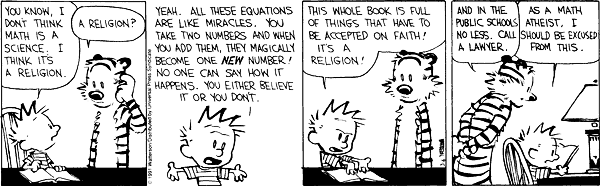
[Bill Watterson identifies the trouble with math problems, through the eyes of Calvin and Hobbes.]

It’s time to revive and (hopefully!) finish my long-neglected series on solving word problems in elementary mathematics. I’ve been having fun making up the problems, so now I just have to write the posts. Coming up soon:

Since it has been more than two years since the last entry, however, I wanted to take a few minutes to recap our progress so far and to refer new readers back to the original posts:

Continue reading Elementary Problem Solving: Review

Do Your Students Understand Division?

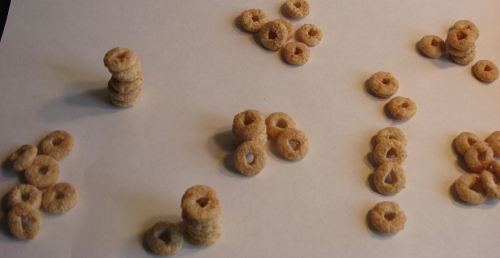
Cheerios by sixes
[I couldn’t find a good picture illustrating “division.” Niner came to my rescue and took this photo of her breakfast.]

I found an interesting question at Mathematics Education Research Blog. In the spirit of Liping Ma’s Knowing and Teaching Elementary Mathematics, Finnish researchers gave this problem to high school students and pre-service teachers:

We know that:
498 \div 6 = 83
How could you use this relationship (without using long-division) to discover the answer to:
491\div6=?
[No calculators allowed!]

The Finnish researchers concluded that “division seems not to be fully understood.” No surprise there!

Check out the pdf report for detailed analysis.

Continue reading Do Your Students Understand Division?

How to Solve Math Problems

[Photo by Aaron Escobar. This post is a revision and update of How to Solve Math Problems from October, 2007.]

HowToSolveIt2

What can you do when you are stumped by a math problem? Not just any old homework exercise, but one of those tricky word problems that can so easily confuse anyone?

The difference between an “exercise” and a “problem” will vary from one person to another, even within a single class. Even so, this easy to remember, 4-step approach can help students at any grade level. In my math classes, I give each child a copy to keep handy:

[Note: Page 1 is the best for quick reference, especially with elementary to middle school children. Page 2 lists the steps in more detail, for the teacher or for older students.]

Continue reading How to Solve Math Problems