The Puzzling Pythagorean Pebbles

Alexandria Jones and her family flew to Italy for spring break. Her father, the famous archaeologist, had to visit an excavation.

It was late when their plane landed in Crotone, a small coastal city near the instep of Italy’s boot. Dr. Jones had used the Internet to find a hotel that allowed pets, so Alex was able to snuggle down with her favorite pillow — her trusty dog, Ramus.

The Original School of Mathematics

The next day, Dr. Jones introduced his family to Sonya Theano, a former student of his and the director of this dig. “Come, let me show you around,” Dr. Theano said. “We’ve uncovered several buildings of a small compound, set apart from the city of Crotona, as it was called then. From the pottery and trade goods, we estimate these buildings were in use around 550-500 BCE.”

Continue reading The Puzzling Pythagorean Pebbles

Happy Pi Day II

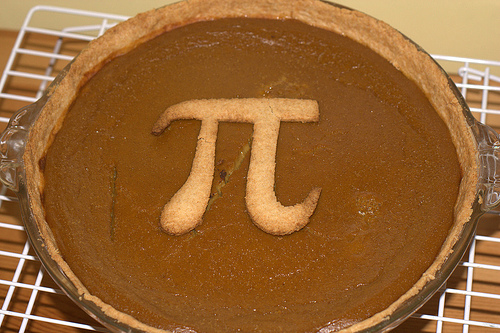
[Feature photo above by pauladamsmith.]

Now there is an ancient Greek letter,
And I think no other is better.
It isn’t too tall,
It might look very small,
But its digits, they go on forever.

— Scott
Mrs. Mitchell’s Virtual School

Time to Celebrate

Are your students doing anything special for \pi Day? After two months with no significant break, we are going stir crazy. We need a day off — and what better way could we spend it than to play math all afternoon?

If you need ideas, here are some great \pi pages:

Continue reading Happy Pi Day II

The Secret of Egyptian Fractions

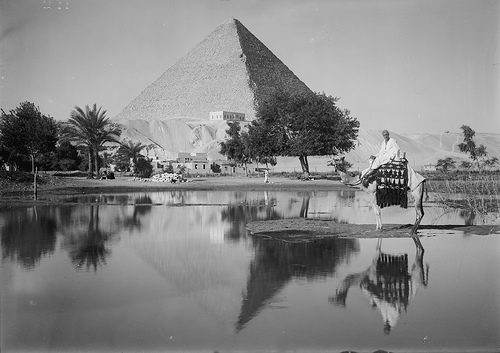
Photo from Library of Congress via pingnews.

Archaeology professor Dr. Fibonacci Jones came home from a long day of lecturing and office work. Stepping inside the front door, he held up a shiny silver disk.

“Ta-da!” he said.
Rhind papyrus

“All right!” said his daughter Alexandria. “The photos are here.”

They had to chase Alex’s brother Leon off the computer so they could view the images on the CD, but that wasn’t hard. He wanted to see the artifacts, too. Alex recognized several of the items they had dug up from the Egyptian scribe’s burial plot: the wooden palette, some clay pots, and of course the embalmed body.

Then came several close-up pictures of writing on papyrus.

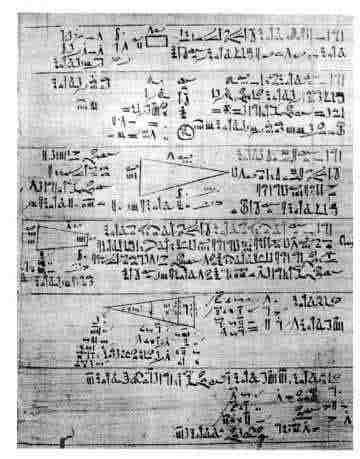
Photo from MathsNet.net.

How to Write Egyptian Fractions

“I remember how to read the Egyptian numbers,” Alex said, “but what are these marks above them?”

Dr. Jones nodded. “I thought you would catch that. Those are fractions. The scribe places an open mouth, which is the hieroglyph ‘r’, over a number to make its reciprocal.”

“I know that word,” Leon said. “It means one over the number. Like, the reciprocal of 12 is 1/12, right?”

“That is right. 1/12 would be written as…”

The Rest of the Story

As I transcribed this article from my old math newsletter, I realized that it would require more graphics than I was willing to construct. LaTex does not handle Egyptian hieroglyphs — or at least, I don’t know how to make it do so. Instead, I decided to scan the newsletter pages and give them to you as a pdf file:

Right-click and choose “Save” to download:

The file includes a student worksheet for Egyptian fractions from 1/2 to 9/10.

Egyptian Fractions: The Answer Sheet

The answers are now posted.

To Be Continued…

Read all the posts from the January/February 1999 issue of my Mathematical Adventures of Alexandria Jones newsletter.
Rewriting the History of Math

Here are a couple of quick links to math in the news:

A Very Short History of Mathematics

This paper was read to the Adams Society (St. John’s College Mathematical Society) at their 25th anniversary dinner, Michaelmas Term, 1948. [Warning: Do not attempt to read this while drinking coffee or other spittable beverage!]

Hat tip: I found this through the math carnival at a mispelt bog.

Update: The original page has disappeared from the internet, or at least I cannot find it any more, but the Internet Archive Wayback Machine came to the rescue. After my plea for help, James Clare pointed me to the article’s new home.

Egyptian Geometry and Other Challenges

Rhind papyrus

Would you like to study “the knowledge of all existing things and all obscure secrets”? That is how Scribe Ahmose (also translated Ahmes) described his mathematical papyrus. Ahmose’s masterpiece is now called the Rhind Papyrus, after Alexander Henry Rhind, a Scotsman who was one of the first archaeologists to make meticulous records of his excavations (rather than simply hunting for treasures). Rhind purchased the papyrus from an antiquities dealer in Luxor, Egypt, in 1858.

Ahmose’s writing included a huge table of fractions as well as story problems, geometry, algebra, and accounting. Can you solve any of Scribe Ahmose’s problems?

Continue reading Egyptian Geometry and Other Challenges

Egyptian Math Puzzles

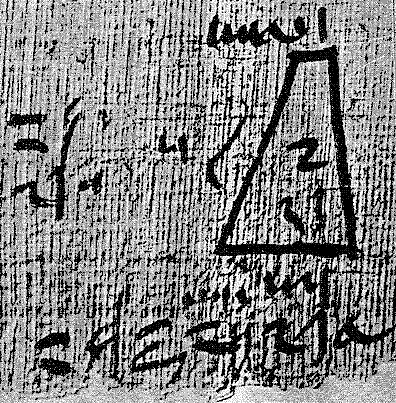
What we know about ancient Egyptian mathematics comes primarily from two papyri, the first one written around 1850 BC. Moscow papyrus problem 14This is called the Moscow papyrus, because it now belongs to Moscow’s Pushkin Museum of Fine Arts. The scroll contains 25 problems, mostly practical examples of various calculations. Problem 14, which finds the volume of a frustrum (a pyramid with its top cut off), is often cited by mathematicians as the most impressive Egyptian pyramid of all.

Continue reading Egyptian Math Puzzles

Egyptian Math in Hieroglyphs

Egyptians wrote in hieroglyphs, a type of picture writing, and in hieratics, which were like a cursive form of hieroglyphs.

Hieroglyphs came first. They were carved in the stone walls of temples and tombs, written on monuments, and used to decorate furniture. But they were a nuisance for scribes, who simplified the pictures and slurred some lines together when they wrote in ink on paper-like papyrus. This hieratic writing — like some people’s cursive today — can be hard to read, so we are only using hieroglyphic numbers on this blog.

Download this page from my old newsletter, and try your hand at translating some Egyptian hieroglyphs:

Then try writing some hieroglyphic calculations of your own.

Edited to add: The answers to these puzzles (and more) are now posted here.

To Be Continued…

Read all the posts from the September/October 1998 issue of my Mathematical Adventures of Alexandria Jones newsletter.

Historical Tidbits: Alexandria Jones

[Read the story of the pharaoh’s treasure: Part 1, Part 2, and Part 3.]

Here are a few more tidbits from math history, along with links to relevant Internet sites or books, and three more math puzzles for you to try. I hope you find them interesting.

Next time, a new adventure (sort of)…

Continue reading Historical Tidbits: Alexandria Jones