Are You Smarter than a 3rd-6th Grader?

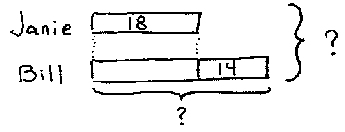
Here are a few challenging word problems from Singapore:

I did fine on the 3rd-grade problems, but I stumbled a bit on the 4/5th-grade “How much sugar…” problem. The toy cars were tricky, but manageable. I misread the problem with the chocolate and sweets at first — I think of chocolates as a sub-category of sweets, but in this problem they are totally different. (Perhaps “sweets” are what I would call “hard candy”?) Finally, I had to resort to algebra for the last two Grade 6 questions.

How many can you solve?

Trouble with Percents

Can your students solve this problem?

There are 20% more girls than boys in the senior class.
What percent of the seniors are girls?

This is from a discussion of the semantics of percent problems and why students have trouble with them, going on over at MathNotations. (Follow-up post here.)

Our pre-algebra class just finished a chapter on percents, so I thought Chickenfoot might have a chance at this one. Nope! He leapt without thought to the conclusion that 60% of the class must be girls.

After I explained the significance of the word “than”, he solved the follow-up problem just fine.

Puzzle: Random Blocks

Red block puzzle

In the first section of George Lenchner’s Creative Problem Solving in School Mathematics, right after his obligatory obeisance to George Polya (see the third quote here), Lechner poses this problem. If you have seen it before, be patient — his point was much more than simply counting blocks.

A wooden cube that measures 3 cm along each edge is painted red. The painted cube is then cut into 1-cm cubes as shown above. How many of the 1-cm cubes do not have red paint on any face?

And then he challenges us as teachers:

Do you have any ideas for extending the problem?
If so, then jot them down.

This is strategically placed at the end of a right-hand page, and I was able to resist turning to read on. I came up with a list of 15 other questions that could have been asked — some of which will be used in future Alexandria Jones stories. Lechner wrote only seven elementary-level problems, and yet his list had at least two questions that I had not considered. How many can you come up with?

Continue reading Puzzle: Random Blocks

How To Start a Homeschool Math Club

From a recent e-mail:

“Hello! I am on the board of a homeschool co-op. We have had requests for a math club and wondered if you have any tips for starting one. We service children from K-10th and would need to try to meet the needs of as many ages as possible.”

There are several ways you might organize a homeschool math club, depending on the students you have and on your goals. I think you would have to split the students by age groups — it is very hard to keep that wide of a range of students interested. Then decide whether you want an activity-oriented club or a more academic focus.

When I started my first math club, I raided the math shelves in the children’s section at my library (510-519) for anything that interested me. I figured that if an activity didn’t interest me, I couldn’t make it fun for the kids. Over the years we have done a variety of games, puzzles, craft projects, and more — always looking for something that was NOT like whatever the kids would be doing in their textbooks at home.

Continue reading How To Start a Homeschool Math Club

How Old Are You, in Nanoseconds?

Conversion factors are special fractions that contain problem-solving information. Why are they called conversion factors? “Conversion” means change, and conversion factors help you change the numbers and units in your problem. “Factors” are things you multiply with. So to use a conversion factor, you will multiply it by something.

For instance, if I am driving an average of 60 mph on the highway, I can use that rate as a conversion factor. I may use the fraction \frac{60 \: miles}{1 \: hour} , or I may flip it over to make \frac{1 \: hour}{60 \: miles} . It all depends on what problem I want to solve.

After driving two hours, I have traveled:

\left(2 \: hours \right) \times \frac{60 \: miles}{1 \: hour} = 120 miles so far.

But if I am planning to go 240 more miles, and I need to know when I will arrive:

\left(240 \: miles \right) \times \frac{1 \: hour}{60 \: miles} = 4 hours to go.

Any rate can be used as a conversion factor. You can recognize them by their form: this per that. Miles per hour, dollars per gallon, cm per meter, and many, many more.

Of course, you will need to use the rate that is relevant to the problem you are trying to solve. If I were trying to figure out how far a tank of gas would take me, it wouldn’t be any help to know that an M1A1 Abrams tank gets 1/3 mile per gallon. I won’t be driving one of those.

Using Conversion Factors Is Like Multiplying by One

If I am driving 65 mph on the interstate highway, then driving for one hour is exactly the same as driving 65 miles, and:

\frac{65 \: miles}{1 \: hour} = the \: same \: thing \: divided \: by \: itself = 1

This may be easier to see if you think of kitchen measurements. Two cups of sour cream are exactly the same as one pint of sour cream, so:

\frac{2 \: cups}{1 \: pint} = \left(2 \: cups \right) \div \left(1 \:pint \right) = 1

If I want to find out how many cups are in 3 pints of sour cream, I can multiply by the conversion factor:

\left(3 \: pints \right) \times \frac{2 \: cups}{1 \: pint} = 6 \: cups

Multiplying by one does not change the original number. In the same way, multiplying by a conversion factor does not change the original amount of stuff. It only changes the units that you measure the stuff in. When I multiplied 3 pints times the conversion factor, I did not change how much sour cream I had, only the way I was measuring it.

Conversion Factors Can Always Be Flipped Over

If there are \frac{60 \: minutes}{1 \: hour} , then there must also be \frac{1 \: hour}{60 \: minutes} .

If I draw house plans at a scale of \frac{4 \: feet}{1 \: inch} , that is the same as saying \frac{1 \: inch}{4 \: feet} .

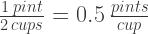
If there are \frac{2\: cups}{1 \: pint} , then there is \frac{1\: pint}{2 \: cups} = 0.5 \: \frac{pints}{cup} .

Or if an airplane is burning fuel at \frac{8\: gallons}{1 \: hour} , then the pilot has only 1/8 hour left to fly for every gallon left in his tank.

This is true for all conversion factors, and it is an important part of what makes them so useful in solving problems. You can choose whichever form of the conversion factor seems most helpful in the problem at hand.

How can you know which form will help you solve the problem? Look at the units you have, and think about the units you need to end up with. In the sour cream measurement above, I started with pints and I wanted to end up with cups. That meant I needed a conversion factor with cups on top (so I would end up with that unit) and pints on bottom (to cancel out).

You Can String Conversion Factors Together

String several conversion factors together to solve more complicated problems. Just as numbers cancel out when the same number is on the top and bottom of a fraction (2/2 = 2 ÷ 2 = 1), so do units cancel out if you have the same unit in the numerator and denominator. In the following example, quarts/quarts = 1.

How many cups of milk are there in a gallon jug?

\left(1\: gallon \right) \times \frac{4\: quarts}{1\: gallon} \times \frac{2\: pints}{1\: quart} \times \frac{2\: cups}{1\: pint} = 16\: cups

As you write out your string of factors, you will want to draw a line through each unit as it cancels out, and then whatever is left will be the units of your answer. Notice that only the units cancel — not the numbers. Even after I canceled out the quarts, the 4 was still part of my calculation.

Let’s Try One More

The true power of conversion factors is their ability to change one piece of information into something that at first glance seems to be unrelated to the number with which you started.

Suppose I drove for 45 minutes at 55 mph in a pickup truck that gets 18 miles to the gallon, and I wanted to know how much gas I used. To find out, I start with a plain number that I know (in this case, the 45 miles) and use conversion factors to cancel out units until I get the units I want for my answer (gallons of gas). How can I change minutes into gallons? I need a string of conversion factors:

\left(45\: min. \right) \times \frac{1\: hour}{60\: min.} \times \frac{55\: miles}{1\: hour} \times \frac{1\: gallon}{18\: miles} = 2.3\: gallons

How Old Are You, Anyway?

If you want to find your exact age in nanoseconds, you need to know the exact moment at which you were born. But for a rough estimate, just knowing your birthday will do. First, find out how many days you have lived:


Days\: I\:have\: lived = \left(my\: age \right) \times \frac{365\: days}{year}

+ \left(number\: of\: leap\: years \right) \times \frac{1\: extra\: day}{leap\: year}

+ \left(days\: since\: my\: last\: birthday,\: inclusive \right)

Once you know how many days you have lived, you can use conversion factors to find out how many nanoseconds that would be. You know how many hours are in a day, minutes in an hour, and seconds in a minute. And just in case you weren’t quite sure:

One\: nanosecond = \frac{1}{1,000,000,000} \: of\: a\: second

Have fun playing around with conversion factors. You will be surprised how many problems these mathematical wonders can solve.


[Note: This article is adapted from my out-of-print book, Master the Math Monsters.]
Solving Complex Story Problems

[Dragon photo above by monkeywingand treasure chest by Tom Praison via flickr.]

Solving-Complex-Story-Problems

Let’s play around with a middle-school/junior high word problem:

Cimorene spent an afternoon cleaning and organizing the dragon’s treasure. One fourth of the items she sorted was jewelry. 60% of the remainder were potions, and the rest were magic swords. If there were 48 magic swords, how many pieces of treasure did she sort in all?

[Problem set in the world of Patricia Wrede’s Enchanted Forest Chronicles. Modified from a story problem in Singapore Primary Math 6B. Think about how you would solve it before reading further.]

How can we teach our students to solve complex, multi-step story problems? Depending on how one counts, the above problem would take four or five steps to solve, and it is relatively easy for a Singapore math word problem. One might approach it with algebra, writing an equation like:

x - \left[\frac{1}{4}x + 0.6\left(\frac{3}{4} \right)x  \right]  = 48

…or something of that sort. But this problem is for students who have not learned algebra yet. Instead, Singapore math teaches students to draw pictures (called bar models or math models or bar diagrams) that make the solution appear almost like magic. It is a trick well worth learning, no matter what math program you use.

Continue reading Solving Complex Story Problems

How Can We Teach Problem Solving?

We continue to plan our co-op courses for next fall. Some of the classes I had hoped for will not happen, and my children are going to have to make some tough choices between the remaining topics. Unfortunately, they have not yet mastered the ability to be in two classrooms at once.

I have three math courses to plan, and I think I will focus as much as I can on teaching math through problems, even at the elementary level. These are once-a-week enrichment classes for homeschooled students, so I assume they have a “normal” math program at home. I want to introduce a few topics they might not otherwise see, to deepen their understanding of the topics they have studied, and to give them a taste of that “Aha!” feeling that comes from conquering a challenging problem. Has anybody done something like this, and can you recommend some good resources?

Continue reading How Can We Teach Problem Solving?

Bill Gates Proportions II

[Feature photo above by Remy Steinegger via Wikimedia Commons (CC BY 2.0).]

Another look at the Bill Gates proportion… Even though I couldn’t find any data on his real income, I did discover that the median American family’s net worth was $93,100 in 2004 (most of that is home equity) and that the figure has gone up a bit since then. This gives me another chance to play around with proportions.

So I wrote a sample problem for my Advanced Math Monsters workshop at the APACHE homeschool conference:

The median American family has a net worth of about $100 thousand. Bill Gates has a net worth of $56 billion. If Average Jane Homeschooler spends $100 in the vendor hall, what would be the equivalent expense for Gates?

Continue reading Bill Gates Proportions II

Putting Bill Gates in Proportion

[Feature photo above by Baluart.net.]

A friend gave me permission to turn our email discussion into an article…

Can you help us figure out how to figure out this problem? I think we have all the information we need, but I’m not sure:

The average household income in the United States is $60,000/year. And a man’s annual income is $56 billion. Is there a way to figure out what this man’s value of $1mil is, compared to the person who earns $60,000/year? In other words, I would like to say — $1,000,000 to us is like 10 cents to Bill Gates.

Continue reading Putting Bill Gates in Proportion

The Case of the Mysterious Story Problem

[Feature photo above by Carla216 via flickr (CC BY 2.0). This post was rescued from my old blog.]
I love story problems. Like a detective, I enjoy sifting out clues and solving the mystery. But what do you do when you come across a real stumper? Acting out story problems could make a one-page assignment take all week.

You don’t have to bake a pie to study fractions or jump off a cliff to learn gravity. Use your imagination instead. The following suggestions will help you find the clues you need to solve the case.

Continue reading The Case of the Mysterious Story Problem