Welcome, TIME Readers!

[Photo by Luis Argerich via flickr.]

If you’ve come here from Bonnie Rochman’s article, Bedtime Math: A Problem a Day Keeps Fear of Arithmetic Away, thank you for dropping in! I have nearly 800 published posts about learning and teaching math, which can seem pretty overwhelming.

Here are a few good places to start:

  • Tell Me a (Math) Story
    What better way could there be to do math than snuggled up on a couch with your little one, or side by side at the sink while your middle-school student helps you wash the dishes, or passing the time on a car ride into town?
  • Homeschooling with Math Anxiety Series
    Our childhood struggles with schoolwork gave most of us a warped view of mathematics. Yet even parents who suffer from math anxiety can learn to enjoy math with their children.
  • How to Conquer the Times Table
    Challenge your student to a joint experiment in mental math. Over the next two months, without flashcards or memory drill, how many math facts can the two of you learn together? We will use the world’s oldest interactive game — conversation — to explore multiplication patterns while memorizing as little as possible.

I hope you enjoy your visit to my blog.
Math Teachers at Play #56 via Another Step To Take…

Would you like to learn about math books, games, puzzles, teaching tips, and more? Check out this month’s Math Teachers at Play:

Math Teachers at Play is a Blog Carnival for teachers, parents, homeschoolers and anyone else interested in learning and teaching mathematics.

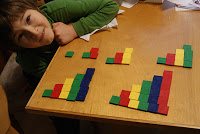
According to the tradition of MTaP we start with some trivia related to edition number. Fifty six is a tetrahedral number, the sum of the first six triangular numbers. To model this number we laid out tiles to for the triangular numbers and then stacked them…

Click here to read the whole post.

10 Questions to Ask About a Math Problem

[Photo by CourtneyCarmody via flickr.]

It’s important to teach our children to ask questions, about math and about life. As I wrote in my series about homeschooling with math anxiety, “School textbooks only ask questions for which they know the answer. When homeschoolers learn to think like mathematicians, we will ask a different type of question.”

So I was delighted to see this new post from Bon Crowder: Ten Questions to Ask About a Math Problem. Click the link and read the whole thing!

Why a list of questions about math problems? Before creating them, I decided the questions should do the following:

  • Allow the student to dig in deeper to the math problem, and the math behind the problem.
  • Help the student to think about the problem in ways they wouldn’t normally.
  • Let the student get creative in thinking about the problem.

And of course doing these things regularly will train them to continue to do this with all math problems through their lives.

— Bon Crowder
Ten Questions to Ask About a Math Problem

Reviews for my Daughter’s Book

I cleaned up the clutter on my other blog, and so I decided to make a page about my daughter’s book, which meant taking the time to pull out excerpts from her reviews. And since I hadn’t posted anything about her on this blog for a couple of months, I thought I’d brag a bit to you all, too.

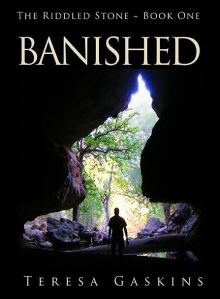
Reviews of Banished

Banished is a captivating fantasy story with a well-thought-out plot that would be a credit to any writer. But it is especially remarkable coming from a thirteen-year-old student who has been homeschooled all her life.

Teresa Gaskins actually wrote this book as a project for the National Novel Writing Month program. One noteworthy thing about the book is that there is no sexuality or bad language (the euphemistic interjection “Blasted” is used once), so, other than those who object to the presence of any kind of magic in books, parents can let their kids read the novel with no reservations.

However, be forewarned. When you reach the final page and find the words, “Not the End…,” you will cry, “Oh! No!” The story does not resolve itself at the end and then pick up in a sequel. Rather, the plot is left hanging at the end and will continue in another book. I for one feel as if I simply can’t wait to read the next installment to find out what happens to Chris and his friends. It’s that good!

— Wayne at Home School Book Review

Continue reading Reviews for my Daughter’s Book

HexaFlexaParty This Weekend!

Sunday, October 21, is the worldwide hexaflexagon party in honor of Martin Gardner’s birthday. Gardner’s article about hexaflexagons launched his career as a recreational math guru who inspired people all around the world to love math.

Here’s how to join in the fun:

Hexaflexagon History

Continue reading HexaFlexaParty This Weekend!

Math Teachers at Play #55 via Mathematical Palette

If you are looking for some mathematical inspiration, check out this month’s Math Teachers at Play blog carnival. It’s full of activity and game ideas, puzzles and problems, and interesting mathematics for students in elementary, middle, or high school. Enjoy!

Welcome to the 55th edition of the Mathematics Teachers at Play Blog Carnival. The number 55 is the 10th Fibonacci number and the sum of the first 10 counting numbers.

Below are the entries to the 55th edition of the Math Teachers at Play Blog Carnival…

Click here to read the whole carnival post.

Photo by Sam via flickr.

What Is a Proof?

I’ve been enjoying the Introduction to Mathematical Thinking course by Keith Devlin. For the first few weeks, we mostly talked about language, especially the language of logical thinking. This week, we started working on proofs.

For a bit of fun, the professor emailed a link to this video. My daughter Kitten enjoyed it, and I hope you do, too.

Full lesson available at Ted-Ed.

PUFM 1.5 Multiplication, Part 2

Poster by Maria Droujkova of NaturalMath.com. In this Homeschooling Math with Profound Understanding (PUFM) Series, we are studying Elementary Mathematics for Teachers and applying its lessons to home education.

Multiplication is taught and explained using three models. Again, it is important for understanding that students see all three models early and often, and learn to use them when solving word problems.

— Thomas H. Parker & Scott J. Baldridge
Elementary Mathematics for Teachers

I hope you are playing the Tell Me a (Math) Story game often, making up word problems for your children and encouraging them to make up some for you. As you play, don’t fall into a rut: Keep the multiplication models from our lesson in mind and use them all. For even greater variety, use the Multiplication Models at NaturalMath.com to create your word problems.

Continue reading PUFM 1.5 Multiplication, Part 2