If you haven’t subscribed to Vi Hart’s blog yet, what are you waiting for?
2011 Mathematics Game
[Photo from Wikipedia.]
Two of the most popular New Year’s Resolutions are to spend more time with family and friends, and to get more exercise. The 2011 Mathematics Game is a chance to do both at once.
So grab a partner, slip into your workout clothes, and pump up those mental muscles!
Here are the rules:
Use the digits in the year 2011 to write mathematical expressions for the counting numbers 1 through 100.
- All four digits must be used in each expression. You may not use any other numbers except 2, 0, 1, and 1.
- You may use the arithmetic operations +, -, x, ÷, sqrt (square root), ^ (raise to a power), and ! (factorial). You may also use parentheses, brackets, or other grouping symbols.
- You may use a decimal point to create numbers such as .1, .02, etc.
- Multi-digit numbers such as 20 or 102 may be used, but preference is given to solutions that avoid them.
Bonus Rules
You may use the overhead-bar (vinculum), dots, or brackets to mark a repeating decimal.You may use multifactorials:
- (n!)! = a factorial of a factorial, which is not the same as a multifactorial
- n!! = a double factorial = the product of all integers from 1 to n that have the same parity (odd or even) as n
- n!!! = a triple factorial = the product of all integers from 1 to n that are equal to n mod 3
[Note to teachers: The bonus rules are not part of the Math Forum guidelines. They make a significant difference in the number of possible solutions, however, and they should not be too difficult for high school students or advanced middle schoolers.]
Visual Proof of the Pythagorean Theorem
Beautifully done!
[From Girl’s Angle: A Math Club for Girls, via Albany Area Math Circle.]
Do you know why this proof works? How can we be sure the red and yellow areas don’t change as they slide around?
Graph-It Game
[Photo by Scott Schram via Flickr.]
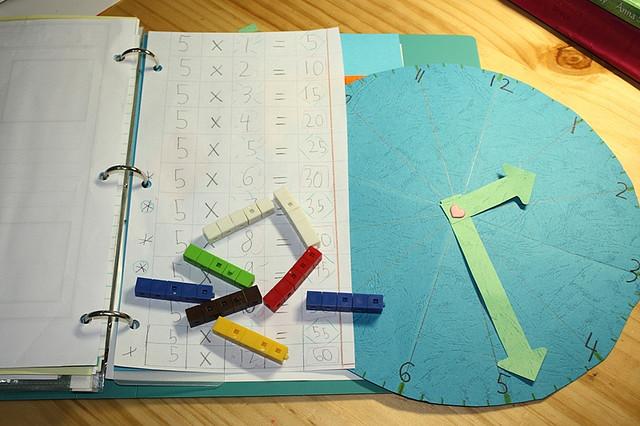
For Leon’s Christmas gift, Alex made the Graph-It game. She wrapped a pad of graph paper and wrote up the instructions:
To play Graph-It, one person designs a picture made by connecting points on a coordinate graph. He reads the points to the other player, who tries to reproduce the picture.
Math Teachers at Play #33 via Old Math Dog

The Math Teachers at Play blog carnival is open for your browsing pleasure at An “Old Math Dog” Learning New Tricks. Topics include:
- humor
- construction
- baking
- water gun battles
- football
- ABCs
- puzzles, games, and much more… Enjoy!
Renée’s Platonic Mobile
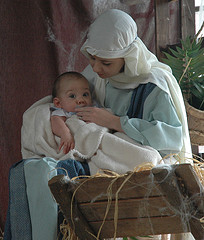
Alexandria Jones struggled to think of a Christmas gift that a one-month-old baby could enjoy, but finally she got an idea.
She cut empty cereal boxes to make regular polygons: 6 squares, 12 regular pentagons, and 32 equilateral triangles. Using small pieces of masking tape, she carefully formed the five Platonic solids. Then she mixed flour and water into a runny paste. She tore an old newspaper into small strips and soaked them in the paste. She covered each solid with a thin layer of paper.
Fun with Math Doodling
Thank you to Dan at Math 4 Love, who pointed me to Vi Hart’s math doodles. (The rest of her page is well worth exploring, too!) Kitten really enjoyed this one and immediately sat down to create her own version of the OuroBorromean Rings…
Quotable: Math Programs
Recognize that every math program, whether more traditionally skill-based or reform-oriented (more problem-solving, projects, less drill) has its merits and its weaknesses. Whether you believe there is too much emphasis on basic facts (less likely!), or not enough, you can supplement with the myriad of resources on the web.
— David Marain, MathNotations
Odds and Evens Week of 12-1-10
Click through to the original post for a counting puzzle, plenty of advice on helping with your child’s math homework, useful math links, and a couple of “cute 3-year-old” stories.
And remember that one of the best ways to supplement any math program is by playing games.
Advent Calendar of Math Games
Homeschoolers, you can have your math and enjoy it, too! Play a mathematics game every day until Christmas at nrich.maths.org:
A Football Puzzle
[Photo by rdesai.]
The MIT Mathmen got the ball on their own 20-yard line for the last drive of the game. They were down by 2 points, so they needed at least a field goal to win the game.
If quarterback Zeno and his offense advanced the ball halfway to the opposing team’s end zone on each play…