Review: Math Mammoth

When Maria of Homeschool Math Blog asked if I would review her Math Mammoth curriculum, I jumped at the chance. I’ve always enjoyed her blog posts, and I liked the worksheets I had seen on her website. (Maria gives away more than 300 pages absolutely free!)
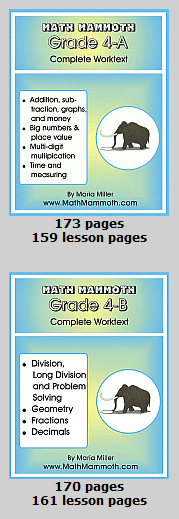
She sent me her then-new 4th grade worktexts, and Kitten and I dug in.

Well, that was longer ago than I care to admit. But of course, it takes quite a bit of daily use before one can be absolutely sure of one’s opinion about a homeschool program — or at least, it does for me. Too many times a homeschool resource will look great in the catalog, and we’ll start it with high hopes only to bog down in the day-to-day grind and abandon it after a few weeks or months. So I wanted to give Math Mammoth a thorough workout before I wrote this review.

And all excuses aside, I really am a pro at crastinating

My aim is to help parents and teachers teach math so our children and students can really understand what is going on. I’ve strived to explain the concepts so that both the teacher and the student can “get it” by reading the explanations in the books.

— Maria Miller
author of Math Mammoth worktexts
and Homeschool Math Blog

Continue reading Review: Math Mammoth

Game: Target Number (or 24)

[Photo by stevendepolo via Flickr (CC BY 2.0).]

Math concepts: addition, subtraction, multiplication, division, powers and roots, factorial, mental math, multi-step thinking
Number of players: any number
Equipment: deck of math cards, pencils and scratch paper, timer (optional)

Set Up

All players must agree on a Target Number for the game. Try to choose a number that has several factors, which means there will be a variety of ways to make it. Traditionally, I start my math club students with a target of 24.

Shuffle the deck, and deal four cards face down to each player. (For larger target numbers, such as 48 or 100, deal five or six cards to each player.) The players must leave the cards face down until everyone is ready. Set the remainder of the deck to one side.

Continue reading Game: Target Number (or 24)

Math Teachers at Play #23 via Math Recreation

The new blog carnival is posted and full of fun:

Enjoy!

Next month, the carnival is coming back home to Let’s Play Math! — and in fact, I’ve already started collecting articles for it. If you would like to contribute, you can use this handy submission form. If you’d like to host a future edition (July or later), let me know.

Head’s Up for e-Day

It’s beyond Kitten’s level and beyond my math club (what’s left of it), but for those of you who are interested, this Sunday is e Day. The only place I can remember seeing the announcement is on the blog 360:

[Do you have an e-Day post? I’d be glad add your link!]

If you’ve never heard of e before, then perhaps you are young enough (or young at heart? ;)) to enjoy celebrating his more famous cousin. Pi Day is coming next month. . .

Updates

Maria has a good introduction to e:

And Zac adds:

Pat chimes in with “something totally different”:

While Robert explains:

What is a Math Carnival?

Over at Walking Randomly, Mike has posted a great explanation with FAQs:

You can send in articles now for either carnival:

Battlestations!!!

Nerds battle hungry football players who want to eat their giant fractal Dorito creation:

For more details on this video (and photos of the fractal’s construction), check out the Blown Apart Studios page. I’m looking forward to their next project, Nerd High, a musical comedy set in an alternate reality where nerds rule the school and jocks are the outcasts.

New Edition of Must-Read Math Book

I thought I knew math fairly well.

I thought arithmetic was boring.

I thought the reason other nations beat America in international math tests was that their students worked harder than ours.

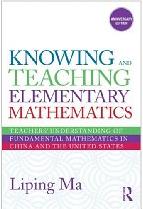
I thought all sorts of silly things before I read Liping Ma’s Knowing and Teaching Elementary Mathematics. Now this must-read book is coming out in a new edition, due in bookstores next week.

I can hardly wait!

In American elementary mathematics education, arithmetic is viewed as negligible, sometimes even with pity and disdain—like Cinderella in her stepmother’s house. Many people seem to believe that arithmetic is only composed of a multitude of “math facts” and a handful of algorithms. . . Who would expect that the intellectual demand for learning such a subject actually is challenging and exciting?

Liping Ma
Arithmetic in American Mathematics Education: An Abandoned Arena?

Continue reading New Edition of Must-Read Math Book