In the News: Teaching Math

Here are a couple of interesting articles about teaching math:

Good Stories, Good Math

Math Trek (Nov. 10, 2007) — Spinning a good yarn may seem to have little to do with mathematics, but a new study suggests otherwise. Preschoolers who tell stories that include many different perspectives do better in math two years later than those who stick to one simple perspective. The researchers believe that the study may highlight a deep connection between mathematical ability and narrative skills… [Hat tip: Wild About Math!]

Gesturing Helps Grade School Children Solve Math Problems

ScienceDaily (Nov. 5, 2007) — Are math problems bugging your kids? Tell them to talk back — using their hands. Psychologists at the University of Chicago report that gesturing can help kids add new and correct problem-solving strategies to their mathematical repertoires. What’s more, when given later instruction, kids who are told to gesture are more likely to succeed on math problems…

Continue reading In the News: Teaching Math

More Fun with Hexa-Trex

Hexa-trex turtle logo

My elementary Math Club students had fun practicing their math facts and “out of the box” thinking with Hexa-Trex puzzles. The object of Hexa-Trex is to find a path through all the number and operation tiles to make a true equation. The “Easy” puzzles are just the right level for my 4th-5th grade students, although they get stumped whenever the equations require Order of Operations. One girl enjoyed the puzzles enough to take our extra pages home for her dad.

Hexa-Trex puzzles were featured in the October issue of Games magazine, and now you can enjoy Hexa-Trex away from the computer with Bogusia Gierus‘s new book, The First Book of Hexa-Trex Puzzles. If you are thinking ahead to Christmas (can it be that time already?!), and if you have a puzzle lover in the family, this little book would make a fun stocking-stuffer.

How to Solve Math Problems

That’s a Tough One!

What can you do when you are stumped? Too many students sit and stare at the page, waiting for inspiration to strike — and when the solution doesn’t crack their heads open and step out, fully formed, they complain: “Math is too hard!”

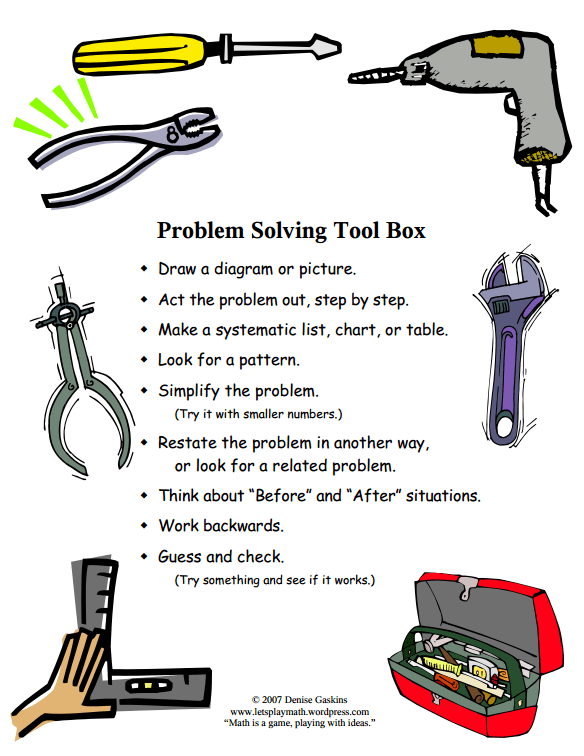
So this year I have given my Math Club students a couple of mini-posters to put up on the wall above their desk, or wherever they do their math homework. The first gives four questions to ask yourself as you think through a math problem, and the second is a list of problem-solving strategies.

Continue reading How to Solve Math Problems

While I Was Distracted…

After a hectic couple of weeks, I finally found a little time to sit at the computer and browse — and boy, was I amazed to see what I had missed! If you have not yet read Dave‘s interview with Prof. Lynn Arthur Steen about the state of math education reform, click over and check it out: Part I here, and Part II here.

According to the intro, Prof. Steen “has been a driving force for the reform of school mathematics for many years and was on the development team that produced NCTM’s Curriculum and Evaluation Standards for School Mathematics. For the last few years, he has been involved in Achieve’s commitment to developing world-class mathematics standards for K-8 and ADP’s similar commitment to secondary mathematics.” He has some interesting things to say, although many of his statements are open to various interpretations, and at times he seems determined to provoke a hot-headed response. For instance:

Continue reading While I Was Distracted…

Reading to Learn Math

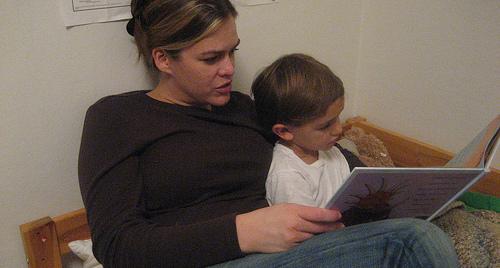
[Photo by Betsssssy.]

Do you ever take your kids’ math tests? It helps me remember what it is like to be a student. I push myself to work quickly, trying to finish in about 1/3 the allotted time, to mimic the pressure students feel. And whenever I do this, I find myself prone to the same stupid mistakes that students make.

Even teachers are human.

In this case, it was a multi-step word problem, a barrage of information to stumble through. In the middle of it all sat this statement:

…and there were 3/4 as many dragons as gryphons…

My eyes saw the words, but my mind heard it this way:

…and 3/4 of them were dragons…

What do you think — did I get the answer right? Of course not! Every little word in a math problem is important, and misreading even the smallest word can lead a student astray. My mental glitch encompassed several words, and my final tally of mythological creatures was correspondingly screwy.

But here is the more important question: Can you explain the difference between these two statements?

Continue reading Reading to Learn Math