Game: Hundred Chart Nim

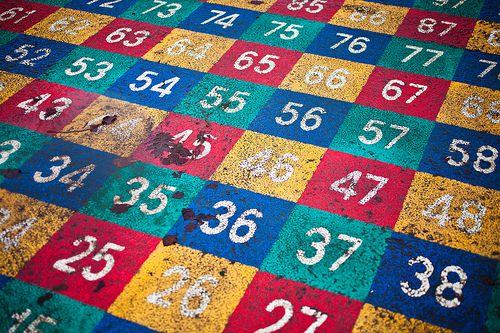
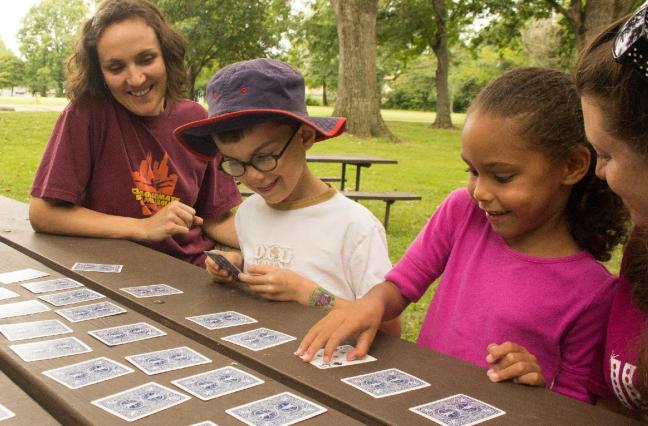
Photo by Håkan Dahlström via flickr.

Math concepts: addition and subtraction within 100, logical strategy
Number of players: 2 or 3
Equipment: printed hundred chart (also called a hundred board) and beans, pennies, or other tokens with which to mark numbers — or use this online hundred chart

Set Up

Place the hundred chart and a small pile of tokens where both players can reach them.

Continue reading Game: Hundred Chart Nim

Ben Franklin Math: Elementary Problem Solving 3rd Grade

The ability to solve word problems ranks high on any math teacher’s list of goals. How can I teach my students to solve math problems? I must help them develop the ability to translate “real world” situations into mathematical language.

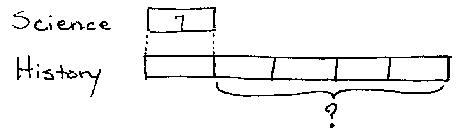
In two previous posts, I introduced the problem-solving tools algebra and bar diagrams. These tools help our students organize the information in a word problem and translate it into a mathematical calculation.

Working Math Problems with Poor Richard

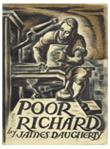
This time I will demonstrate these problem-solving tools in action with a series of 3rd-grade problems based on the Singapore Primary Math series, level 3A. For your reading pleasure, I have translated the problems into the life of Ben Franklin, inspired by the biography Poor Richard by James Daugherty.

Continue reading Ben Franklin Math: Elementary Problem Solving 3rd Grade

Penguin Math: Elementary Problem Solving 2nd Grade

The ability to solve word problems ranks high on any math teacher’s list of goals. How can I teach my students to reason their way through math problems? I must help my students develop the ability to translate “real world” situations into mathematical language.

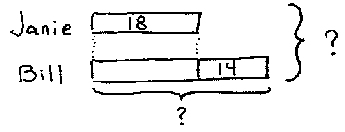
In a previous post, I analyzed two problem-solving tools we can teach our students: algebra and bar diagrams. These tools help our students organize the information in a word problem and translate it into a mathematical calculation.

Now I want to demonstrate these problem-solving tools in action with a series of 2nd grade problems, based on the Singapore Primary Math series, level 2A. For your reading pleasure, I have translated the problems into the universe of one of our family’s favorite read-aloud books, Mr. Popper’s Penguins.

UPDATE: Problems have been genericized to avoid copyright issues.

Continue reading Penguin Math: Elementary Problem Solving 2nd Grade

7 Things to Do with a Hundred Chart


This post has been revised to incorporate all the suggestions in the comments below, plus many more activities. Please update your bookmarks:

Or continue reading the original article…


Continue reading 7 Things to Do with a Hundred Chart

Egyptian Math in Hieroglyphs

Egyptians wrote in hieroglyphs, a type of picture writing, and in hieratics, which were like a cursive form of hieroglyphs.

Hieroglyphs came first. They were carved in the stone walls of temples and tombs, written on monuments, and used to decorate furniture. But they were a nuisance for scribes, who simplified the pictures and slurred some lines together when they wrote in ink on paper-like papyrus. This hieratic writing — like some people’s cursive today — can be hard to read, so we are only using hieroglyphic numbers on this blog.

Download this page from my old newsletter, and try your hand at translating some Egyptian hieroglyphs:

Then try writing some hieroglyphic calculations of your own.

Edited to add: The answers to these puzzles (and more) are now posted here.

To Be Continued…

Read all the posts from the September/October 1998 issue of my Mathematical Adventures of Alexandria Jones newsletter.

Game: Tens Concentration

Math concepts: addition, number bonds for 10, visual memory
Number of players: any number, mixed ages
Equipment: math cards, one deck

Set Up

Each player draws a card, and whoever choses the highest number will go first. Then shuffle the cards and lay them all face down on the table, spread out so no card covers any other card. There are 40 cards in a deck, so you can make a neat array with five rows of eight cards each, or you may scatter them at random.

Continue reading Game: Tens Concentration

Number Bonds = Better Understanding

[Rescued from my old blog.]

number bondsA number bond is a mental picture of the relationship between a number and the parts that combine to make it. The concept of number bonds is very basic, an important foundation for understanding how numbers work. A whole thing is made up of parts. If you know the parts, you can put them together (add) to find the whole. If you know the whole and one of the parts, you take away the part you know (subtract) to find the other part.

Number bonds let children see the inverse relationship between addition and subtraction. Subtraction is not a totally different thing from addition; they are mirror images. To subtract means to figure out how much more you would have to add to get the whole thing.

Continue reading Number Bonds = Better Understanding

Negative Numbers for Young Students

[Rescued from my old blog.]

Would you like to introduce your students to negative numbers before they study them in pre-algebra? With a whimsical number line, negative numbers are easy for children to understand.

Get a sheet of poster board, and paint a tree with roots — or a boat on the ocean, with water and fish below and bright sky above. Use big brushes and thick poster paint, so you are not tempted to put in too much detail. A thick, permanent marker works well to draw in your number line, with zero at ground (or sea) level and the negative numbers down below.

Continue reading Negative Numbers for Young Students

Order of Operations

[Rescued from my old blog.]

Marjorie in AZ asked a terrific question on the (now defunct) AHFH Math forum:

“…I have always been taught that the order of operations (Parenthesis, Exponents, Multiplication, Division, Addition, Subtraction) means that you work a problem in that order. All parenthesis first, then all exponents, then all multiplication from left to right, then all division from left to right, etc. …”

Many people are confused with order of operations, and it is often poorly taught. I’m afraid that Marjorie has fallen victim to a poor teacher — or at least, to a teacher who didn’t fully understand math. Rather than thinking of a strict “PEMDAS” progression, think of a series of stair steps, with the inverse operations being on the same level.

Continue reading Order of Operations
The Game That Is Worth 1,000 Worksheets

Have you and your children been struggling to learn the math facts? The game of Math Card War is worth more than a thousand math drill worksheets, letting you build your children’s calculating speed in a no-stress, no-test way.

Math concepts: greater-than/less-than, addition, subtraction, multiplication, division, fractions, negative numbers, absolute value, and multi-step problem solving.

Continue reading The Game That Is Worth 1,000 Worksheets