Math with Many Right Answers

The discussion matters more than the final answer.

One of the most persistent math myths in popular culture is the idea that mathematics is primarily about getting right answers.

The truth is, the answer doesn’t matter that much in math. What really matters is how you explain that answer. An answer is “right” if the explanation makes sense.

And if you don’t give an explanation, then you really aren’t doing mathematics at all.

Try This Number Puzzle

Here is a short sequence of numbers. Can you figure out the rule and fill in the next three blanks?

2, 3, 5, 7, ___, ___, ___, โ€ฆ

Remember, what’s important is not which numbers you pick, but rather how you explain your answer.

Possibility 1

Perhaps the sequence is the prime numbers?

2, 3, 5, 7, 11, 13, 17, โ€ฆ

The prime numbers make a wonderful sequence, though it isn’t the one I was thinking of.

Continue reading Math with Many Right Answers

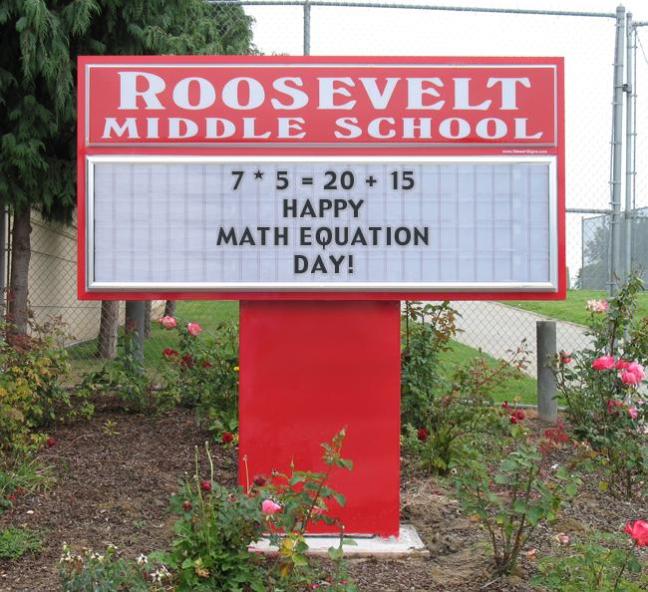
Happy Math Equation Day!

math equation day

Every Day Is Mathematics Day!

Iโ€™m still having fun with David Coffeyโ€™s meme, which started a couple of years ago with this blog post:

Make Your Own

Would you like to create a math holiday, too? Try one of these sign generators:

What kind of math will you celebrate? Leave a link to your Happy Math Day post in the comments below!

Infinite Cake: Don Cohen’s Infinite Series for Kids

Math Concepts: division as equal sharing, naming fractions, adding fractions, infinitesimals, iteration, limits
Prerequisite: able to identify fractions as part of a whole

This is how I tell the story:

  • We have a cake to share, just the two of us. It’s not TOO big a cake, ‘cuz we don’t want to get sick. An 8ย ร—ย 8 or 16ย ร—ย 16 square on the graph paper should be just right. Can you cut the cake so we each get a fair share? Color in your part.

Bobby Flay German Chocolate Cake

  • How big is your piece compared to the whole, original cake?
  • But you know, I’m on a diet, and I just don’t think I can eat my whole piece. Half the cake is too much for me. Is it okay if I share my piece with you? How can we divide it evenly, so we each get a fair share? How big is your new piece? Color it in.
  • How much of the whole, original cake do you have now? How can you tell?
  • I keep thinking of my diet, and I really don’t want all my piece of cake. It looks good, but it’s still just a bit too big for me. Will you take half of it? How big is that piece?
  • Now how much of the whole, original cake do you have? How could we figure it out?
    [Teaching tip: Don’t make kids do the calculation on paper. In the early stages, they can visualize and count up the fourths or maybe the eighths. As the pieces get smaller, the easiest way to find the sum is what Cohen does in the video belowโ€Œโ€”โ€Œidentify how much of the cake is left out.]
  • Even for being on a diet, I still don’t feel very hungry…

Continue reading Infinite Cake: Don Cohen’s Infinite Series for Kids

Puzzle: Crystal Ball Connection Patterns

In the land of Fantasia, where people communicate by crystal ball, Wizard Mathys has been placed in charge of keeping the crystal connections clean and clear. He decides to figure out how many different ways people might talk to each other, assuming there’s no such thing as a crystal conference call.

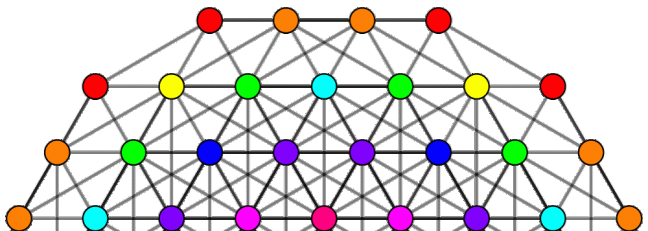
Mathys sketches a diagram of four Fantasian friends and their crystal balls. At the top, you can see all the possible connections, but no one is talking to anyone else because it’s naptime. Fantasians take their siesta very seriously. That’s one possible state of the 4-crystal system.

K4 matchings

On the second line of the diagram, Joe (in the middle) wakes up from siesta and calls each of his friends in turn. Then the friends take turns calling each other, bringing the total number of possible connection-states up to seven.

Finally, Wizard Mathys imagines what would happen if one friend calls Joe at the same time as the other two are talking to each other. That’s the last line of the diagram: three more possible states. Therefore, the total number of conceivable communication configurations for a 4-crystal system is 10.

For some reason Mathys can’t figure out, mathematicians call the numbers that describe the connection pattern states in his crystal ball communication system Telephone numbers.

TheWizardBySeanMcGrath-small

  • Can you help Wizard Mathys figure out the Telephone numbers for different numbers of people?
    T(0) = ?
    T(1) = ?
    T(2) = ?
    T(3) = ?
    T(4) = 10 connection patterns (as above)
    T(5) = ?
    T(6) = ?
    and so on.

Hint: Don’t forget to count the state of the system when no one is on the phone crystal ball.


Feature photo at top of post by Christian Schnettelker (web designer) and wizard photo by Sean McGrath via Flickr (CC BY 2.0). This puzzle was originally featured in the Math Teachers At Play (MTaP) math education blog carnival: MTaP #76.
Math Game: Fan Tan (Sevens)

Math Concepts: sorting by attribute (card suits), counting up, counting down, standard rank of playing cards (aces low).
Players: two or more, best with four to six.
Equipment: one complete deck of cards (including face cards), or a double deck for more than six players. Provide a card holder for young children.

How to Play

Deal out all the cards, even if some players get more than others. The player to the dealerโ€™s left begins by playing a seven of any suit. If that player does not have a seven, then the play passes left to the first player who does.

After that, on your turn you may lay down another seven or play on the cards that are already down. If you cannot play, say, โ€œPass.โ€

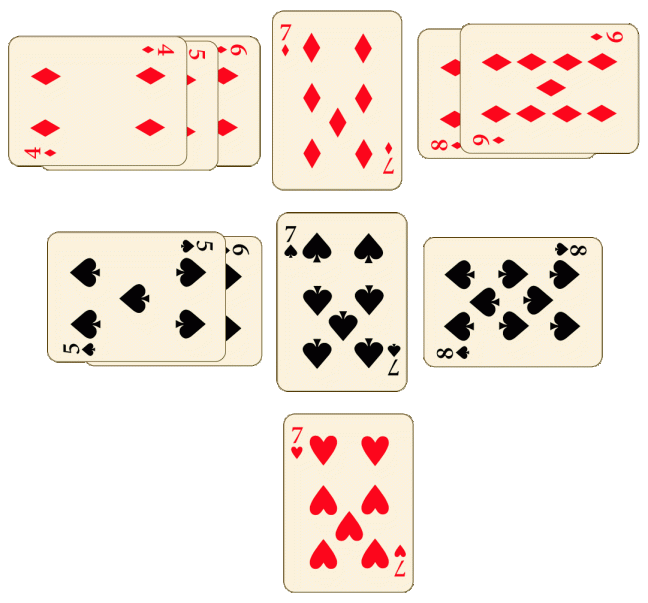
Once a seven is played in any suit, the six and the eight of that suit may be played on either side of it, forming the fan. Then the five through ace can go on the six in counting-down order, and the nine through king can go on the eight, counting up. You can arrange these cards to overlap each other so the cards below are visible, or you can square up the stacks so only the top card is seen.

A Fan Tan game in progress.

Continue reading Math Game: Fan Tan (Sevens)

Math Teachers at Play #85

[Feature photo by Tomruen via Wikimedia Commons.]

Do you enjoy math? I hope so! If not, browsing the articles linked in this post just may change your mind.

Welcome to the 85th edition of the Math Teachers At Play math education blog carnival‌—‌a smorgasbord of links to bloggers all around the internet who have great ideas for learning, teaching, and playing around with math from preschool to pre-college.

By tradition, we start the carnival with a short puzzle or activity. But if you would like to jump straight to our featured blog posts, click here to see the Table of Contents.

Let the mathematical fun begin!

Continue reading Math Teachers at Play #85

Math Game: Thirty-One

Math Concepts: addition to thirty-one, thinking ahead.
Players: best for two.
Equipment: one deck of math cards.

How to Play

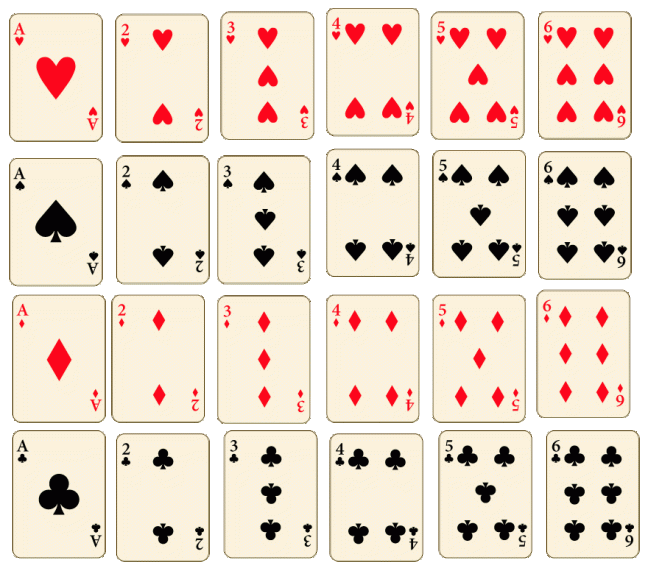
Lay out the ace to six of each suit in a row, face-up and not overlapping, one suit above another. You will have one column of four aces, a column of four twos, and so onโ€Œโ€”โ€Œsix columns in all.

The first player flips a card upside down and says its number value. Then the second player turns down a card, adds it to the first player’s number, and says the sum.

Players alternate, each time turning down one card, mentally adding its value to the running total, and saying the new sum out loud. The player who exactly reaches thirty-one, or who forces the next player to go over that sum, wins the game.

31-Game

Continue reading Math Game: Thirty-One

April 2015 Math Calendar

AprilMathCalendar

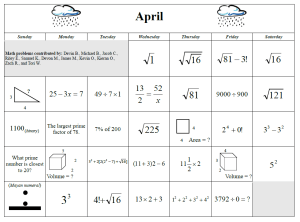
Six years ago, my homeschool co-op classes had fun creating this April calendar to hand out at our end-of-semester party. Looking at my regular calendar today, I noticed that April this year starts on Wednesday, just like it did back then. I wonder when’s the next time that will happen?

A math calendar is not as easy to read as a traditional calendar — it is more like a puzzle. The expression in each square simplifies to that day’s date, so your family can treat each day like a mini-review quiz: “Do you remember how to calculate this?”

The calendar my students made is appropriate for middle school and beyond, but you can make a math calendar with puzzles for any age or skill level. Better yet, encourage the kids to make puzzles of their own.

How to Use the Math Calendar

At home:
Post the calendar on your refrigerator. Use each math puzzle as a daily review “mini-quiz” for your children (or yourself).

In the classroom:
Post today’s calculation on the board as a warm-up puzzle. Encourage your students to make up “Today is…” puzzles of their own.

As a puzzle:
Cut the calendar squares apart, then challenge your students to arrange them in ascending (or descending) order.

Help Us Make the Next Math Calendar

If you like, you may use the following worksheet:

Submission details here: Kidsโ€™ Project — More Math Calendars?

2015 Mathematics Game

[Feature photo above by Scott Lewis and title background (right) by Carol VanHook, both via Flickr (CC BY 2.0, text added).]

2015YearGame

Did you know that playing games is one of the Top 10 Ways To Improve Your Brain Fitness? So slip into your workout clothes and pump up those mental muscles with the Annual Mathematics Year Game Extravaganza!

For many years mathematicians, scientists, engineers and others interested in math have played “year games” via e-mail. We don’t always know whether it’s possible to write all the numbers from 1 to 100 using only the digits in the current year, but it’s fun to see how many you can find.

Math Forum Year Game Site

Rules of the Game

Use the digits in the year 2015 to write mathematical expressions for the counting numbers 1 through 100. The goal is adjustable: Young children can start with looking for 1-10, middle grades with 1-25.

  • You must use all four digits. You may not use any other numbers.
  • Solutions that keep the year digits in 2-0-1-5 order are preferred, but not required.
  • You may use +, -, x, รท, sqrt (square root), ^ (raise to a power), ! (factorial), and parentheses, brackets, or other grouping symbols.
  • You may use a decimal point to create numbers such as .2, .02, etc., but you cannot write 0.02 because we only have one zero in this year’s number.
  • You may create multi-digit numbers such as 10 or 201 or .01, but we prefer solutions that avoid them.

My Special Variations on the Rules

  • You MAY use the overhead-bar (vinculum), dots, or brackets to mark a repeating decimal. But students and teachers beware: you can’t submit answers with repeating decimals to Math Forum.
  • You MAY NOT use a double factorial, n!! = the product of all integers from 1 to n that have the same parity (odd or even) as n. Math Forum allows these, but I’ve decided I prefer my arithmetic straight.

Click here to continue reading.