Welcome to the Math Teachers At Play blog carnival — which is not just for math teachers! If you like to learn new things and play around with ideas, you are sure to find something of interest.
By tradition, we start the carnival with a couple of puzzles in honor of our 66th edition.
Let the mathematical fun begin!
Puzzle 1
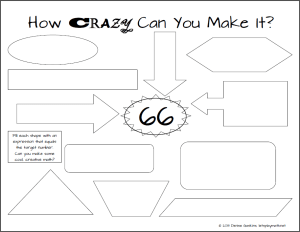
Our first puzzle is based on one of my favorite playsheets from the Miquon Math workbook series. Fill each shape with an expression that equals the target number. Can you make some cool, creative math?
Click the image to download the pdf playsheet set: one page has the target number 66, and a second page is blank so you can set your own target number.
It reminds me of string art designs, but the app makes it easy to vary the pattern and see what happens.
What do your students notice about the patterns?
What questions can they ask?
I liked the way the app uses “minutes” as the unit that describes the star you want the program to draw. That makes it easier (for me, at least) to notice and understand the patterns, since minutes are a more familiar and intuitive unit than degrees, let alone radians.
Do you enjoy math? I hope so! If not, browsing this post just may change your mind. Welcome to the Math Teachers At Play blog carnival — a smorgasbord of ideas for learning, teaching, and playing around with math from preschool to pre-college.
Let the mathematical fun begin!
POLYHEDRON PUZZLE
By tradition, we start the carnival with a puzzle in honor of our 62nd edition:
An Archimedean solid is a polyhedron made of two or more types of regular polygons meeting in identical vertices. A rhombicosidodecahedron (see image above) has 62 sides: triangles, squares, and pentagons.
How many of each shape does it take to make a rhombicosidodecahedron?
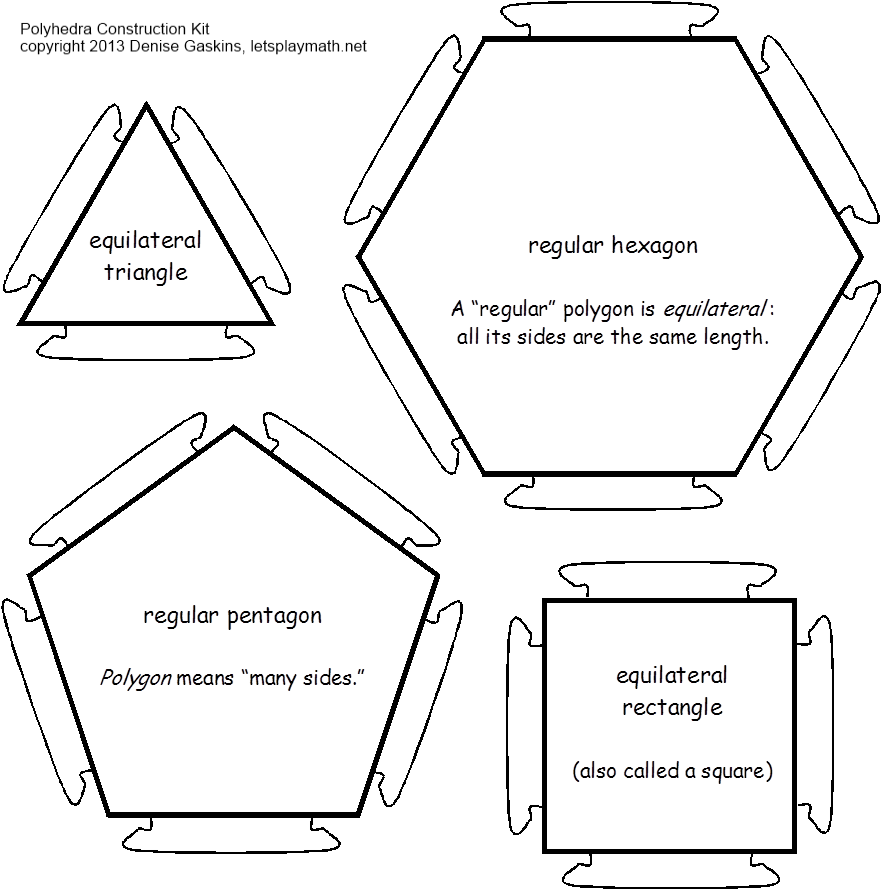
Click for template.
My math club students had fun with a Polyhedra Construction Kit. Here’s how to make your own:
Collect a bunch of empty cereal boxes. Cut the boxes open to make big sheets of cardboard.
Print out the template page (→) and laminate. Cut out each polygon shape, being sure to include the tabs on the sides.
Turn your cardboard brown-side-up and trace around the templates, making several copies of each polygon. I recommend 20 each of the pentagon and hexagon, 40 each of the triangle and square.
Draw the dark outline of each polygon with a ballpoint pen, pressing hard to score the cardboard so the tabs will bend easily.
Cut out the shapes, being careful around the tabs.
Use small rubber bands to connect the tabs. Each rubber band will hold two tabs together, forming one edge of a polyhedron.
So, for instance, it takes six squares and twelve rubber bands to make a cube. How many different polyhedra (plural of polyhedron) will you make?
Can you build a rhombicosidodecahedron?
And now, on to the main attraction: the 62 blog posts. Many of the following articles were submitted by their authors; others were drawn from the immense backlog in my blog reader. If you’d like to skip directly to your area of interest, here’s a quick Table of Contents:
Homeschoolers, after-schoolers, unschoolers, or anyone else: if you’re a parent with kids at home, you need this book. If you work with children in any way (grandparent, aunt/uncle, teacher, child care, baby sitter, etc.) you need this book. Or if you hated math in school and never understood how anyone could enjoy it, you need this book!
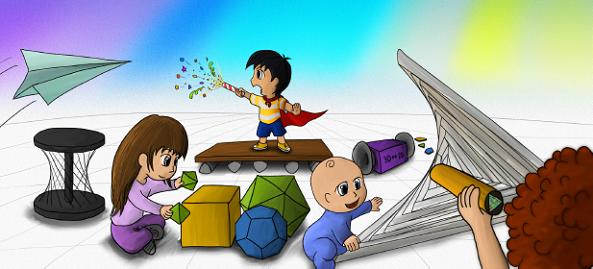
Moebius Noodles is a travel guide to the Math Universe for adventurous families (and it has lots of beautiful pictures, too!) featuring games and activities that draw out the rich, mathematical properties of everyday objects in ways accessible to parents and children:
A snowflake is an example of a fractal and an invitation to explore symmetry.
Cookies offer combinatorics and calculus games.
Paint chips come in beautiful gradients, and floor tiles form tessellations.
Welcome to the Math Teachers At Play blog carnival — a smorgasbord of ideas for learning, teaching, and playing around with math from preschool to pre-college. If you like to learn new things and play around with ideas, you are sure to find something of interest.
Let the mathematical fun begin…
PUZZLE 1
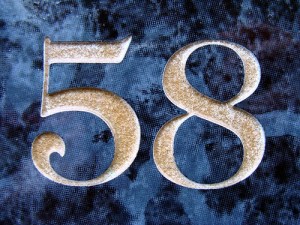
By tradition, we start the carnival with a pair of puzzles in honor of our 58th edition. Click to download the pdf: