New Edition of Must-Read Math Book

I thought I knew math fairly well.

I thought arithmetic was boring.

I thought the reason other nations beat America in international math tests was that their students worked harder than ours.

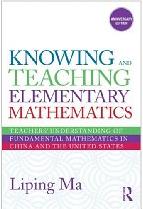
I thought all sorts of silly things before I read Liping Ma’s Knowing and Teaching Elementary Mathematics. Now this must-read book is coming out in a new edition, due in bookstores next week.

I can hardly wait!

In American elementary mathematics education, arithmetic is viewed as negligible, sometimes even with pity and disdain—like Cinderella in her stepmother’s house. Many people seem to believe that arithmetic is only composed of a multitude of “math facts” and a handful of algorithms. . . Who would expect that the intellectual demand for learning such a subject actually is challenging and exciting?

Liping Ma
Arithmetic in American Mathematics Education: An Abandoned Arena?

Continue reading New Edition of Must-Read Math Book

Prime Numbers Are like Monkeys

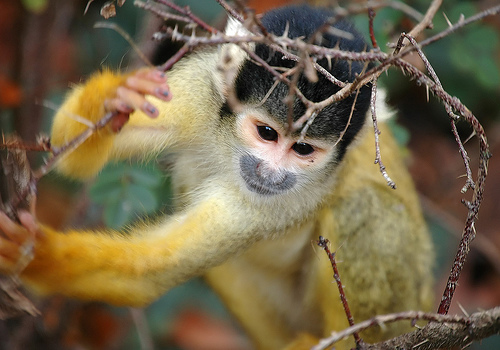
[Photo by mape_s.]

I’m afraid that Math Club may have fallen victim to the economy, which is worse in our town than in the nation in general. Homeschooling families have tight budgets even in the best of times, and now they seem to be cutting back all non-essentials. I assumed that last semester’s students would return, but I should have asked for an RSVP.

Still, Kitten and I had a fun time together. We played four rounds of Tens Concentration, since I had spread out cards on the tables in the library meeting room before we realized that no one was coming. Had to pick up the cards one way or another, so we figured we might as well enjoy them! She won the first two rounds, which put her in a good mood for our lesson.

I had written “Prime numbers are like monkeys!” on the whiteboard, and Kitten asked me what that meant. That was all the encouragement I needed to launch into my planned lesson, despite the frustrating dearth of students. The idea is taken from Danica McKellar’s book Math Doesn’t Suck.

Continue reading Prime Numbers Are like Monkeys

2010 Mathematics Game


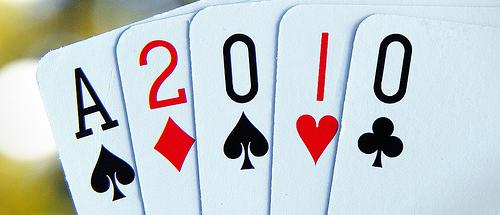
[Photo by pfala.]

Did you know that playing games is one of the Top 10 Ways To Improve Your Brain Fitness? So slip into your workout clothes and pump up those mental muscles with the 2010 Mathematics Game!

Here are the rules:

Use the digits in the year 2010 to write mathematical expressions for the counting numbers 1 through 100.

  • All four digits must be used in each expression. You may not use any other numbers except 2, 0, 1, and 0.
  • You may use the arithmetic operations +, -, x, ÷, sqrt (square root), ^ (raise to a power), and ! (factorial). You may also use parentheses, brackets, or other grouping symbols.
  • You may use a decimal point to create numbers such as .1, .02, etc.
  • Multi-digit numbers such as 20 or 102 may be used, but preference is given to solutions that avoid them.

Bonus Rule
You may use the overhead-bar (vinculum), dots, or brackets to mark a repeating decimal.

[Note to teachers: This rule is not part of the Math Forum guidelines. It makes a significant difference in the number of possible solutions, however, and it should not be too difficult for high school students or advanced middle schoolers.]

Continue reading 2010 Mathematics Game

Narnia Math: Elementary Problem Solving 4th Grade

[Photo by armigeress.]

In 4th grade, math problems take a large step up on the difficulty scale. Students are more mature and can read and follow more complex stories. Multi-step word problems become the new norm, and proportional relationships (like “three times as many”) show up frequently. As the year progresses, fractions grow to be a dominant theme.

As a math teacher, one of my top goals is that my students learn to solve word problems. Arithmetic is (relatively) easy, but many children struggle in applying it to “real world” situations.

In previous posts, I introduced the problem-solving tools of word algebra and bar diagrams, either of which can help students organize the information in a word problem and translate it into a mathematical calculation. The earlier posts in this series are:

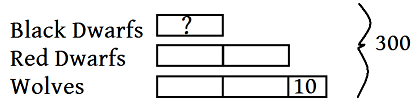
In this installment, I will continue to demonstrate the problem-solving tool of bar diagrams through a series of ten 4th grade problems based on the Singapore Primary Math series, level 4A. For your reading pleasure, I have translated the problems into the universe of a family-favorite story by C. S. Lewis, The Lion, the Witch and the Wardrobe.

UPDATE: Problems have been genericized to avoid copyright issues.

Continue reading Narnia Math: Elementary Problem Solving 4th Grade

Math Teachers at Play #20

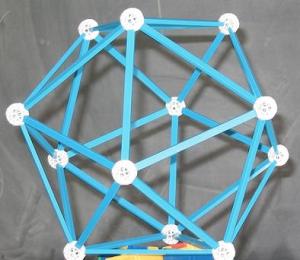
blue icosahedron, by shonk[Photo by shonk.]

Welcome to the Math Teachers At Play blog carnival — which is not just for math teachers! If you like to learn new things and play around with ideas, you are sure to find something of interest.

Let’s start the mathematical fun with a couple of puzzles in honor of our 20th edition: First, the shape to our right is an icosahedron, one of the Platonic solids. Each face is an equilateral triangle — can you count them? For more fun, make your own model.

Continue reading Math Teachers at Play #20

Elementary Problem Solving: Review

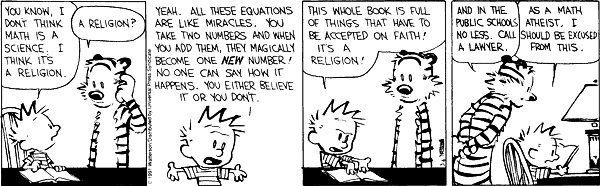
[Bill Watterson identifies the trouble with math problems, through the eyes of Calvin and Hobbes.]

It’s time to revive and (hopefully!) finish my long-neglected series on solving word problems in elementary mathematics. I’ve been having fun making up the problems, so now I just have to write the posts. Coming up soon:

Since it has been more than two years since the last entry, however, I wanted to take a few minutes to recap our progress so far and to refer new readers back to the original posts:

Continue reading Elementary Problem Solving: Review

Do Your Students Understand Division?

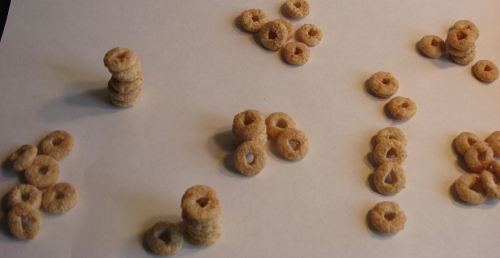
Cheerios by sixes
[I couldn’t find a good picture illustrating “division.” Niner came to my rescue and took this photo of her breakfast.]

I found an interesting question at Mathematics Education Research Blog. In the spirit of Liping Ma’s Knowing and Teaching Elementary Mathematics, Finnish researchers gave this problem to high school students and pre-service teachers:

We know that:
498 \div 6 = 83
How could you use this relationship (without using long-division) to discover the answer to:
491\div6=?
[No calculators allowed!]

The Finnish researchers concluded that “division seems not to be fully understood.” No surprise there!

Check out the pdf report for detailed analysis.

Continue reading Do Your Students Understand Division?

Mental Math: Addition

[Photo by woodleywonderworks.]

The question came from a homeschool forum, though I’ve reworded it to avoid plagiarism:

My student is just starting first grade, but I’ve been looking ahead and wondering: How will we do big addition problems without using pencil and paper? I think it must have something to do with number bonds. For instance, how would you solve a problem like 27 + 35 mentally?

The purpose of number bonds is that students will be comfortable taking numbers apart and putting them back together in their heads. As they learn to work with numbers this way, students grow in understanding — some call it “number sense” — and develop a confidence about math that I often find lacking in children who simply follow the steps of an algorithm.

[“Algorithm” means a set of instructions for doing something, like a recipe. In this case, it means the standard, pencil and paper method for adding numbers: Write one number above the other, then start by adding the ones column and work towards the higher place values, carrying or “renaming” as needed.]

For the calculation you mention, I can think of three ways to take the numbers apart and put them back together. You can choose whichever method you like, or perhaps you might come up with another one yourself…

Continue reading Mental Math: Addition

Math Teachers at Play #8

party-child-by-jaaron

[Photo by jaaron.]

Welcome to the Math Teachers At Play blog carnival — which is not just for math teachers! We accept entries from anyone who enjoys playing around with math, as long as the topic is relevant to students or teachers of preK-12th grade mathematics.

Some articles were submitted by their authors, other were drawn from the back-log in my blog reader, and I’ve spiced it all up with a few math jokes courtesy of the Mathematical humor collection of Andrej and Elena Cherkaev.

Let the mathematical fun begin…

Continue reading Math Teachers at Play #8

Math Facts: 5 Minutes a Day

free-rice-image

Y of x reminded me about one of my old favorite websites for math fact practice with a purpose:

5-10 minutes of daily practice will cement the math facts in your student’s mind, while at the same time doing a good deed. For each correct answer, a Free Rice sponsor donates a very small amount of rice to feed hungry people worldwide through the UN World Food Program.

Even very small amounts of rice add up. Since Free Rice started in 2007, its sponsors have bought more than 63 billion grains of rice, just by paying for one right answer click at a time.

You and your students can practice other topics as well:

Continue reading Math Facts: 5 Minutes a Day