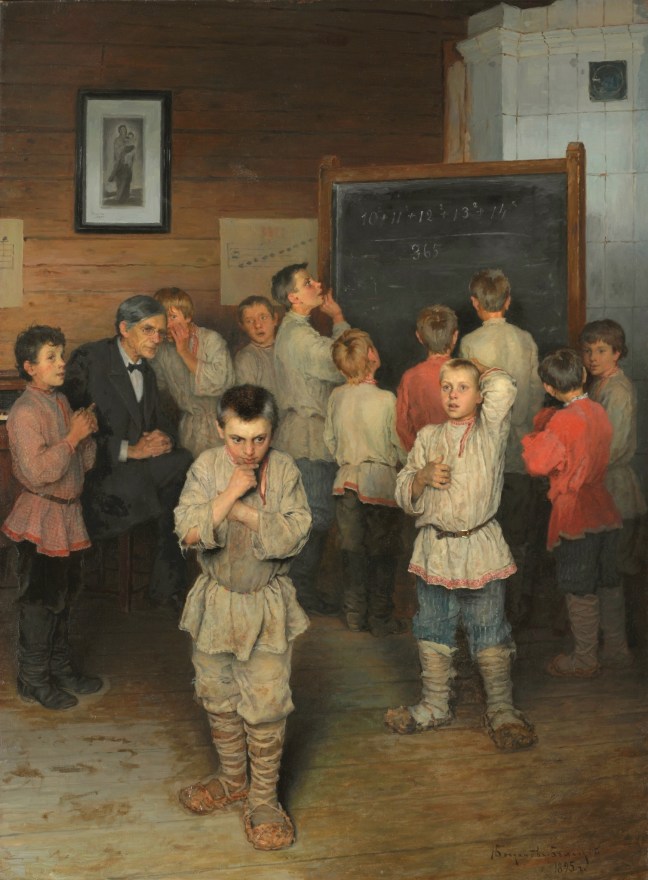
This lovely puzzle (for upper-elementary and beyond) is from Nikolay Bogdanov-Belsky’s 1895 painting “Mental Calculation. In Public School of S. A. Rachinsky.” Pat Ballew posted it on his blog On This Day in Math, in honor of the 365th day of the year.
I love the expressions on the boys’ faces. So many different ways to manifest hard thinking!
Here’s the question:
No calculator allowed. But you can talk it over with a friend, as the boys on the right are doing.
You can even use scratch paper, if you like.
Thinking About Square Numbers
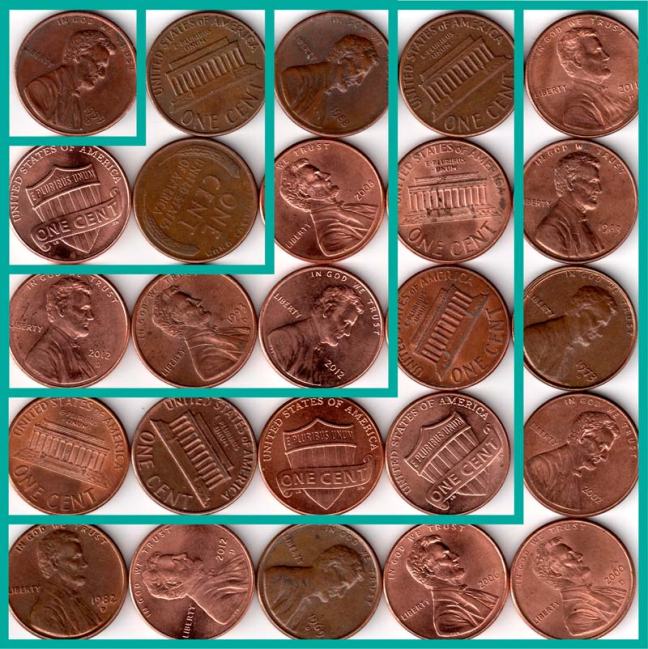
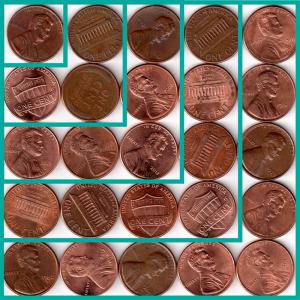
And if you’d like a hint, you can figure out square numbers using this trick. Think of a square number made from rows of pennies.
Can you see how to make the next-bigger square?
Any square number, plus one more row and one more column, plus a penny for the corner, makes the next-bigger square.
So if you know that ten squared is one hundred, then:
… and so onward to your answer. If the Russian schoolboys could figure it out, then you can, too!
Update
Simon Gregg (@Simon_Gregg) added this wonderful related puzzle for the new year:
My youngest daughter wanted to do Singapore math. Miquon Red was her main math text at the time, but we added a bit of Singapore Primary Math 1B whenever she was in the mood.
We turned to the lesson on subtracting with numbers in the 30-somethings.
Do you enjoy math? I hope so! If not, browsing this post just may change your mind.
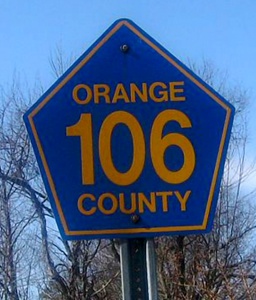
Welcome to the 106th edition of the Math Teachers At Play math education blog carnival — a smorgasbord of links to bloggers all around the internet who have great ideas for learning, teaching, and playing around with math from preschool to pre-college. Let the mathematical fun begin!
By tradition, we start the carnival with a puzzle in honor of our 106th edition. But if you would like to jump straight to our featured blog posts, click here to see the Table of Contents.
Try This Puzzle
If you slice a pizza with a lightsaber, you’ll make straight cuts all the way across. Slice it once, and you get two pieces.
If you slice it five times, you’ll get a maximum of sixteen pieces. (And if you’re lucky you might get a star!)
How many times would you have to slice the pizza to get 106 pieces?
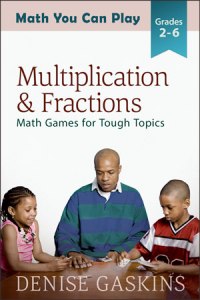
It’s here! My long-awaited upper-elementary Math You Can Play games book has finally hit the online bookstores.
Multiplication & Fractions features 25 kid-tested games, offering a variety of challenges for school-age students. Children master several math models that provide a sturdy foundation for understanding multiplication and fractions. The games feature times table facts and more advanced concepts such as division, fractions, decimals, and multistep mental math.
Maybe you never really understood what multiplication means or what fractions are? As long as you start with an open mind and are willing to engage playfully, the activities in the book can help you as you help your kids.
Anecdotally, these two areas are the first major stumbling point for students in their math studies. The sequencing in the book will help kids develop a strong foundation.
Kids (and parents!) find these games fun. I’ve been field testing math games for the last 18 months and keep seeing how engaged kids get when playing math games.
Mathematical Models: Learn the basic pictures that help support your child’s comprehension.
Conquer the Times Tables: Enjoy practicing the math facts until correct answers become automatic.
Mixed Operations: Give mental muscles a workout with games that require number skills and logical thinking.
Fractions and Decimals: Master equivalent fractions, work with decimal place value, and multiply fractions and decimal numbers.
If you are a parent, these games provide opportunities to enjoy quality time with your children. If you are a classroom teacher, use the games as warm-ups and learning center activities or for a relaxing review day at the end of a term. If you are a tutor or homeschooler, make games a regular feature in your lesson plans to build your students’ mental math skills.
So what are you waiting for? Clear off a table, grab a deck of cards, and let’s play some math!
It starts with models that are visual explanations of the concepts. Gaskins also breaks learning these concepts into comfortable steps that emphasize patterns and relationships, the real ideas that are behind properly understanding multiplication and fractions (indeed, math generally).
The sequence of games in each section starts by building familiarity and then fluency (speed) to solidify all of that work.
Most of the Math You Can Play games use materials you already have around the house, such as playing cards or dice. But this book introduces multiplication and fractions with several games using two special mathematical model card decks.
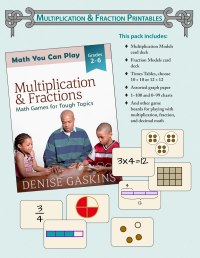
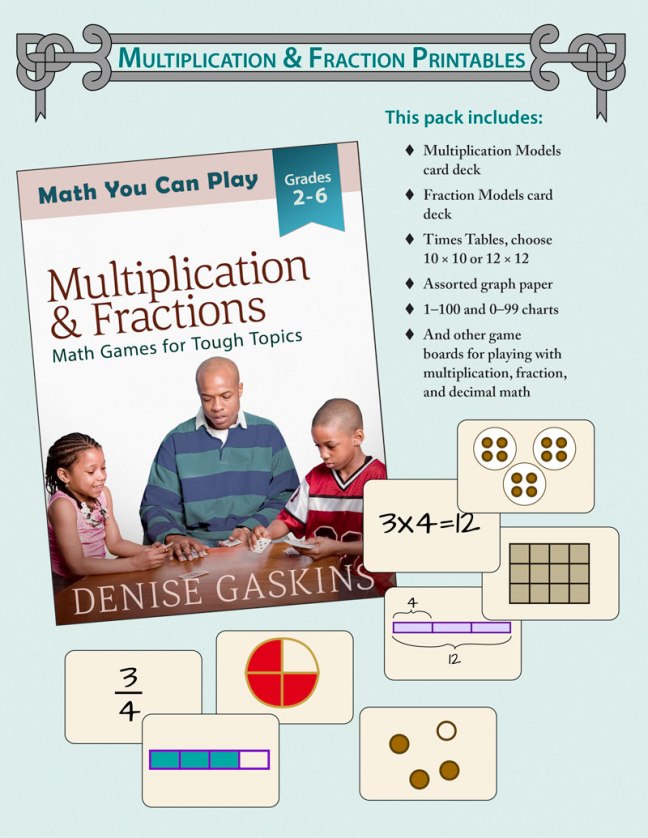
Click here to download the Multiplication & Fraction Printables, featuring all the math model cards, hundred charts, and game boards you will need for any game in the book.
One step closer to getting my long-awaited Multiplication & Fraction Games book out — I finished the printables file! At least, I hope I’ve finished. Sometimes it seems like whack-a-typo never ends…
Multiplication & Fraction Printables
Click here to download the Multiplication & Fraction Printables, featuring mathematical model cards, hundred charts, and game boards to accompany the upcoming Math You Can Play: Multiplication & Fractions book.
The Multiplication & Fractions ebook will come out sometime in November, and the paperback should follow in time for Christmas. If you’re interested, my newsletter subscribers will get a special introductory sale price whenever the book is published. Join now!
You may also want to check out:
Number Game Printables Pack
Click here to download the Number Game Printables Pack, featuring hundred charts, graph paper, and game boards from the first two Math You Can Play books.
You have permission to copy and use these game boards and worksheets in your own local classroom, home school, math circle, co-op class, etc. But you may not post them on your own website (though you can link to this post, if you like) or sell them. If you’re not sure how copyright works on the Internet, check out Daniel Scocco’s Copyright Law: 12 Dos and Don’ts.
“Worksheet problems make my daughter’s brain freeze. Even simple things such as “2 + ___ = 2″ confuse her. What can I do?”
Can your daughter do math if you put away the worksheet and ask her a real-life problem: “I have a lunch sack. I put two cookies into the sack, and then I give it to you. When you look into the sack, you see two cookies there. Can you tell me what was in the sack at the beginning, before I put my cookies in?”
Or can she solve problems when the answer isn’t zero? Could she figure out how many you started with if she saw four cookies when she looked in the sack?
The idea of having a number for “nothing” can seem strange to young children.
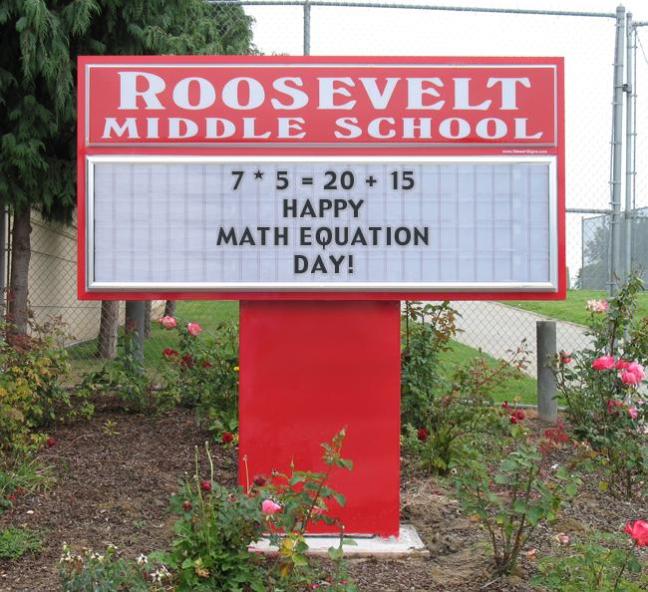
Have you made a New Year’s resolution to spend more time with your family this year, and to get more exercise? Problem-solvers of all ages can pump up their (mental) muscles with the Annual Mathematics Year Game Extravaganza. Please join us!
For many years mathematicians, scientists, engineers and others interested in math have played “year games” via e-mail. We don’t always know whether it’s possible to write all the numbers from 1 to 100 using only the digits in the current year, but it’s fun to see how many you can find.
Use the digits in the year 2016 to write mathematical expressions for the counting numbers 1 through 100. The goal is adjustable: Young children can start with looking for 1-10, middle grades with 1-25.
You must use all four digits. You may not use any other numbers.
Solutions that keep the year digits in 2-0-1-6 order are preferred, but not required.
You may use a decimal point to create numbers such as .2, .02, etc., but you cannot write 0.02 because we only have one zero in this year’s number.
You may create multi-digit numbers such as 10 or 201 or .01, but we prefer solutions that avoid them.
My Special Variations on the Rules
You MAY use the overhead-bar (vinculum), dots, or brackets to mark a repeating decimal. But students and teachers beware: you can’t submit answers with repeating decimals to Math Forum.
You MAY use a double factorial, n!! = the product of all integers from 1 to n that have the same parity (odd or even) as n. I’m including these because Math Forum allows them, but I personally try to avoid the beasts. I feel much more creative when I can wrangle a solution without invoking them.
You know you’re a math teacher when you see a penny in the parking lot, and your first thought is, “Cool! A free math manipulative.”
My homeschool co-op math students love doing math with pennies. They’re rather heavy to carry to class, but worth it for the student buy-in.
This month, I’m finishing up the nearly 150 new illustrations for the upcoming paperback edition of my Let’s Play Math book. I’m no artist, and it’s been a long slog. But a couple of the graphics involved pennies—so when I saw that penny on the ground, it made me think of my book.
And thinking of my book made me think it would be fun to share a sneak peek at coming attractions…
The Penny Square: An Example of Real Mathematics
Real mathematics is intriguing and full of wonder, an exploration of patterns and mysterious connections. It rewards us with the joy of the “Aha!” feeling. Workbook math, on the other hand, is several pages of long division by hand followed by a rousing chorus of the fraction song: “Ours is not to reason why, just invert and multiply.”
Real math is the surprising fact that the odd numbers add up to perfect squares (1, 1 + 3, 1 + 3 + 5, etc.) and the satisfaction of seeing why it must be so.
Did your algebra teacher ever explain to you that a square number is literally a number that can be arranged to make a square? Try it for yourself:
Gather a bunch of pennies—or any small items that will not roll away when you set them out in rows—and place one of them in front of you on the table. Imagine drawing a frame around it: one penny makes a (very small) square. One row, with one item in each row.
Now, put out three more pennies. How will you add them to the first one in order to form a new, bigger square? Arrange them in a small L-shape around the original penny to make two rows with two pennies in each row.
Set out five additional pennies. Without moving the current four pennies, how can you place these five to form the next square? Three rows of three.
Then how many will you have to add to make four rows of four?
Twenty-five is a square number, because we can arrange twenty-five items to make a square: five rows with five items in each row.
Each new set of pennies must add an extra row and column to the current square, plus a corner penny where the new row and column meet. The row and column match exactly, making an even number, and then the extra penny at the corner makes it odd.
Can you see that the “next odd number” pattern will continue as long as there are pennies to add, and that it could keep going forever in your imagination?
The point of the penny square is not to memorize the square numbers or to get any particular “right answer,” but to see numbers in a new way—to understand that numbers are related to each other and that we can show such relationships with diagrams or physical models. The more relationships like this our children explore, the more they see numbers as familiar friends.
The Penny Birthday Challenge: Exponential Growth
A large jar of assorted coins makes a wonderful math toy. Children love to play with, count, and sort coins.
Add a dollar bill to the jar, so you can play the Dollar Game: Take turns throwing a pair of dice, gathering that many pennies and trading up to bigger coins. Five pennies trade for a nickel, two nickels for a dime, etc. Whoever is the first to claim the dollar wins the game.
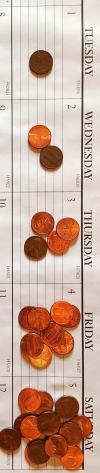
Or take the Penny Birthday Challenge to learn about exponential growth: Print out a calendar for your child’s birthday month. Put one penny on the first day of the month, two pennies on the second day, four pennies on the third day, etc. If you continued doubling the pennies each day until you reach your child’s birthday, how much money would you need?
Warning: Beware the Penny Birthday Challenge! Those pennies will add up to dollars much faster than most people expect. Do not promise to give the money to your child unless the birthday comes near the beginning of the month.
A Penny Holiday Challenge
The first time I did pennies on a calendar with my homeschool co-op class was during December, so we called it the Penny Christmas Challenge:
How many pennies would you need to cover all the days up to the 25th?
I told the kids that if their grandparents asked what gift they wanted for Christmas, they could say, “Not much. Just a few pennies…”
The Penny Square, Dollar Game, and Penny Birthday Challenge are just three of the myriad math tips and activity ideas in the paperback edition of Let’s Play Math: How Families Can Learn Math Together and Enjoy It. Coming in early 2016 to your favorite online bookstore…
Math Concepts: basic facts of addition, multiplication. Players: one. Equipment: one deck of math cards (poker- or bridge-style playing cards with the face cards and jokers removed).
The best way to practice the math facts is through the give-and-take of conversation, orally quizzing each other and talking about how you might figure the answers out. But occasionally your child may want a simple, solitaire method for review.





 Do you enjoy math? I hope so! If not, browsing this post just may change your mind.
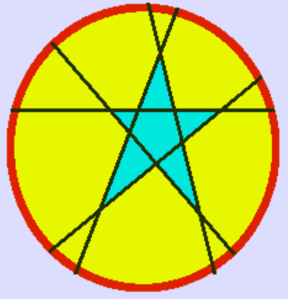 If you slice a pizza with a lightsaber, you’ll make straight cuts all the way across. Slice it once, and you get two pieces.



 Denise Gaskins' Let's Play Math
