Elementary Problem Solving: Review

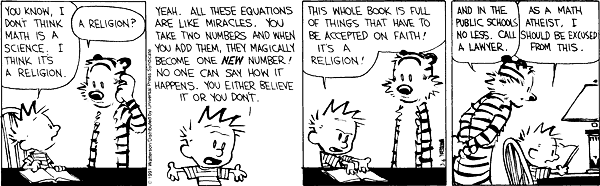
[Bill Watterson identifies the trouble with math problems, through the eyes of Calvin and Hobbes.]

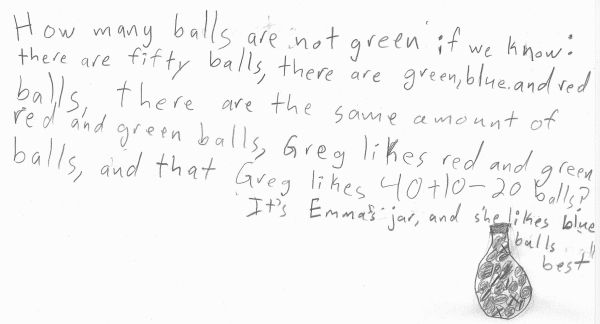
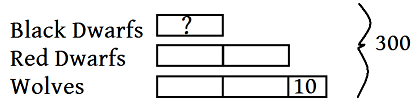
It’s time to revive and (hopefully!) finish my long-neglected series on solving word problems in elementary mathematics. I’ve been having fun making up the problems, so now I just have to write the posts. Coming up soon:

Since it has been more than two years since the last entry, however, I wanted to take a few minutes to recap our progress so far and to refer new readers back to the original posts:

Continue reading Elementary Problem Solving: Review

Mental Math: Addition

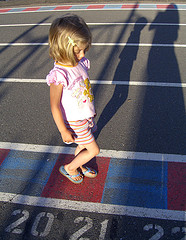
[Photo by woodleywonderworks.]

The question came from a homeschool forum, though I’ve reworded it to avoid plagiarism:

My student is just starting first grade, but I’ve been looking ahead and wondering: How will we do big addition problems without using pencil and paper? I think it must have something to do with number bonds. For instance, how would you solve a problem like 27 + 35 mentally?

The purpose of number bonds is that students will be comfortable taking numbers apart and putting them back together in their heads. As they learn to work with numbers this way, students grow in understanding — some call it “number sense” — and develop a confidence about math that I often find lacking in children who simply follow the steps of an algorithm.

[“Algorithm” means a set of instructions for doing something, like a recipe. In this case, it means the standard, pencil and paper method for adding numbers: Write one number above the other, then start by adding the ones column and work towards the higher place values, carrying or “renaming” as needed.]

For the calculation you mention, I can think of three ways to take the numbers apart and put them back together. You can choose whichever method you like, or perhaps you might come up with another one yourself…

Continue reading Mental Math: Addition

Buddy-Style Math: Doing Homework Without Tears

My daughter Kitten strongly dislikes math when forced to do it on her own, so I am trying to get back into the habit of doing “Buddy-Style Math” with her. We take turns working the problems in her workbook: mine, hers, mine, hers, and so on down the page. We work each problem out loud, explaining how we got the answer and checking each other as we go.

In a way, it is like Charlotte Mason-style narration applied to math, since my daughter has to process her thoughts in order to explain how she worked the problem, which fixes the math concepts more deeply in her mind.

Continue reading Buddy-Style Math: Doing Homework Without Tears

Cute Math Facts for Visual Thinkers

numberwalk[Photo by angela7dreams.]

A forum friend posted about her daughter’s adventure in learning the math facts:

“She loves stories and drawing, so I came up with the Math Friends book. She made a little book, and we talked about different numbers that are buddies.”

Continue reading Cute Math Facts for Visual Thinkers

30+ Things to Do with a Hundred Chart

[Photo by geishaboy500 via Flickr (CC BY 2.0).]

Are you looking for creative ways to help your children study math? Even without a workbook or teacher’s manual, your kids can learn a lot about numbers. Just spend an afternoon playing around with a hundred chart (also called a hundred board or hundred grid).

My free 50-page PDF Hundred Charts Galore! printables file features 1–100 charts, 0–99 charts, bottom’s-up versions, multiple-chart pages, blank charts, game boards, and more. Everything you need to play the activities below and those in my new 70+ Things to Do with a Hundred Chart book.
Download Free “Hundred Charts Galore!” Printables

Shop for “70+ Things To Do with a Hundred Chart” Book

And now, let’s play…

Continue reading 30+ Things to Do with a Hundred Chart

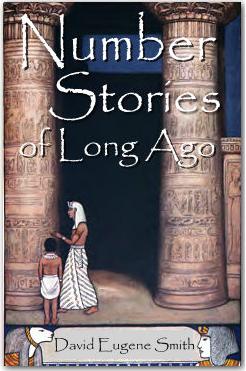
Free Math History: Number Stories of Long Ago

If you teach elementary children, check out this read-aloud math history resource from Homeschool Freebie of the Day:

Number Stories of Long Ago
by David Eugene Smith

[This download is available for one day only. If you missed it, see the end of this post for other ways to get the book.]

From the Preface

“These are the stories that were really told in the crisp autumn evenings, the Story Teller sitting by the fire that burned in the great fireplace in the cottage by the sea. These are the stories as he told them to the Tease and the rest of the circle of friends known as the Crowd. Sitting by the fire and listening to the stories, in the lights and shadows of the dancing flames they could see the forms of Ching and Lugal and all the rest with their curious dress of long ago…”

Continue reading Free Math History: Number Stories of Long Ago

What’s Wrong with “Repeated Addition”?

[Photo by Alejandra Mavroski.]

Myrtle called it The article that launched a thousand posts…, and counting comments on this and several other blogs, that may not be too much of an exaggeration. Yet the discussion feels incomplete — I have not been able to put into words all that I want to say. Thus, at the risk of once again revealing my mathematical ignorance, I am going to try another response to Keith Devlin’s multiplication articles.

Let me state up front that I speak as a teacher, not as a mathematician. I am not qualified, nor do I intend, to argue about the implications of Peano’s Axioms. My experience lies primarily in teaching K-10, from elementary arithmetic through basic algebra and geometry. I remember only snippets of my college math classes, back in the days when we worried more about nuclear winter than global warming.

I will start with a few things we can all agree on…

Continue reading What’s Wrong with “Repeated Addition”?