Memorizing the Math Facts

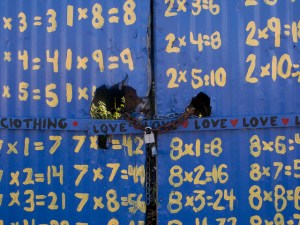
Central City Times Tables[Photo by dsb nola via flickr. (CC BY 2.0)]

The most effective and powerful way I’ve found to commit math facts to memory is to try to understand why they’re true in as many ways as possible. It’s a very slow process, but the fact becomes permanently lodged, and I usually learn a lot of surrounding information as well that helps me use it more effectively.

Actually, a close friend of mine describes this same experience: he couldn’t learn his times tables in elementary school and used to think he was dumb. Meanwhile, he was forced to rely on actually thinking about number relationships and properties of operations in order to do his schoolwork. (E.g. I can’t remember 9×5, but I know 8×5 is half of 8×10, which is 80, so 8×5 must be 40, and 9×5 is one more 5, so 45. This is how he got through school.) Later, he figured out that all this hard work had actually given him a leg up because he understood numbers better than other folks. He majored in math in college and is now a cancer researcher who deals with a lot of statistics.

Ben Blum-Smith
Comment on Math Mama’s post What must be memorized?

The entire discussion (article and comments) is well worth reading:

You may also enjoy:

March 2016 Math Calendars

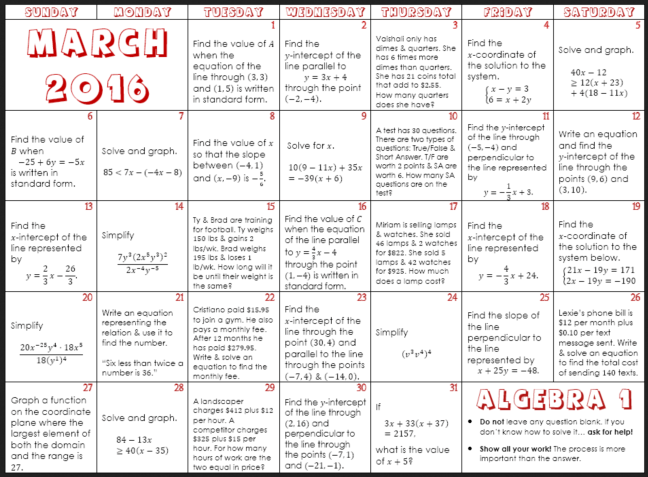
Once again, a few of my favorite bloggers have come through with math calendars for our students to puzzle over. Check them out:

algebra calendar

Things to Do with a Math Calendar

At home:
Post the calendar on your refrigerator. Use each math puzzle as a daily review “mini-quiz” for your children (or yourself).

In the classroom:
Post today’s calculation on the board as a warm-up puzzle. Encourage your students to make up “Today is…” puzzles of their own.

As a puzzle:
Cut the calendar squares apart and trim off the dates. Then challenge your students to arrange them in ascending (or descending) order.

Make up problems to fill a new calendar for next month.
And if you do, please share!

Active Math Game: Rock

Gordon Hamilton of Math Pickle posted Rock – Low unique number game for grades K–2. If you have a set of active kids and a few minutes to spare, give it a try!

How to Play Rock

  • Everyone makes a rock shape with eyes closed.
  • Everyone chooses a number: 0, 1, 2, 3, 4, 5, 6, 7, 8 …
  • Teacher calls out numbers consecutively, starting at 0.
  • When a student hears their number being called they immediately raise a hand. When the teacher tags the hand, they stand up.
  • If more than one hand was raised, those students lose. They become your helpers, tagging raised hands.
  • If only one hand was raised, that child wins the round.

Rock-game

“Each game takes about 45 seconds,” Hamilton says. “This is part of the key to its success. Children who have not learned the art of losing are quickly thrown into another game before they have a chance to get sad.”

The experience of mathematics should be profound and beautiful. Too much of the regular K-12 mathematics experience is trite and true. Children deserve tough, beautiful puzzles.

Gordon Hamilton

What Happens When Grownups Play Rock

What are the best numbers to pick? Patrick Vennebush hosted on online version of the game at his Math Jokes 4 Mathy Folks blog a few years back, though we didn’t have to bend over into rocks‌—‌which is a good thing for some of us older folks.

Vennebush also posted a finger-game version suitable for small groups of all ages, called Low-Sham-Bo:

  • On the count of 1-2-3, each person “throws” out a hand showing any number of fingers from zero to five.
  • The winner is the person who throws the smallest unique number.

You may want to count “Ready, set, go!” for throwing out fingers, so the numbers in the count don’t influence the play.

The official name for this sort of game is Lowest Unique Bid Auction.

 
* * *

This blog is reader-supported.

If you’d like to help fund the blog on an on-going basis, then please join me on Patreon for mathy inspiration, tips, and an ever-growing archive of printable activities.

If you liked this post, and want to show your one-time appreciation, the place to do that is PayPal: paypal.me/DeniseGaskinsMath. If you go that route, please include your email address in the notes section, so I can say thank you.

Which I am going to say right now. Thank you!

“Active Math Game: Rock” copyright © 2015 by Denise Gaskins. .

New Hundred Chart Game: Odd-Even-Prime Race

Counting all the fractional variations, my massive blog post 30+ Things to Do with a Hundred Chart now offers nearly forty ideas for playing around with numbers from preschool to prealgebra.

Here is the newest entry, a variation on #10, the “Race to 100” game:

(11.5) Play “Odd-‌Even-‌Prime Race.″ Roll two dice. If your token is starting on an odd number, move that many spaces forward. From an even number (except 2), move backward — but never lower than the first square. If you are starting on a prime number (including 2), you may choose to either add or multiply the dice and move that many spaces forward. The first person to reach or pass 100 wins the game.
[Hat tip: Ali Adams in a comment on another post.]

And here’s a question for your students:

  • If you’re sitting on a prime number, wouldn’t you always want to multiply the dice to move farther up the board? Doesn’t multiplying always make the number bigger?

 
* * *

This blog is reader-supported.

If you’d like to help fund the blog on an on-going basis, then please join me on Patreon for mathy inspiration, tips, and an ever-growing archive of printable activities.

If you liked this post, and want to show your one-time appreciation, the place to do that is PayPal: paypal.me/DeniseGaskinsMath. If you go that route, please include your email address in the notes section, so I can say thank you.

Which I am going to say right now. Thank you!

“New Hundred Chart Game: Odd-Even-Prime Race” copyright © 2015 by Denise Gaskins. Image at the top of the post copyright © geishaboy500 (CC BY 2.0).

Infinite Cake: Don Cohen’s Infinite Series for Kids

Math Concepts: division as equal sharing, naming fractions, adding fractions, infinitesimals, iteration, limits
Prerequisite: able to identify fractions as part of a whole

This is how I tell the story:

  • We have a cake to share, just the two of us. It’s not TOO big a cake, ‘cuz we don’t want to get sick. An 8 × 8 or 16 × 16 square on the graph paper should be just right. Can you cut the cake so we each get a fair share? Color in your part.

Bobby Flay German Chocolate Cake

  • How big is your piece compared to the whole, original cake?
  • But you know, I’m on a diet, and I just don’t think I can eat my whole piece. Half the cake is too much for me. Is it okay if I share my piece with you? How can we divide it evenly, so we each get a fair share? How big is your new piece? Color it in.
  • How much of the whole, original cake do you have now? How can you tell?
  • I keep thinking of my diet, and I really don’t want all my piece of cake. It looks good, but it’s still just a bit too big for me. Will you take half of it? How big is that piece?
  • Now how much of the whole, original cake do you have? How could we figure it out?
    [Teaching tip: Don’t make kids do the calculation on paper. In the early stages, they can visualize and count up the fourths or maybe the eighths. As the pieces get smaller, the easiest way to find the sum is what Cohen does in the video below‌—‌identify how much of the cake is left out.]
  • Even for being on a diet, I still don’t feel very hungry…

Continue reading Infinite Cake: Don Cohen’s Infinite Series for Kids

Socks Are Like Pants, Cats Are Like Dogs

Support This New Book from Natural Math

Socks Are Like Pants, Cats Are Like Dogs by Malke Rosenfeld and Gordon Hamilton is filled with a diverse collection of math games, puzzles, and activities exploring the mathematics of choosing, identifying and sorting. The activities are easy to start and require little preparation.

The publisher’s crowdfunding goal is $4,000. The book is almost ready to go to press, and I can hardly wait to see it!

Review Game: Once Through the Deck

Math Concepts: basic facts of addition, multiplication.
Players: one.
Equipment: one deck of math cards (poker- or bridge-style playing cards with the face cards and jokers removed).

The best way to practice the math facts is through the give-and-take of conversation, orally quizzing each other and talking about how you might figure the answers out. But occasionally your child may want a simple, solitaire method for review.

Continue reading Review Game: Once Through the Deck

Math Game: Chopsticks

Math Concepts: counting up to five, thinking ahead.
Players: two or more.
Equipment: none.

How to Play

Each player starts with both hands as fists, palm down, pointer fingers extended to show one point for each hand. On your turn, use one of your fingers to tap one hand:

  • If you tap an opponent’s hand, that person must extend as many extra fingers on that hand (in addition to the points already there) as you have showing on the hand that tapped. Your own fingers don’t change.
  • If you force your opponent to extend all the fingers and thumb on one hand, that makes a “dead hand” that must be put behind the player’s back, out of the game.
  • If you tap your own hand, you can “split” fingers from one hand to the other. For instance, if you have three points on one hand and only one on the other, you may tap hands to rearrange them, putting out two fingers on each hand. Splits do not have to end up even, but each hand must end up with at least one point (and less than five, of course).
  • You may even revive a dead hand if you have enough fingers on your other hand to split. A dead hand has lost all its points, so it starts at zero. When you tap it, you can share out the points from your other hand as you wish.

The last player with a live hand wins the game.

When a two-points hand taps a one-point hand, that player must put out two more fingers.

Continue reading Math Game: Chopsticks

The Math Student’s Manifesto

[Feature photo above by Texas A&M University (CC BY 2.0) via Flickr.]

Note to Readers: Please help me improve this list! Add your suggestions or additions in the comment section below…

What does it mean to think like a mathematician? From the very beginning of my education, I can do these things to some degree. And I am always learning to do them better.

(1) I can make sense of problems, and I never give up.

  • I always think about what a math problem means. I consider how the numbers are related, and I imagine what the answer might look like.
  • I remember similar problems I’ve done before. Or I make up similar problems with smaller numbers or simpler shapes, to see how they work.
  • I often use a drawing or sketch to help me think about a problem. Sometimes I even build a physical model of the situation.
  • I like to compare my approach to the problem with other people and hear how they did it differently.

Continue reading The Math Student’s Manifesto

Teaching the Standard Algorithms

[Feature photo above by Samuel Mann, Analytical Engine photo below by Roͬͬ͠͠͡͠͠͠͠͠͠͠͠sͬͬ͠͠͠͠͠͠͠͠͠aͬͬ͠͠͠͠͠͠͠ Menkman, both (CC BY 2.0) via Flickr.]

Babbage's Analytical Engine

An algorithm is a set of steps to follow that produce a certain result. Follow the rules carefully, and you will automatically get the correct answer. No thinking required — even a machine can do it.

This photo shows one section of the first true computer, Charles Babbage’s Analytical Engine. Using a clever arrangement of gears, levers, and switches, the machine could crank out the answer to almost any arithmetic problem. Rather, it would have been able to do so, if Babbage had ever finished building the monster.

One of the biggest arguments surrounding the Common Core State Standards in math is when and how to teach the standard algorithms. But this argument is not new. It goes back at least to the late 19th century.

Here is a passage from a book that helped shape my teaching style, way back when I began homeschooling in the 1980s…

Ruth Beechick on Teaching Abstract Notation

“Understanding this item is the key to choosing your strategy for the early years of arithmetic teaching. The question is: Should you teach abstract notation as early as the child can learn it, or should you use the time, instead, to teach in greater depth in the mental image mode?

Beechick-EasyStartArithmetic

“Abstract notation includes writing out a column of numbers to add, and writing one number under another before subtracting it. The digits and signs used are symbols. The position of the numbers is an arbitrary decision of society. They are conventions that adult, abstract thinkers use as a kind of shorthand to speed up our thinking.

“When we teach these to children, we must realize that we simply are introducing them to our abstract tools. We are not suddenly turning children into abstract thinkers. And the danger of starting too early and pushing this kind of work is that we will spend an inordinate amount of time with it. We will be teaching the importance of making straight columns, writing numbers in certain places, and other trivial matters. By calling them trivial, we don’t mean that they are unnecessary. But they are small matters compared to real arithmetic thinking.

“If you stay with meaningful mental arithmetic longer, you will find that your child, if she is average, can do problems much more advanced than the level listed for her grade. You will find that she likes arithmetic more. And when she does get to abstractions, she will understand them better. She will not need two or three years of work in primary grades to learn how to write out something like a subtraction problem with two-digit numbers. She can learn that in a few moments of time, if you just wait.”

— Ruth Beechick
An Easy Start in Arithmetic (Grades K-3)
(emphasis mine)