Math Puzzle from the Ancient Kingdom of Cats

It may look like Cimorene has lain down on the job, but don’t be fooled! She’s hard at work, creating a math investigation for your students to explore.

Cats know how important it can be for students to experiment with math and try new things. Playing with ideas is how kittens (and humans!) learn.

Cimorene wants you to know that the Make 100 Math Rebels Kickstarter offers a great way for human children to learn math through play. She encourages you to go watch the video and read all about the project.

Too often, school math can seem stiff and rigid. To children, it can feel like “Do what I say, whether it makes sense or not.” But cats know that kids are like kittens — they can make sense of ideas just fine if we give them time to play around.

So Cimorene says you should download the free sample journaling pages from the Math Rebels Kickstarter page. The beautiful parchment design makes doing math an adventure.


[The free download will always be there, even after the Kickstarter project ends.]
Make 100 Math Rebels Kickstarter

Cimorene’s Puzzle Challenge

Cimorene’s math puzzle is a classic geometry problem from the ancient Kingdom of Cats: Squaring the Circle.

Draw a circle on your journal page. Can you draw a square (or rectangle) that has the same area?

How would you even begin such a task?

Notice Cimorene’s hint in the photo above: Try drawing the square that just touches the edges of your circle. (We call those just-touching lines “tangents” to the circle.)

  • What do you notice? Do the square and the circle have the same area? How close are they?

The tangent square sets an upper limit on the area of the circle. You can see that any square that exactly matches the circle would have to be smaller than the tangent square.

  • Can you find a square that sets a lower limit on the area of the circle? That is, a square that must have less area than the circle?
  • What’s the biggest square you can draw inside your circle? Can you find a square that has all four corners on the circle?

We call that biggest-inside square “inscribed” in the circle. Any polygon whose corners all sit on the circle is an inscribed polygon.

  • Play around with circles and squares. How close can you get to matching their size?

Further Exploration

After you have explored for awhile on your own, Cimorene has one more twist in her puzzle.

In the ancient Kingdom of Cats, the wise ones estimated the area of a circle this way:

Divide the width of the circle in thirds, and then in thirds again. (That is, cut the diameter into nine parts.) Draw a square with sides measured by eight such parts.

You can try this on your journaling page by drawing a circle that is nine squares wide. Then draw a square overlapping it, with sides that are eight squares in length.

  • How closely do the areas match?

Playing with Pi

Here’s a surprise: Cimorene’s puzzle isn’t really about squares, but about calculus.

The problem of Squaring the Circle is really a much bigger question: Finding the area of a square, rectangle, or other polygon is relatively easy, but how can we discover the area of a curved shape?

For a circle, the area is related to the number pi, which is the number of times you would have to walk across the circle to equal the distance of one time walking around it.

graphic by John Reid (cc by-sa 3.0)

graphic by John Reid (cc by-sa 3.0)
So the problem of Squaring the Circle is really the same as asking, “What is the value of pi?”

  • Can you figure out what approximate value for pi matches the 8/9 square used in the ancient Kingdom of Cats?

If you’d like to learn more about pi, get ready for a celebration: Pi Day is coming soon! Every year, millions of children celebrate math on March 14th, because if you write the date as 3/14, it’s the same as the first three digits of pi.

Find out more about playing with pi in my Pi Day Round-Up post.

You may also enjoy:

Share Your Stories

Cimorene would love to hear about your children’s experiences playing with math! Please share your story in the comments below.

 
* * *

This blog is reader-supported.

If you’d like to help fund the blog on an on-going basis, then please head to my Patreon page.

If you liked this post, and want to show your one-time appreciation, the place to do that is PayPal: paypal.me/DeniseGaskinsMath. If you go that route, please include your email address in the notes section, so I can say thank you.

Which I am going to say right now. Thank you!

“Math Puzzle from the Ancient Kingdom of Cats” copyright © 2021by Denise Gaskins. Image at the top of the post copyright © Denise Gaskins.

Playing with a Hundred Chart #36: Cover 100 Squares

Patrick Vennebush shared this puzzle from his new book, One-Hundred Problems Involving the Number 100:

It’s easy to cover a hundred chart with 100 small squares: 10 rows of 10 squares = 100.

It’s easy to cover a hundred chart with one big square: one 10×10 square = 100.

But can you cover the chart with 20 squares? Or with 57 squares? The squares do NOT have to be all the same size.

If we only consider squares with whole-number sides, so they exactly fit on the grid, then:

  • What numbers of squares work to cover the chart?
  • What numbers don’t work — and can you prove it?

Click to read the original puzzle along with some teaching tips at Patrick’s blog:

Covering 100 Squares

If you’d like some printable hundred charts for coloring in squares, download my free Hundred Charts Galore! file.

And discover more ways to play with these printables in my classic blog post: 30+ Things to Do with a Hundred Chart.

Math Game: War with Special Decks

The all-time most-visited page on this site is my post about Math War: The Game That Is Worth 1,000 Worksheets. It’s easy to adapt to almost any math topic, simple to learn, and quick to play. My homeschool co-op students love it.

But Math War isn’t just for elementary kids. Several teachers have shared special card decks to help middle and high school students practice math by playing games.

Take a look at the links below for games from prealgebra to high school trig. And try the Math War Trumps variation at the end of the post to boost your children’s strategic-thinking potential.

Have fun playing math with your kids!

Continue reading Math Game: War with Special Decks

Math That Is Beautiful

One of the sections in my book Let’s Play Math: How Families Can Learn Math Together — and Enjoy It encourages parents to make beautiful math with their children.

Do you have trouble believing that math can be beautiful?

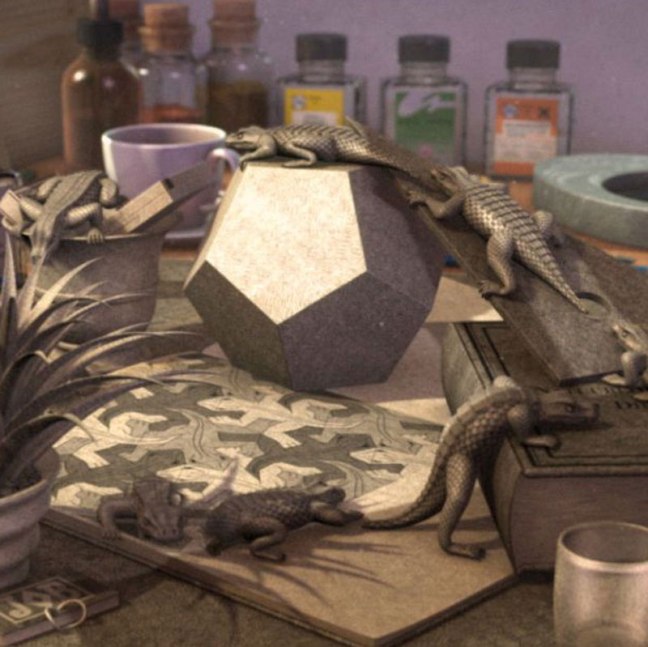
In “Inspirations,” artist Cristóbal Vila creates a wonderful, imaginary work studio for the amazing M.C. Escher. You’ll want to view it in full-screen mode.

How many mathematical objects could you identify?

Vila offers a brief explanation of the history and significance of each item on his page Inspirations: A short movie inspired on Escher’s works.

Read about the inspirations, and then try making some math of your own.

“I looked into that enormous and inexhaustible source of inspiration that is Escher and tried to imagine how it could be his workplace, what things would surround an artist like him, so deeply interested in science in general and mathematics in particular. I imagined that these things could be his travel souvenirs, gifts from friends, sources of inspiration…”

—Cristóbal Vila
Inspirations: A short movie inspired on Escher’s works

Playful Math Education Carnival 106 with Math Art

Do you enjoy math? I hope so! If not, browsing this post just may change your mind.

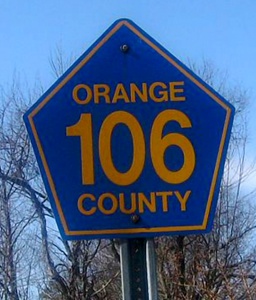
Welcome to the 106th edition of the Math Teachers At Play math education blog carnival — a smorgasbord of links to bloggers all around the internet who have great ideas for learning, teaching, and playing around with math from preschool to pre-college. Let the mathematical fun begin!

By tradition, we start the carnival with a puzzle in honor of our 106th edition. But if you would like to jump straight to our featured blog posts, click here to see the Table of Contents.

Try This Puzzle

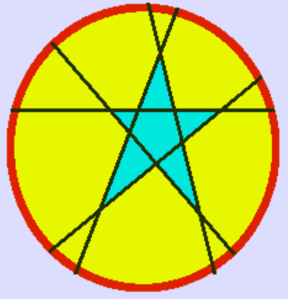
If you slice a pizza with a lightsaber, you’ll make straight cuts all the way across. Slice it once, and you get two pieces.

If you slice it five times, you’ll get a maximum of sixteen pieces. (And if you’re lucky you might get a star!)

  • How many times would you have to slice the pizza to get 106 pieces?

Click here for all the mathy goodness!

Beauty in Math: A Fable

Have you ever wondered what mathematicians mean when they talk about a “beautiful” math proof?

“Beauty in mathematics is seeing the truth without effort.”

George Pólya

“There’s something striking about the economy of the counselor’s construction. He drew a single line, and that totally changed one’s vision of the geometry involved.

“Very often, there’s a simple introduction of something that’s not logically within the framework of the question — and it can be very simple — and it utterly changes your view of what the question really is about.”

Barry Mazur
The Moral of the Scale Fable

CREDITS: Castle photo (top) by Rachel Davis via Unsplash. “A Mathematical Fable” via YouTube. Story told by Barry Mazur. Animation by Pete McPartlan. Video by Brady Haran for Numberphile.

A New Graph-It Puzzle

Since I’ve been posting new Alexandria Jones stories this week (beginning here), I’ve gone back and re-read the old Christmas posts. I noticed that the original Graph-It Game included a religious design, but nothing for those who don’t celebrate Christmas.

So I updated the post with a new, non-religious puzzle. Here it is, if you want to play…

Graph-It Game Design

For this design, you will need graph paper with coordinates from −8 to +8 on both the x- and y-axis. Connect the points in each line. Stop at the periods, and then start a new line at the next point.

(-8,8) – (-8,0) – (0,8) – (-8,8) – (-4,4) – (0,4) – (0,8) – (8,8) – (4,4) – (0,8).

(8,8) – (8,0) – (4,0) – (4,-4) – (8,0) – (8,-8) – (0,-8) – (4,-4) – (0,-4) – (0,-8) – (-8,0) – (-8, -8) – (0,-8).

(-8,-8) – (4,4) – (0,4) – (4,0) – (4,4) – (8,0).

(8,-8) – (-4,4) – (-4,-4) – (0,-4) – (-4,0) – (-8,0).

(0,-2) – (0,-4) – (4,0) – (2,0) – (2,-2) – (-2,-2) – (-2,2) – (2,2) – (2,0) – (1,1) – (1,0) – (2,0) – (0,-2) – (-2,0) – (0,2) – (1,1) – (-1,1) – (-1,-1) – (1,-1) – (1,0) – (-4,0) – (0,4) – (0,-1) – (-1,0) – (0,1) – (1,0) – (0,-1) – (0,-2).

Color in your design and hang it up for the whole family to enjoy!

Now Make Your Own

Of course, the fun of the Graph-It Game is to make up your own graphing puzzle. Can you create a coordinate design for your friends to draw?

Want More?

You can see all the Alexandria Jones Christmas posts at a glance here:

CREDITS: “Love Christmas Lights” photo by Kristen Brasil via Flickr (CC BY 2.0).

The Mysterious Block Puzzle

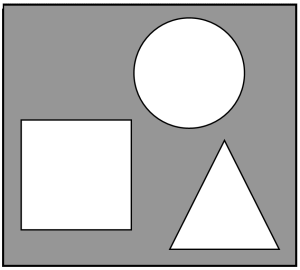
3-way-block-puzzleFor toddler Renée’s Christmas gift, Alex and Leon crafted a puzzle set of wooden blocks.

First, they made a sturdy box with circle, square, and triangle shapes cut in the lid.

To make the blocks large and baby-safe, Alex and Leon bought a 4-foot 2×2 board. Then they asked Uncle Will to help them create a set of special blocks to fit through the holes.

Each block was round and square and triangular, so it could fit exactly through any of the three holes.

How can that be?

To Be Continued…

Read all the posts from the December 2000/January 2001 issue of my Mathematical Adventures of Alexandria Jones newsletter.

CREDITS: “Christmas Tree Closeup” photo by Zechariah Judy via Flickr (CC BY 2.0).

A Polyhedra Construction Kit

To make a Christmas gift for her brother Leon, Alex asked all her friends to save empty cereal boxes. She collected about a dozen boxes.

She cut the boxes open, which gave her several big sheets of thin cardboard.

Then she carefully traced the templates for a regular triangle, square, pentagon, and hexagon, as shown below.

polyhedra-construction-kit

Click here to download the polygon templates

She drew the dark outline of each polygon with a ballpoint pen, pressing hard to score the cardboard so the tabs would bend easily.

She cut out shapes until her fingers felt bruised: 20 each of the pentagon and hexagon, 40 each of the triangle and square.

Alex bought a bag of small rubber bands for holding the tabs together. Each rubber band can hold two tabs, forming an edge of the polyhedron. So, for instance, it takes six squares and twelve rubber bands to make a cube.

Finally, she stuffed the whole kit in a plastic zipper bag, along with the following instructions.

Polyhedra Have “Many Faces”

Poly means many, and hedron means face, so a polyhedron is a 3-D shape with many faces.

The plural of polyhedron is polyhedra, thanks to the ancient Greeks, who didn’t know that the proper way to make a plural was to use the letter s.

Each corner of a polyhedron is called a vertex, and to make it more confusing, the plural of vertex is vertices.

Regular Polyhedra

Regular polyhedra have exactly the same faces and corners all around. If one side is a square, then all the sides will be squares. And if three squares meet to make one vertex, then all the other vertices will be made of three squares, just like that first one.

There are only five possible regular polyhedra. Can you figure out why?

Here are the five regular polyhedra, also called the Platonic solids. Try to build each of them with your construction kit.

Tetrahedron: three equilateral triangles meeting at each vertex.

Hexahedron: three squares meeting at each vertex. Do you know its common name?

Octahedron: four triangles at each vertex.

Icosahedron: five triangles at each vertex.

Dodecahedron: three pentagons per vertex.

You can find pictures of these online, but it’s more challenging to build them without peeking at the finished product. Just repeat the vertex pattern at every corner until the polygons connect together to make a complete 3-D shape.

Semi-Regular Polyhedra

Semi-regular polyhedra have each face a regular polygon, although not all the same. Each corner is still the same all around. These are often called the Archimedean polyhedra.

For example, on the cuboctahedron, every vertex consists of a square-triangle-square-triangle combination.

Here are a few semi-regular polyhedra you might try to build, described by the faces in the order they meet at each corner:

Icosidodecahedron: triangle, pentagon, triangle, pentagon.

Truncated octahedron: square, hexagon, hexagon.

Truncated icosahedron: pentagon, hexagon, hexagon. Where have you seen this?

Rhombicuboctahedron: triangle, square, square, square.

Rhombicosidodecahedron: triangle, square, pentagon, square.

Now, make up some original polyhedra of your own. What will you name them?

To Be Continued…

Read all the posts from the December 2000/January 2001 issue of my Mathematical Adventures of Alexandria Jones newsletter.

CREDITS: “50/52 Weeks of Teddy – Merry Christmas” photo by Austin Kirk via Flickr (CC BY 2.0).

November Math Calendars

High school math teacher Chris Rime has done it again. Check out his November 2015 printable math calendars for Algebra 1 (in English or Spanish), Algebra 2, and Geometry students. Enjoy!

algebra-2-november-2015-preview

Things to Do with a Math Calendar

At home:
Post the calendar on your refrigerator. Use each math puzzle as a daily review “mini-quiz” for your children (or yourself).

In the classroom:
Post today’s calculation on the board as a warm-up puzzle. Encourage your students to make up “Today is…” puzzles of their own.

As a puzzle:
Cut the calendar squares apart and trim off the dates. Then challenge your students to arrange them in ascending (or descending) order.

Make up problems to fill a new calendar for next month.
And if you do, please share!