Have you ever wondered why so many plants grow in Fibonacci Numbers? Vi Hart offers a great explanation (with hands-on activities) in these three videos — and she introduces a new species called the slugcat, which my daughter thinks is adorable.
Math Teachers at Play #46: Living Books for Math

Welcome to the Math Teachers At Play blog carnival — which is not just for math teachers! Here is a smorgasbord of ideas for learning, teaching, and playing around with math from preschool to pre-college. Some articles were submitted by their authors, others were drawn from the immense backlog in my blog reader. If you like to learn new things, you are sure to find something of interest.
Living Books for Math
A child’s intercourse must always be with good books, the best that we can find… We must put into their hands the sources which we must needs use for ourselves, the best books of the best writers.
…
For the mind is capable of dealing with only one kind of food; it lives, grows and is nourished upon ideas only; mere information is to it as a meal of sawdust to the body.
Princess Kitten and I took a longer than usual holiday break from homeschooling, but now I’m in plan-for-the-new-semester mode. I hope to include more living math in our schedule, so I decided to illustrate this edition of the MTaP carnival with a few of my favorite living math books. I’d love to hear more living book suggestions in the comments!
If you click on a book cover, the links take you to Amazon.com, where you can read reviews and other details (and where I earn a small affiliate commission if you actually buy the book), but all of these books should be available through your public library or via inter-library loan.
Let the mathematical fun begin…
Continue reading Math Teachers at Play #46: Living Books for Math
Math Teachers at Play #39


Welcome to the Math Teachers At Play blog carnival — which is not just for math teachers! If you like to learn new things and play around with ideas, you are sure to find something of interest.
Several of these articles were submitted by the bloggers; others were drawn from my overflowing blog reader. Don’t try to skim everything all at once, but take the time to enjoy browsing. Savor a few posts today, and then come back for another helping tomorrow or next week.
Most of the photos below are from the 2010 MAA Found Math Gallery; click each image for more details. Quotations are from Mike Cook’s Canonical List of Math Jokes.
Let the mathematical fun begin…
Hyperbolic Crochet Coral Reef
Wow! And to think, I was proud of myself for finishing a crochet afghan. Once.
For More Details
Try It Yourself
Chain several. Leave straight to work in rows, or connect into a loop. Single crochet until your patience runs out, increasing every nth stitch (add an extra sc in the same place). Experiment with different colors and patterns. This pdf will give you more ideas.
The more frequently you increase, the frillier your hyperbolic plane will be, while a less-frequent increase makes it easier for students to see the structure. Daina Taimina recommends a 12:13 ratio (increase after every 12th stitch) for classroom use.
Hat tip: 2010 MAA Found Math Gallery, Week 45, and authentic arts by jenny hoople for the pdf.
Math Teachers at Play #35

Welcome to the Math Teachers At Play blog carnival — which is not just for math teachers.
Do you enjoy math? I hope so! If not, browsing these links just may change your mind. Most of these posts were submitted by the bloggers themselves; others are drawn from my overflowing Google Reader. From preschool to high school, there are plenty of interesting things to learn.
Let the mathematical fun begin…
Visual Proof of the Pythagorean Theorem
Beautifully done!
[From Girl’s Angle: A Math Club for Girls, via Albany Area Math Circle.]
Do you know why this proof works? How can we be sure the red and yellow areas don’t change as they slide around?
Graph-It Game
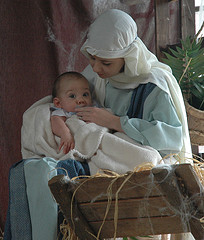 [Photo by Scott Schram via Flickr.]
For Leon’s Christmas gift, Alex made the Graph-It game. She wrapped a pad of graph paper and wrote up the instructions:
To play Graph-It, one person designs a picture made by connecting points on a coordinate graph. He reads the points to the other player, who tries to reproduce the picture.
Renée’s Platonic Mobile
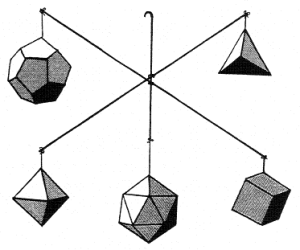 Alexandria Jones struggled to think of a Christmas gift that a one-month-old baby could enjoy, but finally she got an idea.
She cut empty cereal boxes to make regular polygons: 6 squares, 12 regular pentagons, and 32 equilateral triangles. Using small pieces of masking tape, she carefully formed the five Platonic solids. Then she mixed flour and water into a runny paste. She tore an old newspaper into small strips and soaked them in the paste. She covered each solid with a thin layer of paper.
Mathematical Juggling
Math Project: Measure the Earth
Tomorrow, September 23, is the equinox — when night and day are equally balanced (or would be, if the sun appeared as a point, rather than a disc). If we lived on the equator, the sun would appear directly overhead at noon and would cast no shadow. Therefore, it’s a great day to perform Eratosthenes’ experiment of measuring the earth:
 Denise Gaskins' Let's Play Math