Euclid’s Geometric Algebra

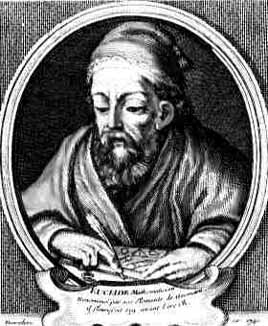
Picture from MacTutor Archives.

After the Pythagorean crisis with the square root of two, Greek mathematicians tried to avoid working with numbers. Instead, the Greeks used geometry to demonstrate mathematical concepts. A line can be drawn any length, so straight lines became a sort of non-algebraic variable.

You can see an example of this in The Pythagorean Proof, where Alexandria Jones represented the sides of her triangle by the letters a and b. These sides may be any length. The sizes of the squares will change with the triangle sides, but the relationship a^2 + b^2 = c^2 is always true for every right triangle.

Continue reading Euclid’s Geometric Algebra

The Mosaic Tile Mystery

Dear Alexandria Jones,

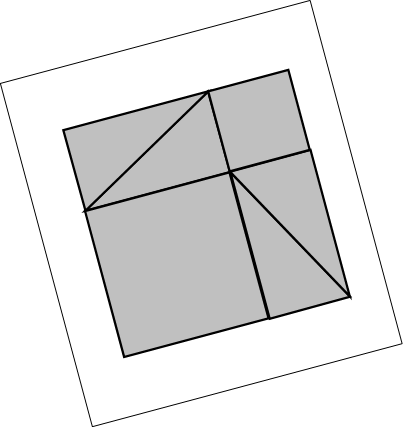
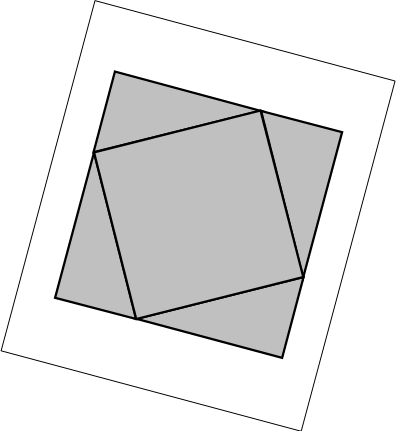
We continue to excavate the ancient building complex, which I believe may have been Pythagoras’s school. Yesterday, one of our digging crews uncovered a mosaic tile floor in the courtyard. The pattern of the tiles alternates between two square designs. (See enclosed sketches.)

During your family’s recent visit, you expressed an interest in the mathematical ideas of Pythagoras. Could you or your father offer us any insight into what these tile designs may represent?

I look forward to your response.

Sincerely,
Sofia Theano, Ph.D.
Crotone, Italy

Continue reading The Mosaic Tile Mystery

An Ancient Mathematical Crisis

PythagoreanCat

[When Alexandria Jones and her family visited an excavation in southern Italy, they learned several tidbits about the ancient school of mathematics and philosophy founded by Pythagoras. Here is Alex’s favorite story.]

It hit the Pythagorean Brotherhood like an earthquake, a crisis of faith which shook the foundations of their universe. Some say Pythagoras himself made the dread discovery, others blame Hippasus of Metapontum.

Something certainly did happen with Hippasus. The Brotherhood sent him into exile for insubordination, or for breaking the rule of secrecy — or was it for proving the unthinkable? According to legend, Hippasus drowned at sea, but was it a mere shipwreck or the wrath of the gods? Some say the irate Pythagoreans threw him overboard…

Continue reading An Ancient Mathematical Crisis

April Fool’s Day: Fun with Math Fallacies

Photo by RBerteig. Take a break from “serious” math and have a little fun today with some classics of recreational mathematics. Do you have a favorite math or logic fallacy? Please share it in the Comments below. Continue reading April Fool’s Day: Fun with Math Fallacies

The Game of Algebra

NFL football
Photo by velo_city.

My pre-algebra class hit the topic of equations just as the NFL season moved into the playoffs. The result was this series of class notes called “The Game of Algebra.”

We used the Singapore Math NEM 1 textbook, which is full of example problems and quality exercises. These notes simply introduce or review the main concepts and vocabulary in a less-textbooky way.

I hope you find them useful.

Continue reading The Game of Algebra

2008 Mathematics Game

Are you ready for a challenge? Join us for the 2008 Mathematics Game. Here are the rules:

Use the digits in the year 2008 and the operations +, -, x, ÷, sqrt (square root), ^ (raise to a power), and ! (factorial) — along with parentheses, brackets, or other grouping symbols — to write expressions for the counting numbers 1 through 100.

  • All four digits must be used in each expression.
  • Only the digits 2, 0, 0, 8 may be used.
  • Multi-digit numbers such as 20, 208, or .02 MAY be used this year.
  • The square function may NOT be used.
  • The integer function may NOT be used.

By definition:
0! = 1
[See Dr. Math’s Why does 0 factorial equal 1?]

For this game we will accept the value:
{0}^{0} = 1
[See the Dr. Math FAQ 0 to the 0 power.]

Continue reading 2008 Mathematics Game

The Golden Christmas Tree

Last time, Alexandria Jones and her family were on their way to Uncle William’s tree farm to find the perfect Christmas tree, and Dr. Jones taught us about the Golden Section:

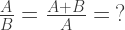
The \; Golden \; Section \; ratio

|———————A———————|————B————|

A \; is \; to \; B \; as \; \left(A + B \right) \; is \; to \; A, \; or . . .

\frac{A}{B}   =  \frac{A + B}{A}  = \: ?

I gave you three algebra puzzles to solve. Did you try them?

  • What is the exact value of the Golden Section ratio?
  • If a 7-foot tree will fit in the Jones family’s living room, allowing for the tree stand and for a star on top, how wide will the tree be?
  • Approximately how much surface area will Alex and Leon have to fill with lights and ornaments?

Math Adventurer’s Rule: Figure It Out for yourself

Whenever I give a problem in an Alexandria Jones story, I will try to post the answer soon afterward. But don’t peek! If I tell you the answer, you miss out on the fun of solving the puzzle. So if you have not worked these problems yet, go back to the original post. Figure them out for yourself — and then check the answers just to prove that you got them right.

Continue reading The Golden Christmas Tree

High School Math Challenge

The USA Mathematical Talent Search (USAMTS) has posted its current set of challenge problems, the first of four rounds scheduled for the 2007-2008 school year. USAMTS is a free competition open to all United States middle school and high school students. Young mathematicians have a little over a month (until October 9) to write and send in solutions for the five questions.

According to the USAMTS website:

Student solutions to the USAMTS problems are graded by mathematicians and comments are returned to the students. Our goal is to help all students develop their problem solving skills, improve their technical writing abilities, and mature mathematically while having fun. We wish to foster not only insight, ingenuity and creativity, but also the virtue of perseverance, which is equally essential in scientific endeavors.

A mere five questions. How hard can it be? (Ha!)