Puzzle: Patty Paper Trisection

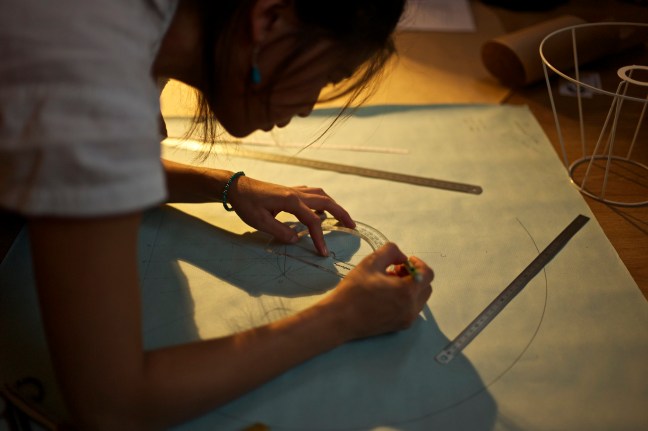
student using drafting tools

One of the great unsolved problems of antiquity was to trisect any angle, to cut it into thirds with only the basic tools of Euclidean geometry: an unmarked straight-edge and a compass.

Like the alchemist’s dream of turning lead into gold, this proved to be an impossible task. If you want to trisect an angle, you have to “cheat.” A straight-edge and compass can’t do it. You have to use some sort of crutch, just as an alchemist would have to use a particle accelerator.

One “cheat” that works is to fold your paper.

I will show you how it works, and your job is to show why.

Continue reading Puzzle: Patty Paper Trisection

Charlotte Mason Math: Living Books

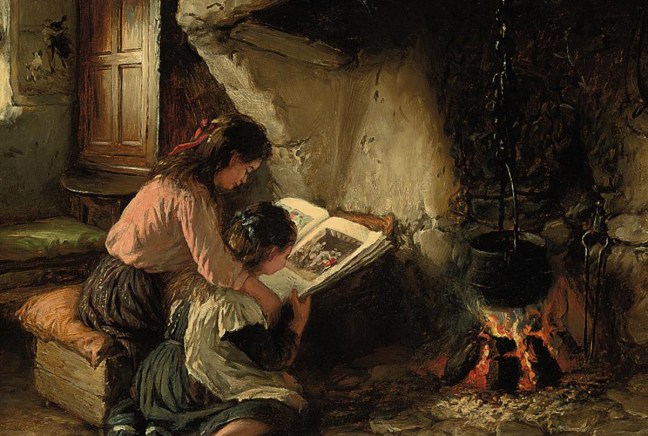
“The Reading Lesson” painting by Jonathan Pratt, public domain

[An addendum to my earlier Charlotte Mason Math series.]

“Our business is to give [children] mind-stuff, and both quality and quantity are essential. Naturally, each of us possesses this mind-stuff only in limited measure, but we know where to procure it; for the best thought the world possesses is stored in books; we must open books to children, the best books; our own concern is abundant provision and orderly serving.”

— Charlotte Mason, Toward A Philosophy of Education

Most homeschool teachers, whatever our curriculum or schooling approach, understand the importance of teaching with living books. We read aloud biographies, historical fiction, or the classics of literature. We scour library shelves for the most creative presentations of scientific topics that interest our children, and encourage our high school students to go back to the original documents whenever possible.

And we teach math with a textbook.

Not that textbooks are inherently bad, because math is an abstract science. We need to meet the ideas  — the “mind-stuff” — of math on their own terms, and textbooks can help with that.

But it’s not enough.

Continue reading Charlotte Mason Math: Living Books

Can You Solve It? The Cyclists’ Feast

English mathematician Henry Ernest Dudeney wrote logic puzzles and mathematical games for several newspapers and magazines, later collected into books. This poem is from Amusements in Mathematics, published by Thomas Nelson and Sons, 1917.

The numbers are simple enough that younger students can solve it by the guess-and-check method. Older students or adults may want to set up a quadratic equation.

Historical Note: In the British currency of the time, there were 12 pennies to a shilling and 20 shillings to a pound (which was also called a sovereign).

The Cyclists’ Feast

’Twas last Bank Holiday, so I’ve been told,
Some cyclists rode abroad in glorious weather.
Resting at noon within a tavern old,
They all agreed to have a feast together.

“Put it all in one bill, mine host,” they said,
“For everyone an equal share will pay.”
The bill was promptly on the table laid,
And four pounds was the reckoning that day.

But, sad to state, when they prepared to square,
’Twas found that two had sneaked outside and fled.
So, for two shillings more than his due share
Each honest friend who had remained was bled.

They settled later with those rogues, no doubt.
How many were they when they first set out?

Did You Solve It?

One fun thing about math is that you really don’t need the answer book. You can always check the math for yourself: Does your answer make sense? Does it fit the story?

Would you like to write a math poem puzzle of your own? I’d love to hear it!

 
* * *

For more ideas on writing math poetry, check out Math Makers: Write a Poem.

This blog is reader-supported.

If you’d like to help fund the blog on an on-going basis, then please join me on Patreon for mathy inspiration, tips, and an ever-growing archive of printable activities.

If you liked this post, and want to show your one-time appreciation, the place to do that is PayPal: paypal.me/DeniseGaskinsMath. If you go that route, please include your email address in the notes section, so I can say thank you.

Which I am going to say right now. Thank you!

“Can You Solve It? The Cyclists’ Feast” copyright © 2023 by Denise Gaskins. Image at the top of the post copyright © yanlev / Depositphotos.

What Are Mixed Numbers?

I just discovered a fascinating fact: In some places in the world, mixed numbers apparently don’t exist.

So that made me curious about my blog readers:

  • Did you learn about mixed numbers in school?
  • Do you ever use mixed numbers in daily life?
  • Are your children learning to work with them?

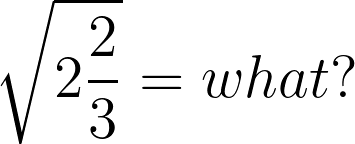
And if you DO know mixed numbers, can you simplify this mess:

[If you enjoy dry math humor, the answer is worth the work.]

Continue reading What Are Mixed Numbers?

Happy Hamilton Day (Belated)

While searching for posts to add to the Playful Math Carnival, I stumbled on a new-to-me math holiday.

Hamilton Day celebrates mathematical discovery — that “Aha!” moment when your eyes are opened and you see something new.

Or something new-to-you. That’s worth celebrating, too.

History of Hamilton Day

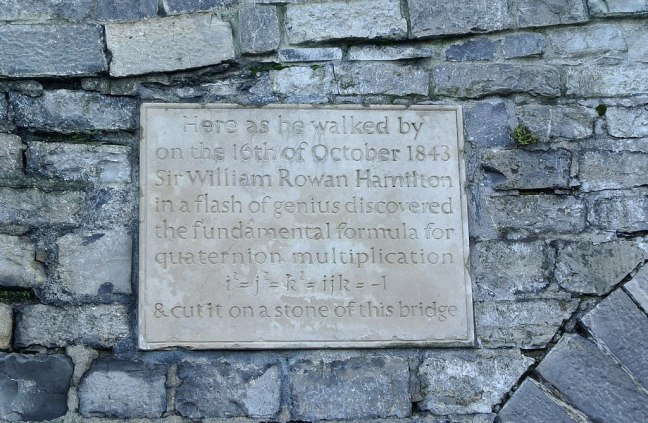
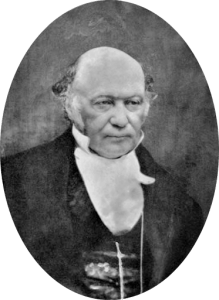
Irish mathematician William R. Hamilton was struggling with a tough math problem in October, 1843. It had him stumped. Then on the 16th, as he walked along Dublin’s Royal Canal with his wife, inspiration struck.

He suddenly realized he could look at the problem from a new direction, and that would make everything fall into place.

“And here there dawned on me the notion that we must admit, in some sense, a fourth dimension of space for the purpose of calculating with triples … An electric circuit seemed to close, and a spark flashed forth.”

—Sir William Rowan Hamilton

In one of the most famous acts of vandalism in math history, Hamilton pulled out a knife and scratched his new equation into the stone of the Broome Bridge: i² = j² = k² = ijk = -1.

Also by Hamilton

“Who would not rather have the fame of Archimedes than that of his conqueror Marcellus?”

—Sir William Rowan Hamilton
quoted in H. Eves, Mathematical Circles Revisited

Why Celebrate Hamilton Day

“So there’s much to celebrate on Hamilton Day. Beyond its utility, we can appreciate mathematics as a human endeavor, with struggles and setbacks and triumphs. We can highlight the opportunity math affords for daring, creativity, and out-of-the-box thinking.

“Hamilton Day could, in other words, pivot away from Pi Day’s gluttony and memorization, neither of which is part of mathematics, toward the intellectual freedom and drama that are.”

— Katharine Merow
Celebrate Hamilton Day, a Better Mathematical Holiday

How Will You Celebrate?

  • Learn about a new-to-you math topic.
  • Work on a tough math problem.
  • Think about different ways to do things.
  • Try a nonstandard approach.
  • Talk about how it feels when you learn something new and it finally makes sense.

I’ve penciled Hamilton Day (October 16) into my calendar for next year.

How about you?

I’d love to hear your ideas for celebrating math! Please share in the comments section below.

 
* * *

This blog is reader-supported.

If you’d like to help fund the blog on an on-going basis, then please join me on Patreon for mathy inspiration, tips, and an ever-growing archive of printable activities.

If you liked this post, and want to show your one-time appreciation, the place to do that is PayPal: paypal.me/DeniseGaskinsMath. If you go that route, please include your email address in the notes section, so I can say thank you.

Which I am going to say right now. Thank you!

“Happy Hamilton Day (Belated)” copyright © 2020 by Denise Gaskins.

Commemorative plaque photo (top) by Cone83, CC BY-SA 4.0. Hamilton portrait by Unknown artist and “Death of Archimedes” by Thomas Degeorge, public domain. All via Wikimedia Commons.

Morning Coffee – 28 October 2019

Morning Coffee image

One of the best ways we can help our children learn mathematics (or anything else) is to always be learning ourselves.

Here are a few stories to enjoy with your Monday morning coffee:

“When you’re working every day, you’re not thinking, ‘What impact is this going to have on the world?’ You’re thinking, ‘I’ve got to get this right.’”

—Gladys West
quoted in Dr. Gladys West: The Black Woman Behind GPS Technology

  • I like to keep a quick game in reserve for spare time in my homeschool co-op class. Kent Haines explains Sprouts and suggests ways to launch math discussions.

“I don’t get irritated by these mistakes. I desperately wait for such mistakes. Yes! Because I think it is a golden opportunity for the teacher to spot a student thinking this way. It presents just the right context and time for driving an enriching mathematical conversation in the whole class.”

—Rupesh Gesota
Part-2: Re-learning and Enjoying Polynomial Division with students

“To teach students SSS congruence without pointing out why this is so interesting is harmful for two reasons. First of all, this is an amazing result. It is the our job to point out amazing results! Triangles are rigid figures in a way that other polygons are not.”

—Rachel Chou
Teaching the Distributive Property

CREDITS: Feature photo (top) by Kira auf der Heide via Unsplash. “Morning Coffee” post format inspired by Nate Hoffelder at The Digital Reader.

Math That Is Beautiful

One of the sections in my book Let’s Play Math: How Families Can Learn Math Together — and Enjoy It encourages parents to make beautiful math with their children.

Do you have trouble believing that math can be beautiful?

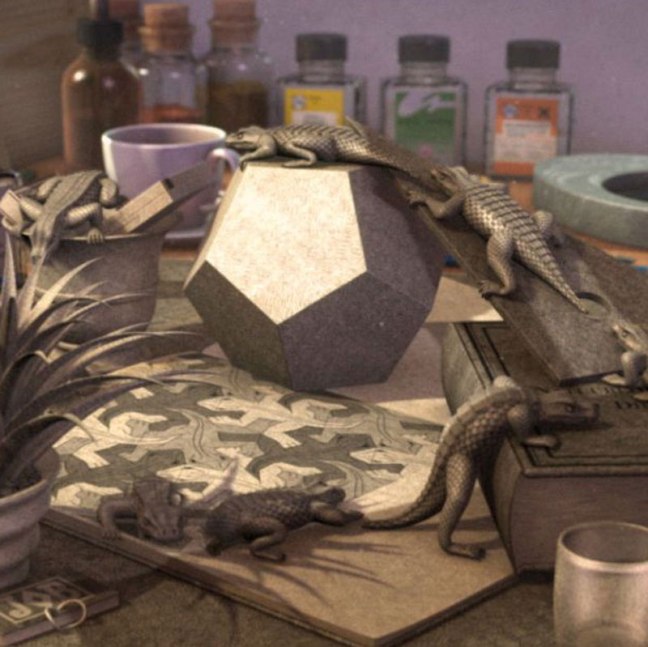
In “Inspirations,” artist Cristóbal Vila creates a wonderful, imaginary work studio for the amazing M.C. Escher. You’ll want to view it in full-screen mode.

How many mathematical objects could you identify?

Vila offers a brief explanation of the history and significance of each item on his page Inspirations: A short movie inspired on Escher’s works.

Read about the inspirations, and then try making some math of your own.

“I looked into that enormous and inexhaustible source of inspiration that is Escher and tried to imagine how it could be his workplace, what things would surround an artist like him, so deeply interested in science in general and mathematics in particular. I imagined that these things could be his travel souvenirs, gifts from friends, sources of inspiration…”

—Cristóbal Vila
Inspirations: A short movie inspired on Escher’s works

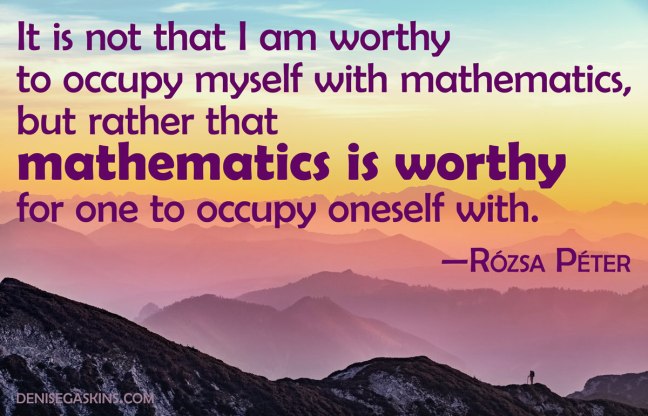
Mathematics Is Worthy

“When I began my college education, I still had many doubts about whether I was good enough for mathematics. Then a colleague said the decisive words to me: it is not that I am worthy to occupy myself with mathematics, but rather that mathematics is worthy for one to occupy oneself with.”

Rózsa Péter
Mathematics is beautiful
essay in The Mathematical Intelligencer

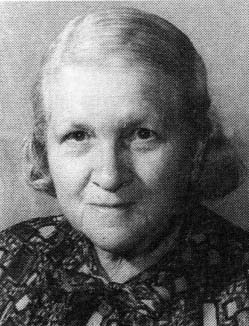
Rózsa Péter and the Curious Students

I would like to win over those who consider mathematics useful, but colourless and dry — a necessary evil…
 
No other field can offer, to such an extent as mathematics, the joy of discovery, which is perhaps the greatest human joy.
 
The schoolchildren that I have taught in the past were always attuned to this, and so I have also learned much from them.
 
It never would have occurred to me, for instance, to talk about the Euclidean Algorithm in a class with twelve-year-old girls, but my students led me to do it.
 
I would like to recount this lesson.
 
What we were busy with was that I would name two numbers, and the students would figure out their greatest common divisor. For small numbers this went quickly. Gradually, I named larger and larger numbers so that the students would experience difficulty and would want to have a procedure.
 
I thought that the procedure would be factorization into primes.
 
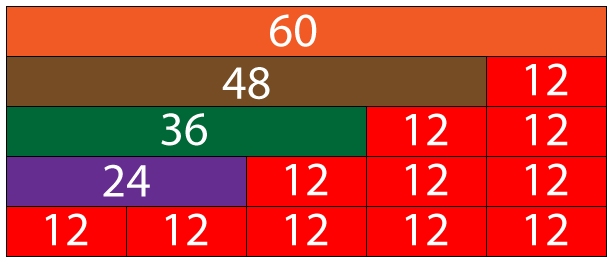
They had still easily figured out the greatest common divisor of 60 and 48: “Twelve!”
 
But a girl remarked: “Well, that’s just the same as the difference of 60 and 48.”


“That’s a coincidence,” I said and wanted to go on.
 
But they would not let me go on: “Please name us numbers where it isn’t like that.”
 
“Fine. 60 and 36 also have 12 as their greatest common divisor, and their difference is 24.”


Another interruption: “Here the difference is twice as big as the greatest common divisor.”
 
“All right, if this will satisfy all of you, it is in fact no coincidence: the difference of two numbers is always divisible by all their common divisors. And so is their sum.”
 
Certainly that needed to be stated in full, but having done so, I really did want to move on.
 
However, I still could not do that.
 
A girl asked: “Couldn’t they discover a procedure to find the greatest common divisor just from that?”


They certainly could! But that is precisely the basic idea behind the Euclidean Algorithm!
 
So I abandoned my plan and went the way that my students led me.
 

— Rózsa Péter
quoted at the MacTutor History of Mathematics Archive

For Further Exploration

Note: When the video narrator says “Greatest Common Denominator,” he really means “Greatest Common Divisor.”

CREDITS: “Pink toned thoughts on a hike” photo courtesy of Simon Matzinger on Unsplash.

Playful Math Education Carnival 115—Women of Mathematics

Welcome to the 115th edition of the Playful Math Education Blog Carnival — a smorgasbord of links to bloggers all around the internet who have great ideas for learning, teaching, and playing around with math from preschool to pre-college.

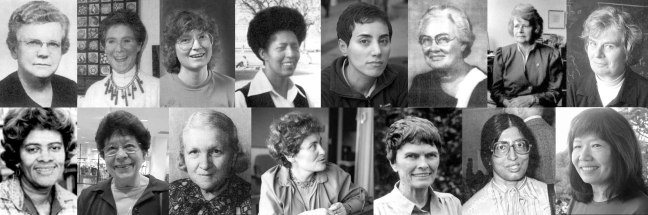
In honor of Women’s History Month, this carnival features quotes from fifteen women mathematicians.

If you would like to jump straight to our featured blog posts, click here to see the Table of Contents.

Let the mathematical fun begin!

The Women of Mathematics

They came from many countries and followed a variety of interests.

They conquered new topics in mathematics and expanded the world’s understanding of old ones.

They wrestled with theorems, raised children, published articles, won awards, faced discrimination, led professional organizations, and kept going through both success and failure.

Some gained international renown, but most enjoyed quiet lives.

They studied, learned, and lived (and some still live) as most of us do — loving their families and friends, joking with colleagues, hoping to influence students.

I think you’ll find their words inspiring.
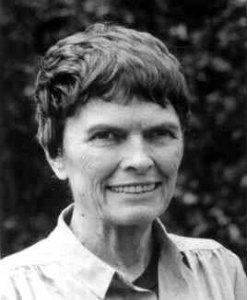
“What I really am is a mathematician. Rather than being remembered as the first woman this or that, I would prefer to be remembered, as a mathematician should, simply for the theorems I have proved and the problems I have solved.”
Julia Robinson (1919–1985)


“All in all, I have found great delight and pleasure in the pursuit of mathematics. Along the way I have made great friends and worked with a number of creative and interesting people. I have been saved from boredom, dourness, and self-absorption. One cannot ask for more.”
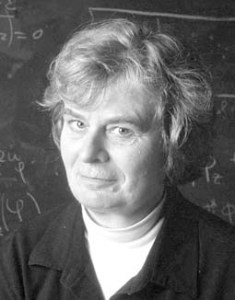
Karen Uhlenbeck (b. 1942)

Continue reading Playful Math Education Carnival 115—Women of Mathematics

A Map of Mathematics

Pure mathematics, applied math, and more — all summarized in a single map! Watch the video by physicist and award-winning science writer Dominic Walliman:

https://youtu.be/OmJ-4B-mS-Y&rel=0

Walliman says, “To err is to human, and I human a lot. I always try my best to be as correct as possible, but unfortunately I make mistakes…”

  • Can you find three mistakes in the map?

Check your answers in the description on Walliman’s YouTube page.

If you enjoy this video, you can purchase the poster (or T-shirt, coffee mug, tote bag, etc.) at Red Bubble.

 
* * *

CREDITS: Map of Mathematics poster by Dominic Walliman via Flickr (CC BY-NC-ND 2.0).

This blog is reader-supported.

If you’d like to help fund the blog on an on-going basis, then please head to my Patreon page.

If you liked this post, and want to show your one-time appreciation, the place to do that is PayPal: paypal.me/DeniseGaskinsMath. If you go that route, please include your email address in the notes section, so I can say thank you.

Which I am going to say right now. Thank you!

“A Map of Mathematics” copyright © 2017 by Denise Gaskins.