A Very Short History of Mathematics

This paper was read to the Adams Society (St. John’s College Mathematical Society) at their 25th anniversary dinner, Michaelmas Term, 1948. [Warning: Do not attempt to read this while drinking coffee or other spittable beverage!]

Hat tip: I found this through the math carnival at a mispelt bog.

Update: The original page has disappeared from the internet, or at least I cannot find it any more, but the Internet Archive Wayback Machine came to the rescue. After my plea for help, James Clare pointed me to the article’s new home.

Egyptian Math Puzzles

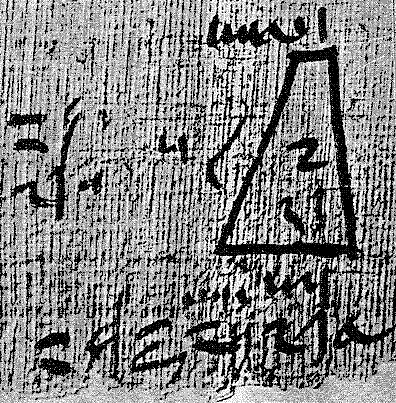
What we know about ancient Egyptian mathematics comes primarily from two papyri, the first one written around 1850 BC. Moscow papyrus problem 14This is called the Moscow papyrus, because it now belongs to Moscow’s Pushkin Museum of Fine Arts. The scroll contains 25 problems, mostly practical examples of various calculations. Problem 14, which finds the volume of a frustrum (a pyramid with its top cut off), is often cited by mathematicians as the most impressive Egyptian pyramid of all.

Continue reading Egyptian Math Puzzles

Living with History

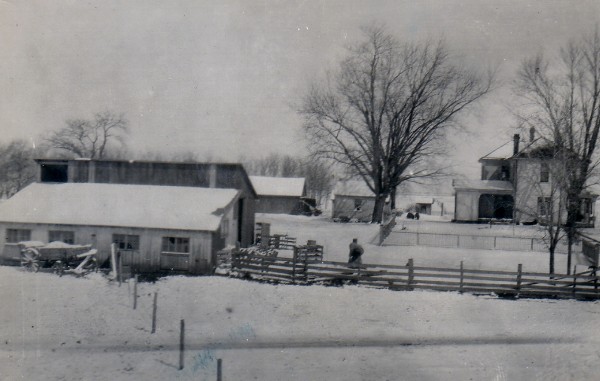
Farm in winterMy daughter has been decorating the kitchen, and she decided to hang these old photos that came with the house. The frames needed repairs, so I took the opportunity to scan the photos. (Click for larger view.)

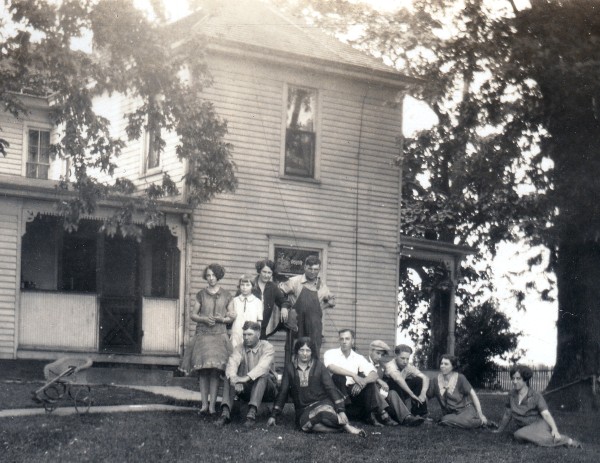
Family farmI wish I knew who the people were, or when the photos were taken. The house shows changes over the years. Eventually, the back porch was closed in to create a pantry and laundry room off the kitchen.

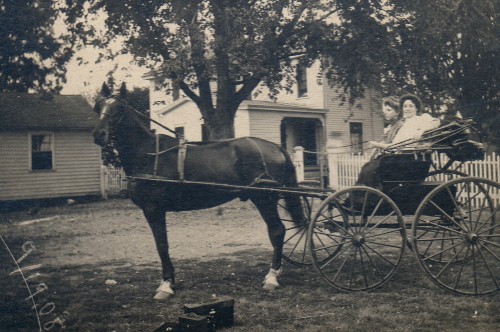
Horse cartThe horse cart picture has a date across one corner. It looks like 9/1908.

Pony trick

This young boy has taught his pony a trick: to step up on a box or something — I can’t quite see what.

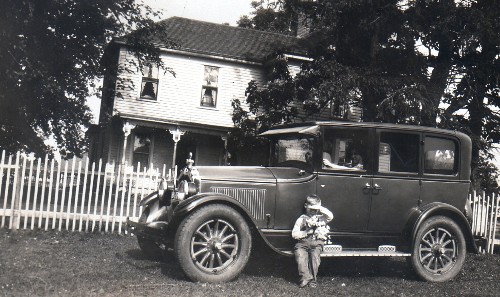
Vintage carCan anyone identify this car? The boy looks sweet with a bouquet for his mother. I wonder if that’s her in the driver’s seat.

How To Start a Homeschool Math Club

From a recent e-mail:

“Hello! I am on the board of a homeschool co-op. We have had requests for a math club and wondered if you have any tips for starting one. We service children from K-10th and would need to try to meet the needs of as many ages as possible.”

There are several ways you might organize a homeschool math club, depending on the students you have and on your goals. I think you would have to split the students by age groups — it is very hard to keep that wide of a range of students interested. Then decide whether you want an activity-oriented club or a more academic focus.

When I started my first math club, I raided the math shelves in the children’s section at my library (510-519) for anything that interested me. I figured that if an activity didn’t interest me, I couldn’t make it fun for the kids. Over the years we have done a variety of games, puzzles, craft projects, and more — always looking for something that was NOT like whatever the kids would be doing in their textbooks at home.

Continue reading How To Start a Homeschool Math Club

Solution: The Cat’s Lasagna

The puzzle (from The mysterious temporal freeze) was:

A certain famous cat snarfs down an 11″x13″ pan of lasagna in 3 seconds flat. Assuming the fat feline has a bottomless pit for a stomach and continues to eat at the same rate, how long will it take him to devour a pasta the size of the state of Illinois?

Remember the Math Adventurer’s Rule: Figure it out for yourself! Whenever I give a problem in an Alexandria Jones story, I will try to post the answer soon afterwards. But don’t peek! If I tell you the answer, you miss out on the fun of solving the puzzle. Figure it out for yourself — and then check the answer just to prove that you got it right.

Continue reading Solution: The Cat’s Lasagna

Historical Tidbits: Alexandria Jones Answers

The Math Adventurer’s Rule: Figure It Out for Yourself!

Whenever I give a problem in an Alexandria Jones story, I will try to post the answer soon afterwards. But don’t peek! If I tell you the answer, you miss out on the fun of solving the puzzle. Figure it out for yourself — and then check the answer just to prove that you got it right.

Continue reading Historical Tidbits: Alexandria Jones Answers

Historical Tidbits: Alexandria Jones

[Read the story of the pharaoh’s treasure: Part 1, Part 2, and Part 3.]

Here are a few more tidbits from math history, along with links to relevant Internet sites or books, and three more math puzzles for you to try. I hope you find them interesting.

Next time, a new adventure (sort of)…

Continue reading Historical Tidbits: Alexandria Jones

Answers and Other Tidbits: The Pharaoh’s Treasure

[Read the story of the pharaoh’s treasure here: Part 1, Part 2, and Part 3.]

I confess: I lied — or rather, I helped to propagate a legend. Scholars tell us that the Egyptian rope stretchers did not use a 3-4-5 triangle for right-angled corners. They say it is a myth, like the corny old story of George Washington and the cherry tree, which bounces from one storyteller to the next — as I got it from a book I bought as a library discard.

None of the Egyptian papyri that have been found show any indication that the Egyptians knew of the Pythagorean Theorem, one of the great theorems of mathematics, which is the basis for the 3-4-5 triangle. Unless a real archaeologist finds a rope like Alexandria Jones discovered in my story, or a papyrus describing how to use one, we must assume the 3-4-5 rope triangle is an unfounded rumor.

Continue reading Answers and Other Tidbits: The Pharaoh’s Treasure

The Secret of the Pharaoh’s Treasure, Part 3

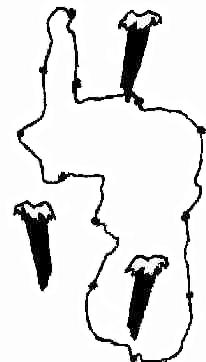
[In the last episode, Alexandria Jones discovered a mysterious treasure: three wooden sticks, like tent pegs, and a long loop of rope with 12 evenly spaced knots. Her father explained that it was an ancient Egyptian surveyor’s tool, used to mark right angles.]

Back at the camp, Fibonacci Jones stacked multi-layer sandwiches while Alexandria poured milk and set the table for supper.

“Geometry,” Fibonacci said.

“What?”

Geo means earth, and metry means to measure. So geometry means to measure the earth. That is what the Egyptian rope stretches did.”

Alex thought for a moment. “So in the beginning, math was just surveying?”

“And taxes…”

Continue reading The Secret of the Pharaoh’s Treasure, Part 3

Confession: I Am Not Good at Math

I want to tell you a story. Everyone likes a story, right? But at the heart of my story lies a confession that I am afraid will shock many readers. People assume that because I teach math, blog about math, give advice about math on internet forums, and present workshops about teaching math — because I do all this, I must be good at math.

Apply logic to that statement. The conclusion simply isn’t valid. …

Update: This post has moved.

Click here to read the new, expanded version