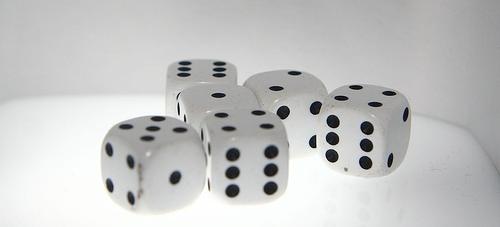
2010 Mathematics Game


[Photo by pfala.]

Did you know that playing games is one of the Top 10 Ways To Improve Your Brain Fitness? So slip into your workout clothes and pump up those mental muscles with the 2010 Mathematics Game!

Here are the rules:

Use the digits in the year 2010 to write mathematical expressions for the counting numbers 1 through 100.

  • All four digits must be used in each expression. You may not use any other numbers except 2, 0, 1, and 0.
  • You may use the arithmetic operations +, -, x, ÷, sqrt (square root), ^ (raise to a power), and ! (factorial). You may also use parentheses, brackets, or other grouping symbols.
  • You may use a decimal point to create numbers such as .1, .02, etc.
  • Multi-digit numbers such as 20 or 102 may be used, but preference is given to solutions that avoid them.

Bonus Rule
You may use the overhead-bar (vinculum), dots, or brackets to mark a repeating decimal.

[Note to teachers: This rule is not part of the Math Forum guidelines. It makes a significant difference in the number of possible solutions, however, and it should not be too difficult for high school students or advanced middle schoolers.]
Continue reading 2010 Mathematics Game

Cardstock Geometry Puzzle

While browsing the Kim Komando website for ideas I could use in my blogging class, I followed a rabbit trail through Kim’s video archive. I think we will try this in Math Club next semester:

If the embedded video doesn’t work on your computer, you can find the original here: Unbelievable Paper Transformer.

Update

Simon posted a template for the puzzle at his MathsClass blog.

Math Warm-Up: Today Is February 4×3×2×1

[Feature photo above by Tom@HK.]

One of my favorite warm-up exercises for Math Club is “Today is ______.” Each student invents one or more mathematical expressions for today’s date and writes his or her favorite on the board for all to admire. Answers range from lazy (24×1 — at least it’s an excuse to talk about identity elements) to unnecessarily repetitive (1+1+1+…), but we usually get a few gems as well.

Continue reading Math Warm-Up: Today Is February 4×3×2×1

MathNotations Contest for Middle-High School

math-team-edit
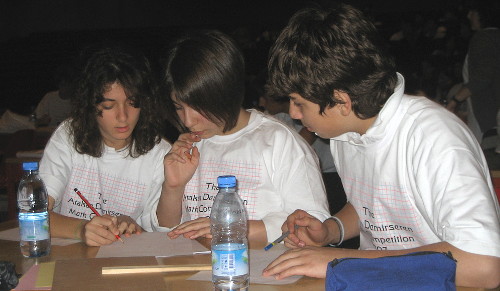
[Photo by ccarlstead.]

Can you can put together a team of 2-6 middle or high school students for an afternoon of mathematical play? If so, then Dave at MathNotations is running a math competition you just have to check out.

Teachers register by email on or before Thursday, January 29, and will receive the six thought-provoking contest problems and official answer form by return email. Hold the contest at your convenience on Tuesday, February 3, allowing your team up to 90 minutes to complete and electronically submit their answers.

Continue reading MathNotations Contest for Middle-High School

Free Online Math for Middle School and Up

alcumus

The Art of Problem Solving people recently announced their new Alcumus program, which provides online lessons on assorted math topics, including probability and combinatorics, which most math textbooks do not cover well, if at all.

Update October 2011:

Alcumus currently complements our Introduction to Algebra, Introduction to Counting & Probability, Introduction to Number Theory, and Prealgebra textbooks, as well as our Algebra 1, Algebra 2, Introduction to Counting & Probability, Introduction to Number Theory, and Prealgebra 1 online courses. We expect to continue to expand topics in Alcumus.

AoPS Alcumus information page

I am signing up all my MathCounts students. If you’re a homeschooler, we would love to have you join us!

Continue reading Free Online Math for Middle School and Up

2009 Mathematics Game

new-year
[Photo by Amanda M Hatfield.]

Have you made a resolution to exercise your mental muscles this year? Then please join us for the 2009 Mathematics Game. Here are the rules:

Use the digits in the year 2009 and the operations +, -, x, ÷, sqrt (square root), ^ (raise to a power), and ! (factorial) — along with parentheses, brackets, or other grouping symbols — to write expressions for the counting numbers 1 through 100.

  • All four digits must be used in each expression.
  • Only the digits 2, 0, 0, 9 may be used.
  • The decimal point may be used, as in .9, .02, etc.
  • Multi-digit numbers such as 29 or 902 may be used, but preference is given to solutions that avoid them.

By definition: 0! = 1 .
[See Dr. Math’s Why does 0 factorial equal 1?]

For this game we will accept: {0}^{0} = 1 .
[See the Dr. Math FAQ 0 to the 0 power.]

Continue reading 2009 Mathematics Game

MathCounts — Ready or Not, Here It Comes

[Feature photo above “You’re a mean one, Mr. Grinch” from CheezBurger.com.]

Okay, kids, I know you’re on break, but Mr. Grinch would tell you that’s no excuse to laze around playing games and eating cookies. There is only a month until our school MathCounts competition, which doesn’t give you much time to prepare. I’ve collected several resources to build up your mental muscle-power before the test…

Continue reading MathCounts — Ready or Not, Here It Comes

Contig Game: Master Your Math Facts

[Photo by Photo Mojo via Flickr (CC BY 2.0).]

Yahtzee and other board games provide a modicum of math fact practice. But for intensive, thought-provoking math drill, I can’t think of any game that would beat Contig.

Math concepts: addition, subtraction, multiplication, division, order of operations, mental math
Number of players: 2 – 4
Equipment: Contig game board, three 6-sided dice, pencil and scratch paper for keeping score, and bingo chips or wide-tip markers to mark game squares

Set Up

Place the game board and dice between players, and give each player a marker or pile of chips. (Markers do not need to be different colors.) Write the players’ names at the top of the scratch paper to make a score sheet.

Continue reading Contig Game: Master Your Math Facts

Math Club: Counting 101

[Fature photo above by ThunderChild tm.]

The last couple of weeks, in Math Club, we’ve been learning to count. My new set of MathCounts students have never heard of combinatorics, so we started at the very beginning:

Continue reading Math Club: Counting 101