Math Debates with a Hundred Chart

Euclid game
Wow! My all-time most popular post continues to grow. Thanks to an entry from this week’s blog carnival, there are now more than thirty great ideas for mathematical play:

The latest tips:

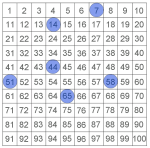
(31) Have a math debate: Should the hundred chart count 1-100 or 0-99? Give evidence for your opinion and critique each other’s reasoning.
[Hat tip: Tricia Stohr-Hunt, Instructional Conundrum: 100 Board or 0-99 Chart?]

(32) Rearrange the chart (either 0-99 or 1-100) so that as you count to greater numbers, you climb higher on the board. Have another math debate: Which way makes more intuitive sense?
[Hat tip: Graham Fletcher, Bottoms Up to Conceptually Understanding Numbers.]

(33) Cut the chart into rows and paste them into a long number line. Try a counting pattern, or Race to 100 game, or the Sieve of Eratosthenes on the number line. Have a new math debate: Grid chart or number line — which do you prefer?
[Hat tip: Joe Schwartz, Number Grids and Number Lines: Can They Live Together in Peace? ]

Math Teachers at Play #79: Puzzles and Games

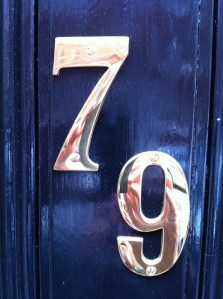
79

[Feature photo above by Jimmie, and “79” image (right) by Steve Bowbrick via flickr (CC BY 2.0).]

Do you enjoy math? I hope so! If not, browsing this post just may change your mind.

Welcome to the 79th edition of the Math Teachers At Play (MTaP) math education blog carnival — a smorgasbord of links to bloggers all around the internet who have great ideas for learning, teaching, and playing around with math from preschool to pre-college.

Let the mathematical fun begin!

By tradition, we start the carnival with a puzzle, game, or trivia tidbits. If you would like to jump straight to our featured blog posts, click here to see the Table of Contents.

Since I’ve been spending all my free time working on my upcoming Math You Can Play book series, I’m in the mood for games. So I found a few games featuring prime and nonprime numbers [which category is #79 — do you know?], and I’ll sprinkle some of my best-loved math game books throughout the carnival.

Continue reading Math Teachers at Play #79: Puzzles and Games

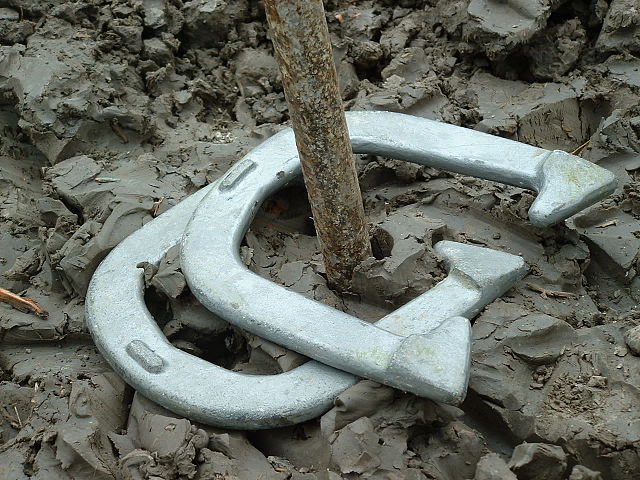
Horseshoes: A Place Value Game

[Feature photo above by Johnmack161 via Wikimedia Commons (CC BY 2.5).]

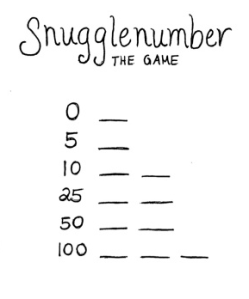
I first saw place value games on the old PBS Square One TV show (video below). Many teachers have posted versions of the game online, but Snugglenumber by Anna Weltman is by far the cutest variation. Anna kindly gave me permission to use the game in my upcoming Math You Can Play book series, and I added the following variation:

Horseshoes

snugglenumber

Math Concepts: place value, strategic thinking.
Players: two or more.
Equipment: one deck of playing cards, or a double deck for more than three players.

Separate out the cards numbered ace (one) through nine, plus cards to represent the digit zero. We use the queens (Q is round enough for pretend), but you could also use the tens and just count them as zero.

Shuffle well and deal eleven cards to each player. Arrange your cards in the snugglenumber pattern shown here, one card per blank line, to form numbers that come as close to each target number as you can get it.

Continue reading Horseshoes: A Place Value Game

Fractions: 1/5 = 1/10 = 1/80 = 1?

[Feature photo is a screen shot from the video “the sausages sharing episode,” see below.]

Fractions: 1/5 = 1/10 = 1/80 = 1?

How in the world can 1/5 be the same as 1/10? Or 1/80 be the same as one whole thing? Such nonsense!

No, not nonsense. This is real-world common sense from a couple of boys faced with a problem just inside the edge of their ability — a problem that stretches them, but that they successfully solve, with a bit of gentle help on vocabulary.

Here’s the problem:

  • How can you divide eight sausages evenly among five people?

Think for a moment about how you (or your child) might solve this puzzle, and then watch the video below.

What Do You Notice?

Continue reading Fractions: 1/5 = 1/10 = 1/80 = 1?

Fraction Game: My Closest Neighbor

[Feature photo above by Jim Larrison, and antique playing cards below by Marcee Duggar, via Flickr (CC BY 2.0).]

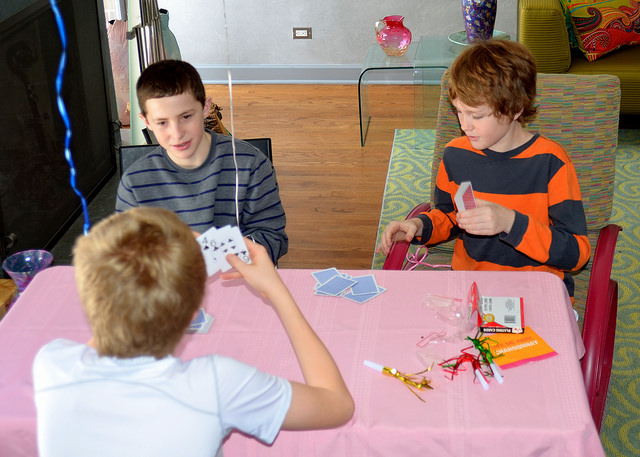
I missed out on the adventures at Twitter Math Camp, but I’m having a great time working through the blog posts about it. I prefer it this way — slow reading is more my speed. Chris at A Sea of Math posted a wonderful game based on one of the TMC workshops. Here is my variation.

Math concepts: comparing fractions, equivalent fractions, benchmark numbers, strategic thinking.

Players: two to four.

Equipment: two players need one deck of playing cards, three or four players need a double deck.

Continue reading Fraction Game: My Closest Neighbor

Quotable: Math Connections

ConnectedGearsJoBoaler

It turns out that the people who do well in math are those who make connections and see math as a connected subject. The people who don’t do well are people who see math as a lot of isolated methods.

— Jo Boaler
Math Connections

If you or your children struggle with math, Boaler’s non-profit YouCubed.org may help you recover your joy in learning.

Reblog: Solving Complex Story Problems

[Dragon photo above by monkeywingand treasure chest by Tom Praison via flickr.]

Dealing with Dragons

Over the years, some of my favorite blog posts have been the Word Problems from Literature, where I make up a story problem set in the world of one of our family’s favorite books and then show how to solve it with bar model diagrams. The following was my first bar diagram post, and I spent an inordinate amount of time trying to decide whether “one fourth was” or “one fourth were.” I’m still not sure I chose right.

I hope you enjoy this “Throw-back Thursday” blast from the Let’s Play Math! blog archives:


Solving-Complex-Story-Problems

Cimorene spent an afternoon cleaning and organizing the dragon’s treasure. One fourth of the items she sorted was jewelry. 60% of the remainder were potions, and the rest were magic swords. If there were 48 magic swords, how many pieces of treasure did she sort in all?

[Problem set in the world of Patricia Wrede’s Enchanted Forest Chronicles. Modified from a story problem in Singapore Primary Math 6B. Think about how you would solve it before reading further.]

How can we teach our students to solve complex, multi-step story problems? Depending on how one counts, the above problem would take four or five steps to solve, and it is relatively easy for a Singapore math word problem. One might approach it with algebra, writing an equation like:

x - \left[\frac{1}{4}x + 0.6\left(\frac{3}{4} \right)x  \right]  = 48

… or something of that sort. But this problem is for students who have not learned algebra yet. Instead, Singapore math teaches students to draw pictures (called bar models or math models or bar diagrams) that make the solution appear almost like magic. It is a trick well worth learning, no matter what math program you use …

[Click here to go read Solving Complex Story Problems.]

Update: My New Book

You can help prevent math anxiety by giving your children the mental tools they need to conquer the toughest story problems.

Read Cimorene’s story and many more in Word Problems from Literature: An Introduction to Bar Model Diagrams—now available at all your favorite online bookstores!

And there’s a Student Workbook, too.

Playing with Pinterest: New Math Boards

Do you like Pinterest? I’ve enjoyed exploring the site lately, so I set up a few boards where I can pin the goodies I find. It may take awhile before I get all the old games and posts from this blog loaded up, so save the links and come back often…

Playful Math Games & Activities

Middle-High School

As our children (and their parents!) play around with mathematical ideas and the relationships between them, we develop deep understanding that is strong enough to support future learning. Playful math links include math games, activities, and interesting lesson plans.

Math Doodling

Math Doodling

Making abstract math visual: Math doodles let us see and experiment with a wide range of mathematical structures — and even to feel them, if we include hands-on 3D doodles in clay or other media. Links include art projects, geometry constructions, and physical models to explore.

Math Teaching Tips & Resources

Math Teaching Tips

A variety of math teaching ideas for homeschool families or classroom teachers. Learning mathematics is more than just answer-getting: help your students make conceptual connections. These links are more “schooly” than on the other boards, and they include conceptual lessons that build your own understanding of mathematics as well as that of your students. And math notebooking resources, too.

MTaP Math Education Blog Carnival Archive

MTaP archive

Since early 2009, the Math Teachers at Play (MTaP) blog carnival has offered tips, tidbits, games, and activities for students and teachers of preschool through pre-college mathematics. Now published once a month, the carnival welcomes entries from parents, students, teachers, homeschoolers, and just plain folks. If you like to learn new things and play around with ideas, you are sure to find something of interest.

Math-Ed Quotes

Math-Ed Quotes

Inspiration for homeschooling parents and classroom teachers. This is where I’m posting my Wednesday Wisdom quotes.

And that’s the end of my Pinterest boards (so far).

What are some of your favorite Pinterest sites? Please share a link in the comments!

The Linear Inequality Adventures of Ohio Jones

Ohio Jones 1

Last week, Kitten and I reached her textbook’s chapter on graphing linear equations, and a minor mistake with negative numbers threw her into an “I can’t do it!” funk. It’s not easy teaching a perfectionist kid.

Usually her mood improves if we switch to a slightly more advanced topic, and luckily I had saved these worksheets on my desktop, waiting for just such an opportunity. Today’s lesson:

  • Some fun(ish) worksheets
    “For tomorrow, students will be graphing systems of inequalities, so I decided to create a little Ohio Jones adventure (Indiana’s lesser known brother)…”

I offered to give her a hint, but she wanted to try it totally on her own. It took her about 40 minutes to work through the first few rooms of the Lost Templo de los Dulces and explain her solutions to me. I’m sure she’ll speed up with experience.

So far, she’s enjoying it much more than the textbook lesson. It’s fascinating to me how the mere hint of fantasy adventure can change graphing equations from boring to cool. Thanks, Dan!

2014 Mathematics Game

2014-Calendar

[Feature photo above by Artis Rams (CC BY 2.0) via flickr. Title background (right) by Dan Moyle (CC BY 2.0) via flickr]

Have you made a New Year’s resolution to spend more time with your family this year, and to get more exercise? Problem-solvers of all ages can pump up their (mental) muscles with the Annual Mathematics Year Game Extravaganza!

For many years mathematicians, scientists, engineers and others interested in mathematics have played “year games” via e-mail and in newsgroups. We don’t always know whether it is possible to write expressions for all the numbers from 1 to 100 using only the digits in the current year, but it is fun to try to see how many you can find.

Math Forum Year Game Site

Rules of the Game

Use the digits in the year 2014 to write mathematical expressions for the counting numbers 1 through 100. The goal is adjustable by age: Young children can start with looking for 1-10, or 1-25.

  • You must use all four digits. You may not use any other numbers.
  • Solutions that keep the year digits in 2-0-1-4 order are preferred, but not required.
  • You may use +, -, x, ÷, sqrt (square root), ^ (raise to a power), ! (factorial), and parentheses, brackets, or other grouping symbols.
  • You may use a decimal point to create numbers such as .2, .02, etc., but you cannot write 0.02 because we only have one zero in this year’s number.
  • You may use the overhead-bar (vinculum), dots, or brackets to mark a repeating decimal.
  • You may create multi-digit numbers such as 10 or 201 or .01, but we prefer solutions that avoid them.
  • You may use a double factorial, but we prefer solutions that avoid them. n!! = the product of all integers from 1 to n that have the same parity (odd or even) as n.

[Note to students and teachers: If you want to take part in the Math Forum Year Game, be warned that they do not allow repeating decimals.]

Click here to continue reading.