How to Teach Math to a Struggling Student

photo by MC Quinn via flickr (CC BY 2.0)

Paraphrased from a homeschool math discussion forum:

“Help! My daughter struggles with arithmetic. I guess she is like me: just not a math person. She is an outstanding reader. When we do word problems, she usually has no trouble. She’s a whiz at strategy games and beats her dad at chess every time. But numbers — yikes! When we play Yahtzee, she gets lost trying to add up her score. The simple basics of adding and subtracting confuse her.

“Since I find math difficult myself, it’s hard for me to know what she needs. What’s missing to make it click for her? She used to think math was fun and tested well above grade level, but I listened to some well-meaning advice and totally changed the way we were schooling. I switched from using workbooks and games to using Saxon math, and she got extremely frustrated. Now she hates math.”

Continue reading How to Teach Math to a Struggling Student

500 (?) and Counting

Celebrate
Photo by rileyroxx.

Could this be my 500th post? That doesn’t seem possible, even counting all those half-finished-and-then-deleted drafts. Well, at least it is my 500th something, according to the WordPress.com dashboard. And surely a 500th anything is worth a small celebration, right?

Maybe my students aren’t so bad, after all…

It has been awhile since I posted a link to Rudbeckia Hirta’s Learning Curves blog. Here are a few of her students’ recent bloopers:

Continue reading 500 (?) and Counting

How to Read a Fraction

Fraction notation and operations may be the most abstract math monsters our students meet until they get to algebra. Before we can explain those frustrating fractions, we teachers need to go back to the basics for ourselves. First, let’s get rid of two common misconceptions:

  • A fraction is not two numbers.
    Every fraction is a single number. A fraction can be added to other numbers (or subtracted, multiplied, etc.), and it has to obey the Distributive Law and all the other standard rules for numbers. It takes two digits (plus a bar) to write a fraction, just as it takes two digits to write the number 18 — but, like 18, the fraction is a single number that names a certain amount of whatever we are counting or measuring.
  • A fraction is not something to do.
    A fraction is a number, not a recipe for action. The fraction 3/4 does not mean, “Cut your pizza into 4 pieces, and then keep 3 of them.” The fraction 3/4 simply names a certain amount of stuff, more than a half but not as much as a whole thing. When our students are learning fractions, we do cut up models to help them understand, but the fractions themselves are simply numbers.

Continue reading How to Read a Fraction

Quiz: Those Frustrating Fractions

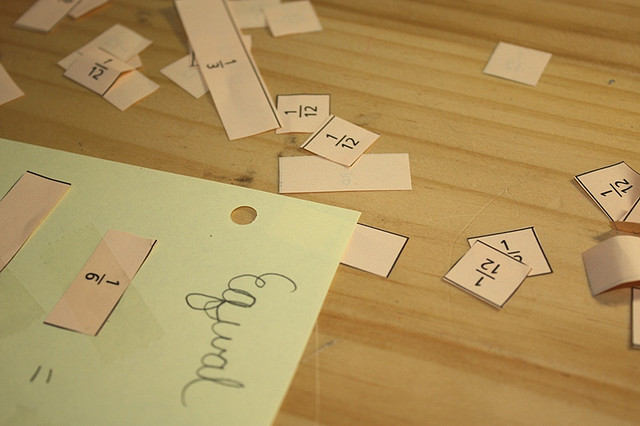
[Photo by jimmiehomeschoolmom.]

Fractions confuse almost everybody. In fact, fractions probably cause more math phobia among children (and their parents) than any other topic before algebra. Middle school textbooks devote a tremendous number of pages to teaching fractions, and still many students find fractions impossible to understand. Standardized tests are stacked with fraction questions.

Fractions are a filter, separating the math haves from the luckless have nots. One major source of difficulty with fractions is that the rules do not seem to make sense. Can you explain these to your children?

Start with an easy one…

Question #1

If you need a common denominator to add or subtract fractions…

  • Why don’t you need a common denominator when you multiply?

Continue reading Quiz: Those Frustrating Fractions

Reading to Learn Math

[Photo by Betsssssy.]

Do you ever take your kids’ math tests? It helps me remember what it is like to be a student. I push myself to work quickly, trying to finish in about 1/3 the allotted time, to mimic the pressure students feel. And whenever I do this, I find myself prone to the same stupid mistakes that students make.

Even teachers are human.

In this case, it was a multi-step word problem, a barrage of information to stumble through. In the middle of it all sat this statement:

…and there were 3/4 as many dragons as gryphons…

My eyes saw the words, but my mind heard it this way:

…and 3/4 of them were dragons…

What do you think — did I get the answer right? Of course not! Every little word in a math problem is important, and misreading even the smallest word can lead a student astray. My mental glitch encompassed several words, and my final tally of mythological creatures was correspondingly screwy.

But here is the more important question: Can you explain the difference between these two statements?

Continue reading Reading to Learn Math

Trouble with Percents

Can your students solve this problem?

There are 20% more girls than boys in the senior class.
What percent of the seniors are girls?

This is from a discussion of the semantics of percent problems and why students have trouble with them, going on over at MathNotations. (Follow-up post here.)

Our pre-algebra class just finished a chapter on percents, so I thought Chickenfoot might have a chance at this one. Nope! He leapt without thought to the conclusion that 60% of the class must be girls.

After I explained the significance of the word “than”, he solved the follow-up problem just fine.

Improper Fractions: A Mathematical Trauma

Feature photo (above) by Jimmie via flickr. Photo (right) by Old Shoe Woman via Flickr.

Nearing the end of Miquon Blue today, my youngest daughter encountered fractions greater than one. She collapsed on the floor of my bedroom in tears.

The worksheet started innocently enough:

\frac{1}{2} \times 8=\left[ \quad \right]

Continue reading Improper Fractions: A Mathematical Trauma

Confession: I Am Not Good at Math

I want to tell you a story. Everyone likes a story, right? But at the heart of my story lies a confession that I am afraid will shock many readers. People assume that because I teach math, blog about math, give advice about math on internet forums, and present workshops about teaching math — because I do all this, I must be good at math.

Apply logic to that statement. The conclusion simply isn’t valid. …

Update: This post has moved.

Click here to read the new, expanded version

Mathematics and Imagination

Comments by W. W. Sawyer, in his wonderful, little book, Mathematician’s Delight:

Earlier we considered the argument, ‘Twice two must be four, because we cannot imagine it otherwise.’ This argument brings out clearly the connexion between reason and imagination: reason is in fact neither more nor less than an experiment carried out in the imagination.

Continue reading Mathematics and Imagination