Euclid’s Geometric Algebra

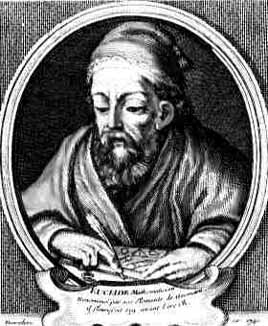
Picture from MacTutor Archives.

After the Pythagorean crisis with the square root of two, Greek mathematicians tried to avoid working with numbers. Instead, the Greeks used geometry to demonstrate mathematical concepts. A line can be drawn any length, so straight lines became a sort of non-algebraic variable.

You can see an example of this in The Pythagorean Proof, where Alexandria Jones represented the sides of her triangle by the letters a and b. These sides may be any length. The sizes of the squares will change with the triangle sides, but the relationship a^2 + b^2 = c^2 is always true for every right triangle.


Continue reading Euclid’s Geometric Algebra

If It Ain’t Repeated Addition, What Is It?

[Photo by SuperFantastic.]

Keith Devlin’s latest article, It Ain’t No Repeated Addition, brought me up short. I have used the “multiplication is repeated addition” formula many times in the past — for instance, in explaining order of operations. But according to Devlin:

Multiplication simply is not repeated addition, and telling young pupils it is inevitably leads to problems when they subsequently learn that it is not.

I found myself arguing with the article as I read it. (Does anybody else do that?) If multiplication is not repeated addition, then what in the world is it?

Continue reading If It Ain’t Repeated Addition, What Is It?

Diagnosis: Math Workbook Syndrome

Photo by otisarchives3.

I discovered a case of MWS (Math Workbook Syndrome) one afternoon, as I was playing Multiplication War with a pair of 4th grade boys. They did fine with the small numbers and knew many of the math facts by heart, but they consistently tried to count out the times-9 problems on their fingers. Most of the time, they lost track of what they were counting and gave wildly wrong answers.

Continue reading Diagnosis: Math Workbook Syndrome

Math Games by Kids

Photo by Mike Licht, NotionsCapital.com.

The cold came back and knocked me flat, but there are compensations. The downtime gave me a chance to browse my overflowing bookmarks folder, and I found something to add to my resource page. Princess Kitten and I enjoyed exploring these games and quizzes from Ambleweb.

Continue reading Math Games by Kids

How Should We Teach Arithmetic?

Dave Marain of MathNotations is running a poll about how to teach multiplication, but the question has broader application:

How should we teach the arithmetic algorithms
— or should we teach them at all?

Algorithms are step-by-step methods for doing something. In arithmetic, we have standard algorithms for addition, subtraction, multiplication, and long division. Once the student masters the steps for any particular algorithm, he can follow the steps to a correct answer without ever thinking about what the numbers mean.

Continue reading How Should We Teach Arithmetic?

Ben Franklin Math: Elementary Problem Solving 3rd Grade

The ability to solve word problems ranks high on any math teacher’s list of goals. How can I teach my students to solve math problems? I must help them develop the ability to translate “real world” situations into mathematical language.

In two previous posts, I introduced the problem-solving tools algebra and bar diagrams. These tools help our students organize the information in a word problem and translate it into a mathematical calculation.

Working Math Problems with Poor Richard

This time I will demonstrate these problem-solving tools in action with a series of 3rd-grade problems based on the Singapore Primary Math series, level 3A. For your reading pleasure, I have translated the problems into the life of Ben Franklin, inspired by the biography Poor Richard by James Daugherty.

Continue reading Ben Franklin Math: Elementary Problem Solving 3rd Grade

Penguin Math: Elementary Problem Solving 2nd Grade

The ability to solve word problems ranks high on any math teacher’s list of goals. How can I teach my students to reason their way through math problems? I must help my students develop the ability to translate “real world” situations into mathematical language.

In a previous post, I analyzed two problem-solving tools we can teach our students: algebra and bar diagrams. These tools help our students organize the information in a word problem and translate it into a mathematical calculation.

Now I want to demonstrate these problem-solving tools in action with a series of 2nd grade problems, based on the Singapore Primary Math series, level 2A. For your reading pleasure, I have translated the problems into the universe of one of our family’s favorite read-aloud books, Mr. Popper’s Penguins.

UPDATE: Problems have been genericized to avoid copyright issues.

Continue reading Penguin Math: Elementary Problem Solving 2nd Grade

7 Things to Do with a Hundred Chart


This post has been revised to incorporate all the suggestions in the comments below, plus many more activities. Please update your bookmarks:

Or continue reading the original article…


Continue reading 7 Things to Do with a Hundred Chart

Egyptian Math Puzzles

What we know about ancient Egyptian mathematics comes primarily from two papyri, the first one written around 1850 BC. Moscow papyrus problem 14This is called the Moscow papyrus, because it now belongs to Moscow’s Pushkin Museum of Fine Arts. The scroll contains 25 problems, mostly practical examples of various calculations. Problem 14, which finds the volume of a frustrum (a pyramid with its top cut off), is often cited by mathematicians as the most impressive Egyptian pyramid of all.

Continue reading Egyptian Math Puzzles