Remember the Math Adventurer’s Rule: Figure it out for yourself! Whenever I give a problem in an Alexandria Jones story, I will try to post the answer soon afterward. But don’t peek! If I tell you the answer, you miss out on the fun of solving the puzzle. So if you haven’t worked these problems yet, go back to the original posts. Figure them out for yourself — and then check the answers just to prove that you got them right.
Alex’s & Leon’s Homeschool Puzzle
While checking out the book table after a homeschool group meeting, Maria Jones glanced up to see her children laughing with some kids she did not recognize. Driving home, she asked about the new family, but Alex and Leon had been too busy exchanging silly stories to even ask the strangers’ names.
“Well,” Leon said, “the boy told me he has twice as many sisters as brothers.”
No way!” said Alex. “The girl told me that she has the same number of brothers and sisters.”
How can that be?
Leonhard’s Block Puzzles
 Leonhard Jones is Alexandria Jones’s younger brother. He enjoys woodworking, and he cut a wooden cube into 8 smaller blocks to make himself a puzzle.
Puzzle #1
Leon painted the 8 blocks with his two favorite colors: red and forest green. When he was finished, Leon could put the blocks together into a red cube, or he could switch them around to make a green cube.
How did Leon paint his blocks?
2008 Mathematics Game
Are you ready for a challenge? Join us for the 2008 Mathematics Game. Here are the rules:
Use the digits in the year 2008 and the operations +, -, x, ÷, sqrt (square root), ^ (raise to a power), and ! (factorial) — along with parentheses, brackets, or other grouping symbols — to write expressions for the counting numbers 1 through 100.
- All four digits must be used in each expression.
- Only the digits 2, 0, 0, 8 may be used.
- Multi-digit numbers such as 20, 208, or .02 MAY be used this year.
- The square function may NOT be used.
- The integer function may NOT be used.
By definition:
[See Dr. Math’s Why does 0 factorial equal 1?]

For this game we will accept the value:
[See the Dr. Math FAQ 0 to the 0 power.]

Puzzles for the New Year

As we all head back to school, here are some interesting calendar puzzles:
- 2008 is a leap year. Why do leap years happen? If we didn’t add a leap day every so often, would January eventually come in the summer?
- Today is Thursday. What day of the week will it be exactly one year from today?
- January 1, 2008, came on a Tuesday. When will be the next year that begins on Tuesday?
- My birthday (in March) lands on a Monday this year. When is the next year my birthday will come on a Monday? How about YOUR birthday — when is the next time it will happen on the same day of the week as this year?
- Can you find a pattern in the way dates move from one day of the week to another, year after year?
Magic Square Puzzles
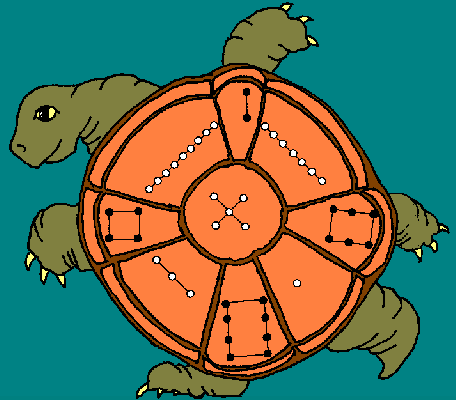
Alex handed her brother Leonhard a box wrapped in the rocket tessellation paper, with air holes carefully punched in two sides.
“Merry Christmas, Leon!” she said.
He ripped open the gift. Alex winced. Boys have no artistic appreciation, she thought.
“Oh, cool! Thanks,” Leon said.
“His name is Lo-shu,” said Alex. “But be careful. I used non-toxic tempera paint. The design will was off.”
Leon turned the turtle and studied the back of its shell. “Oh, that’s just like in the legend! I’ll copy it down before I let him near any water.”
- What do the shapes on Lo-shu’s back mean?
- Why are some dots white and some black?
Leon’s Christmas Gift
Here is the simplest puzzle from the November/December 1998 issue of Alexandria Jones stories. The answer (and more puzzles) will follow.
Christmas gift for Leon (pdf, 68KB)
Edited to Add
More puzzles are now here:
Answers are also posted:
To Be Continued…
Read all the posts from the November/December 1998 issue of my Mathematical Adventures of Alexandria Jones newsletter.
The Golden Christmas Tree
Last time, Alexandria Jones and her family were on their way to Uncle William’s tree farm to find the perfect Christmas tree, and Dr. Jones taught us about the Golden Section:

|———————A———————|————B————|

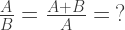
I gave you three algebra puzzles to solve. Did you try them?
- What is the exact value of the Golden Section ratio?
- If a 7-foot tree will fit in the Jones family’s living room, allowing for the tree stand and for a star on top, how wide will the tree be?
- Approximately how much surface area will Alex and Leon have to fill with lights and ornaments?
Math Adventurer’s Rule: Figure It Out for yourself
Whenever I give a problem in an Alexandria Jones story, I will try to post the answer soon afterward. But don’t peek! If I tell you the answer, you miss out on the fun of solving the puzzle. So if you have not worked these problems yet, go back to the original post. Figure them out for yourself — and then check the answers just to prove that you got them right.
A-Hunting They Will Go
Alexandria Jones and her family piled into the car for a drive in the country. This year, they were determined to find an absolutely perfect Christmas tree at Uncle William Jones’s tree farm.
“I want the tallest tree in Uncle Will’s field,” Alex said.
“Hold it,” said her mother. “I refuse to cut a hole in the roof.”
“But, Mom!” Leon whined. “The Peterkin Papers…”
“Too bad. Our ceiling will stay a comfortable 8 feet high.”
The Christmas Present Quandary
Alexandria Jones hated using store-bought wrapping paper at Christmas. She tried to wrap each present as a hand-crafted work of art.
Last year, she did mini-scenes with plastic figures building cotton snowmen or skating on aluminum-foil ponds — and, for her brother Leonhard’s gift, her favorite creation: toy dinosaurs having a snowball fight. But those 3-D scenes got knocked about under the Christmas tree.
This year, she decided, she would wrap the packages flat. But then, how could she make them special?

