Many children are confused by decimals. They are convinced 0.48 > 0.6 because 48 is obviously ever so much bigger than 6. Their intuition tells them 0.2 × 0.3 = 0.6 has the clear ring of truth. And they confidently assert that, if you want to multiply a decimal number by 10, all you have to do is add a zero at the end.
What can we do to help our kids understand decimals?
Christopher Danielson (author of Talking Math with Your Kids) will be hosting the Triangleman Decimal Institute, a free, in-depth, online chat for “everyone involved in children’s learning of decimals.” The Institute starts tomorrow, September 30 (sorry for the short notice!), but you can join in the discussion at any time:
Welcome to the Math Teachers At Play blog carnival — which is not just for math teachers! If you like to learn new things and play around with ideas, you are sure to find something of interest.
By tradition, we start the carnival with a couple of puzzles in honor of our 66th edition.
Let the mathematical fun begin!
Puzzle 1
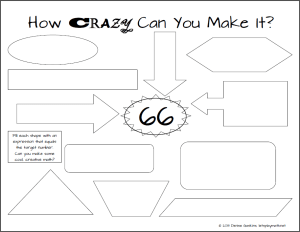
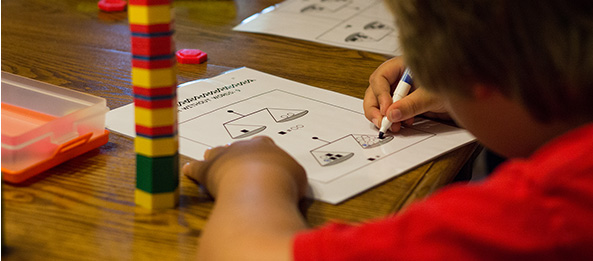
Our first puzzle is based on one of my favorite playsheets from the Miquon Math workbook series. Fill each shape with an expression that equals the target number. Can you make some cool, creative math?
Click the image to download the pdf playsheet set: one page has the target number 66, and a second page is blank so you can set your own target number.
Our homeschool runs a bit off-schedule from the rest of the U.S. school system, as we are still finishing up last year’s work. Even so, we’re calling this month the “beginning” of Kitten’s high school years, which seems to me like something to celebrate.
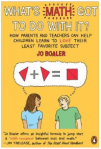
Therefore, I’m launching a one-week sale on my math book:
Please feel free to share the coupon code with your friends.
Update: I’ve just opened up a Ganxy showcase with the sale price, for anyone who would prefer to buy the ebook (in pdf, mobi, and epub) directly from me:
Here is yet another wonderful summer math opportunity for homeschoolers or anyone who works with kids: a free, 3-week mini-course on math problem solving for all ages.
The course is being organized by Dr. James Tanton, Dr. Maria Droujkova, and Yelena McManaman. The course participants include families, math clubs, playgroups, and other small circles casually exploring adventurous mathematics with kids of any age.
Would you like to join us? Check out the mpsMOOC13 home page for instructions. The deadline for joining is July 7 July 3.
Here’s an interesting summer learning opportunity for homeschooling parents and classroom teachers alike. Stanford Online is offering a free summer course from math education professor and author Jo Boaler:
During off-times, at a long stoplight or in grocery store line, when the kids are restless and ready to argue for the sake of argument, I invite them to play the numbers game.
“Can you tell me how to get to twelve?”
My five year old begins, “You could take two fives and add a two.”
“Take sixty and divide it into five parts,” my nearly-seven year old says.
“You could do two tens and then take away a five and a three,” my younger son adds.
Eventually we run out of options and they begin naming numbers. It’s a simple game that builds up computational fluency, flexible thinking and number sense. I never say, “Can you tell me the transitive properties of numbers?” However, they are understanding that they can play with numbers.
…
photo by Mike Baird via flickr
I didn’t learn the rules of baseball by filling out a packet on baseball facts. Nobody held out a flash card where, in isolation, I recited someone else’s definition of the Infield Fly Rule. I didn’t memorize the rules of balls, strikes, and how to get someone out through a catechism of recitation.
If you’d like to help fund the blog on an on-going basis, then please join me on Patreon for mathy inspiration, tips, and an ever-growing archive of printable activities.
If you liked this post, and want to show your one-time appreciation, the place to do that is PayPal: paypal.me/DeniseGaskinsMath. If you go that route, please include your email address in the notes section, so I can say thank you.
Do you enjoy math? I hope so! If not, browsing this post just may change your mind. Welcome to the Math Teachers At Play blog carnival — a smorgasbord of ideas for learning, teaching, and playing around with math from preschool to pre-college.
Let the mathematical fun begin!
POLYHEDRON PUZZLE
By tradition, we start the carnival with a puzzle in honor of our 62nd edition:
An Archimedean solid is a polyhedron made of two or more types of regular polygons meeting in identical vertices. A rhombicosidodecahedron (see image above) has 62 sides: triangles, squares, and pentagons.
How many of each shape does it take to make a rhombicosidodecahedron?
Click for template.
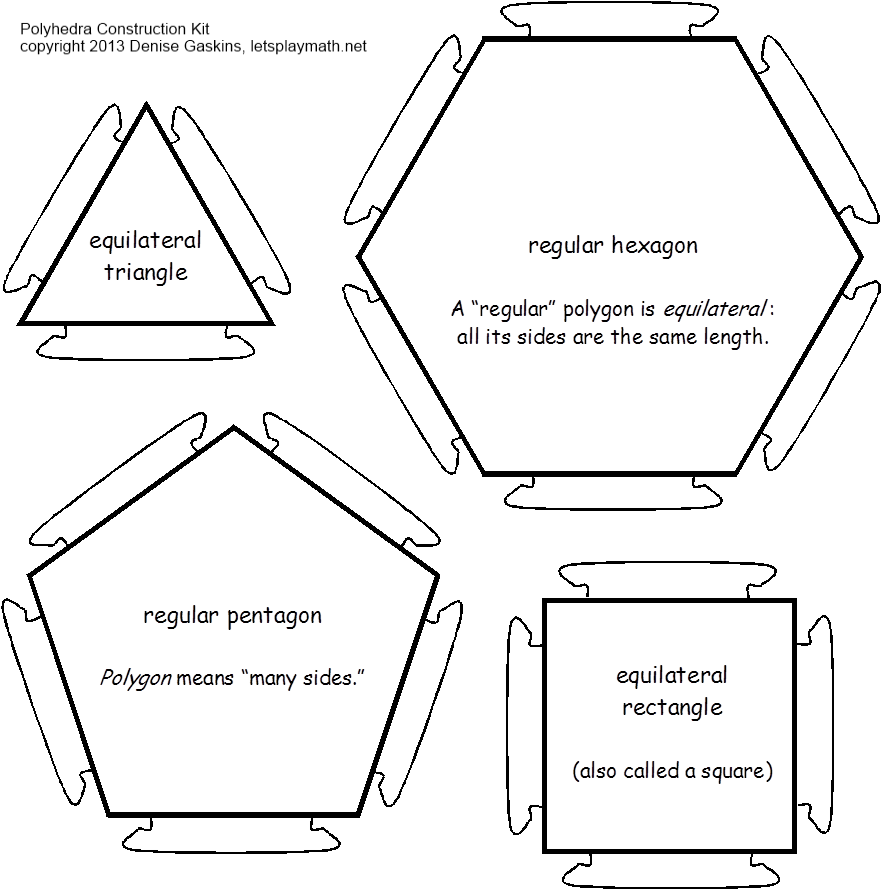
My math club students had fun with a Polyhedra Construction Kit. Here’s how to make your own:
Collect a bunch of empty cereal boxes. Cut the boxes open to make big sheets of cardboard.
Print out the template page (→) and laminate. Cut out each polygon shape, being sure to include the tabs on the sides.
Turn your cardboard brown-side-up and trace around the templates, making several copies of each polygon. I recommend 20 each of the pentagon and hexagon, 40 each of the triangle and square.
Draw the dark outline of each polygon with a ballpoint pen, pressing hard to score the cardboard so the tabs will bend easily.
Cut out the shapes, being careful around the tabs.
Use small rubber bands to connect the tabs. Each rubber band will hold two tabs together, forming one edge of a polyhedron.
So, for instance, it takes six squares and twelve rubber bands to make a cube. How many different polyhedra (plural of polyhedron) will you make?
Can you build a rhombicosidodecahedron?
And now, on to the main attraction: the 62 blog posts. Many of the following articles were submitted by their authors; others were drawn from the immense backlog in my blog reader. If you’d like to skip directly to your area of interest, here’s a quick Table of Contents:
As for mathematics itself, it’s one of the most adventurous endeavors a young child can experience. Mathematics is exotic, even bizarre. It is surprising and unpredictable. And it can be more exciting, scary and dangerous than sailing the high seas!
But most parents and educators don’t present math this way. They just want the children to develop their mathematical skills rather than going for something more nebulous, like the mathematical state of mind.
…
Children marvel as snowflakes magically become fractals, inviting explorations of infinity, symmetry and recursion. Cookies offer gameplay in combinatorics and calculus. Paint chips come in beautiful gradients, and floor tiles form tessellations. Bedtime routines turn into children’s first algorithms. Cooking, then mashing potatoes (and not the other way around!) humorously introduces commutative property. Noticing and exploring math becomes a lot more interesting, even addictive.
Unlike simplistic math that quickly becomes boring, these deep experiences remain fresh, because they grow together with children’s and parents’ understanding of mathematics.
After teaching co-op math classes for several years, I’ve become known as the local math maven. Upon meeting one of my children, fellow homeschoolers often say, “Oh, you’re Denise’s son/daughter? You must be really good at math.”
The kids do their best to smile politely — and not to roll their eyes until the other person has turned away.
I hear similar comments after teaching a math workshop: “Wow, your kids must love math!” But my children are individuals, each with his or her own interests. A couple of them enjoy an occasional geometry or logic puzzle, but they never voluntarily sit down to slog through a math workbook page.
In fact, one daughter expressed the depth of her youthful perfectionist angst by scribbling all over the cover of her Miquon math workbook:
“I hate math! Hate, hate, hate-hate-HATE MATH!!!”
Translation: “If I can’t do it flawlessly the first time, then I don’t want to do it at all.”








 Denise Gaskins' Let's Play Math