Diagnosis: Math Workbook Syndrome

Photo by otisarchives3.

I discovered a case of MWS (Math Workbook Syndrome) one afternoon, as I was playing Multiplication War with a pair of 4th grade boys. They did fine with the small numbers and knew many of the math facts by heart, but they consistently tried to count out the times-9 problems on their fingers. Most of the time, they lost track of what they were counting and gave wildly wrong answers.

Continue reading Diagnosis: Math Workbook Syndrome

How to Teach Math to a Struggling Student

photo by MC Quinn via flickr (CC BY 2.0)

Paraphrased from a homeschool math discussion forum:

“Help! My daughter struggles with arithmetic. I guess she is like me: just not a math person. She is an outstanding reader. When we do word problems, she usually has no trouble. She’s a whiz at strategy games and beats her dad at chess every time. But numbers — yikes! When we play Yahtzee, she gets lost trying to add up her score. The simple basics of adding and subtracting confuse her.

“Since I find math difficult myself, it’s hard for me to know what she needs. What’s missing to make it click for her? She used to think math was fun and tested well above grade level, but I listened to some well-meaning advice and totally changed the way we were schooling. I switched from using workbooks and games to using Saxon math, and she got extremely frustrated. Now she hates math.”

Continue reading How to Teach Math to a Struggling Student

Substitute Teacher Experiments with Combinatorics


Photo by peigianlong.

Here is a puzzle from Just a Substitute Teacher:

Lesson plan entry: “Hand out worksheet packets and have students staple before starting. They know what to do.”

Sounds simple enough! Four numbered sheets, eight total pages, printed front and back. What could go wrong?

Do you know how many possible combinations four pieces of paper can be arranged for stapling?

Continue reading Substitute Teacher Experiments with Combinatorics

Subtracting Mixed Numbers: A Cry for Help

Photo by powerbooktrance.

Paraphrased from a homeschool math discussion forum:

“Help me teach fractions! My son can do long subtraction problems that involve borrowing, and he can handle basic fraction math, but problems like 9  -  5 \frac{2}{5} give him a brain freeze. To me, this is an easy problem, but he can’t grasp the concept of borrowing from the whole number. It is even worse when the math book moves on to 10 \frac{1}{4}  -  2 \frac{3}{7} .”

Several homeschooling parents replied to this question, offering advice about various fraction manipulatives that might be used to demonstrate the concept. I am not sure that manipulatives are needed or helpful in this case. The boy seems to have the basic concept of subtraction down, but he gets flustered and is unsure of what to do in the more complicated mixed-number problems.

The mother says, “To me, this is an easy problem” — and that itself is one source of trouble. Too often, we adults (homeschoolers and classroom teachers alike) don’t appreciate how very complicated an operation we are asking our students to perform. A mixed-number calculation like this is an intricate dance that can seem overwhelming to a beginner.

I will go through the calculation one bite at a time, so you can see just how much a student must remember. As you read through the steps, pay attention to your own emotional reaction. Are you starting to feel a bit of brain freeze, too?

Afterward, we’ll discuss how to make the problem simpler…

Continue reading Subtracting Mixed Numbers: A Cry for Help

500 (?) and Counting

Celebrate
Photo by rileyroxx.

Could this be my 500th post? That doesn’t seem possible, even counting all those half-finished-and-then-deleted drafts. Well, at least it is my 500th something, according to the WordPress.com dashboard. And surely a 500th anything is worth a small celebration, right?

Maybe my students aren’t so bad, after all…

It has been awhile since I posted a link to Rudbeckia Hirta’s Learning Curves blog. Here are a few of her students’ recent bloopers:

Continue reading 500 (?) and Counting

How Should We Teach Arithmetic?

Dave Marain of MathNotations is running a poll about how to teach multiplication, but the question has broader application:

How should we teach the arithmetic algorithms
— or should we teach them at all?

Algorithms are step-by-step methods for doing something. In arithmetic, we have standard algorithms for addition, subtraction, multiplication, and long division. Once the student masters the steps for any particular algorithm, he can follow the steps to a correct answer without ever thinking about what the numbers mean.

Continue reading How Should We Teach Arithmetic?

Quotations XIX: How Do We Learn Math?

He doesn’t learn algebra
in the algebra course;
he learns it in calculus.

I have been catching up on my Bloglines reading [procrastinating blogger at work — I should be going over the MathCounts lesson for Friday’s homeschool co-op class], and found the following quotation at Mathematics under the Microscope [old blog posts are no longer archived].

Continue reading Quotations XIX: How Do We Learn Math?

Best of “Let’s Play Math!” in 2007

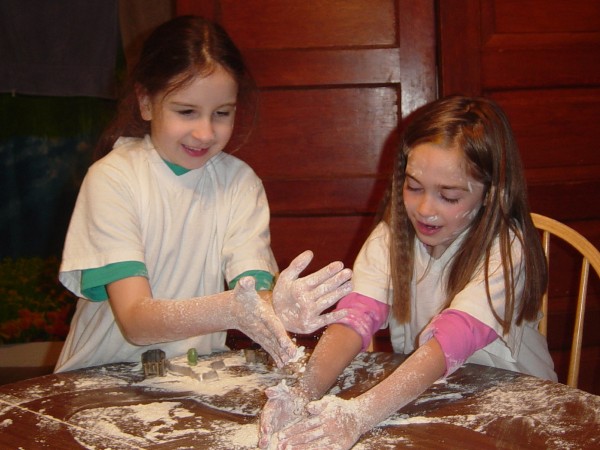
Cooking class

Farewell to 2007. We have snacks on the table so we can munch the night away, and the little ones are giggling over their Barbies, thrilled at the prospect of more sugar than is good for them.

Beach party

The teenagers have launched their annual movie marathon. This year, it was the girls’ turn to invite friends over, so the men in my life have all found excuses to run into town.

Winter in Illinois

Meanwhile, I am hiding in my den, indulging myself in a sort of blogger’s nostalgia. Some of the following posts got a lot of attention when they were published, others not so much. Topics range from preschool to high school, Captain Kitten from kindergarten games to teaching fractions to Shakespearean insults, so I hope there is something to interest everyone.

[The photos are small so this article won’t take forever to load. Click on any picture to view a larger image.]

Continue reading Best of “Let’s Play Math!” in 2007

Word Problems in Russia and America

Andrei Toom calls this an “extended version” of a talk he gave a few years ago at the Swedish Mathematical Society. At 159 pages [2010 updated version is 98 pages], I would call it a book. Whatever you call it, it’s a must-read for math teachers:

Main Thesis: Word problems are very valuable in teaching mathematics not only to master mathematics, but also for general development. Especially valuable are word problems solved with minimal scolarship, without algebra, even sometimes without arithmetics, just by plain common sense. The more naive and ingenuous is solution, the more it provides the child’s contact with abstract reality and independence from authority, the more independent and creative thinker the child becomes.

Continue reading Word Problems in Russia and America