Quotable: Math Connections

It turns out that the people who do well in math are those who make connections and see math as a connected subject. The people who don’t do well are people who see math as a lot of isolated methods.
— Jo Boaler
Math Connections
If you or your children struggle with math, Boaler’s non-profit YouCubed.org may help you recover your joy in learning.
Math Playtime With Blocks
Feature video by Stuart Jeckel via youtube.
DO Try This at Home
And ask questions!
- What do you notice?
- What do you wonder?
- Will the pattern continue?
- How can we know for sure?
Algebra for (Almost) Any Age
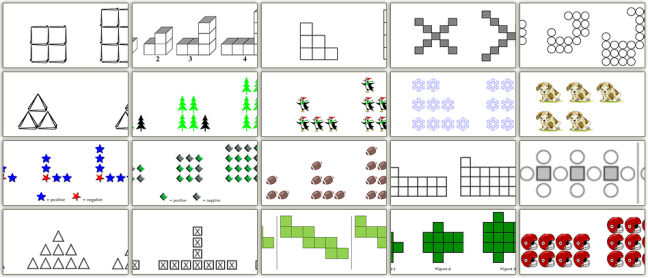
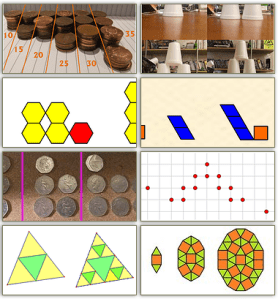
Fawn Nguyen’s Visual Patterns website just keeps getting better and better. Check it out:
In addition to the 115 puzzle patterns (as of this writing), the site features a Gallery page of patterns submitted by students. And under the “Teachers” tab, Fawn shares a form to guide students in thinking their way through to the algebraic formula for a pattern.
How can you use these patterns to develop algebraic thinking with younger students? Mike Lawler and sons demonstrate Pattern #1 in the YouTube video below.
A Math Major Talks About Fear
I’ve dipped my toes in Twitter lately (as part of the Explore #MTBoS program) and been swept up in a crashing tsunami of information. There’s no way to keep up with it all, but I’ll let the tide wash over me and enjoy the tidbits I happen to notice as they float by. For instance, yesterday I discovered a writer who offers tip on writing about injuries and was able to get some great advice for Kitten’s sequel to her first novel.
And then today, Steven Strogatz posted a link to Saramoira Shields, a new blogger I might never have discovered on my own. I think you’ll enjoy her video:
Puzzle: Algebra on Rectangles
Gordon Hamilton of Math Pickle recently posted these videos on how to make algebra 1 puzzles on rectangles. As I was watching, Kitten came in and looked over my shoulder. She said, “Those look like fun!”
They look like fun to me, too, and I bet your beginning algebra students will enjoy them:
- Single Variable Algebra on Rectangles
- History and Algebra Puzzles (part 2)
- Squaring.net collection of rectangles tiled with squares, sorted by size ratio
Multiplying Negative Numbers with Rectangles
I love using rectangles as a model for multiplication. In this video, Mike & son offer a pithy demonstration of WHY a negative number times a negative number has to come out positive:
How To Master Quadratic Equations

Feature photo above by Junya Ogura via Flickr (CC BY 2.0).
A couple of weeks ago, James Tanton launched a wonderful resource: a free online course devoted to quadratic equations. (And he promises more topics to come.)
Kitten and I have been working through the lessons, and she loves it!
We’re skimming through pre-algebra in our regular lessons, but she has enjoyed playing around with simple algebra since she was in kindergarten. She has a strong track record of thinking her way through math problems, and earlier this year she invented her own method for solving systems of equations with two unknowns.
I would guess her background is approximately equal to an above-average Algebra 1 student near the end of the first semester.
After few lessons of Tanton’s course, she proved — within the limits of experimental error — that a catenary (the curve formed by a hanging chain) cannot be described by a quadratic equation. Last Friday, she easily solved the following equations:

and:

and (though it took a bit more thought):

We’ve spent less than half an hour a day on the course, as a supplement to our AoPS Pre-Algebra textbook. We watch each video together, pausing occasionally so she can try her hand at an equation before listening to Tanton’s explanation. Then (usually the next day) she reads the lesson and does the exercises on her own.
So far, she hasn’t needed the answers in the Companion Guide to Quadratics, but she did use the “Dots on a Circle” activity — and knowing that she has the answers available helps her feel more independent.
Beautiful Math: Visualizing Music
Mathematicians Ask Questions
If we want to teach our children to think mathematically, we need to model and encourage asking questions. For instance:
- What is the difference between the rectangular sounds and the round ones?
- At 5:20, the orange notes (violin) change to a different shape. Why? What change in the sound does this represent?
What questions does the video inspire for you? I’d love to hear your comments!
 Denise Gaskins' Let's Play Math