Puzzle: Random Blocks

Red block puzzle

In the first section of George Lenchner’s Creative Problem Solving in School Mathematics, right after his obligatory obeisance to George Polya (see the third quote here), Lechner poses this problem. If you have seen it before, be patient — his point was much more than simply counting blocks.

A wooden cube that measures 3 cm along each edge is painted red. The painted cube is then cut into 1-cm cubes as shown above. How many of the 1-cm cubes do not have red paint on any face?

And then he challenges us as teachers:

Do you have any ideas for extending the problem?
If so, then jot them down.

This is strategically placed at the end of a right-hand page, and I was able to resist turning to read on. I came up with a list of 15 other questions that could have been asked — some of which will be used in future Alexandria Jones stories. Lechner wrote only seven elementary-level problems, and yet his list had at least two questions that I had not considered. How many can you come up with?

Continue reading Puzzle: Random Blocks

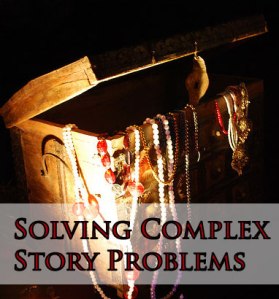
Solving Complex Story Problems

[Dragon photo above by monkeywingand treasure chest by Tom Praison via flickr.]

Solving-Complex-Story-Problems

Let’s play around with a middle-school/junior high word problem:

Cimorene spent an afternoon cleaning and organizing the dragon’s treasure. One fourth of the items she sorted was jewelry. 60% of the remainder were potions, and the rest were magic swords. If there were 48 magic swords, how many pieces of treasure did she sort in all?

[Problem set in the world of Patricia Wrede’s Enchanted Forest Chronicles. Modified from a story problem in Singapore Primary Math 6B. Think about how you would solve it before reading further.]

How can we teach our students to solve complex, multi-step story problems? Depending on how one counts, the above problem would take four or five steps to solve, and it is relatively easy for a Singapore math word problem. One might approach it with algebra, writing an equation like:

x - \left[\frac{1}{4}x + 0.6\left(\frac{3}{4} \right)x  \right]  = 48

…or something of that sort. But this problem is for students who have not learned algebra yet. Instead, Singapore math teaches students to draw pictures (called bar models or math models or bar diagrams) that make the solution appear almost like magic. It is a trick well worth learning, no matter what math program you use.

Continue reading Solving Complex Story Problems

Bill Gates Proportions II

[Feature photo above by Remy Steinegger via Wikimedia Commons (CC BY 2.0).]

Another look at the Bill Gates proportion… Even though I couldn’t find any data on his real income, I did discover that the median American family’s net worth was $93,100 in 2004 (most of that is home equity) and that the figure has gone up a bit since then. This gives me another chance to play around with proportions.

So I wrote a sample problem for my Advanced Math Monsters workshop at the APACHE homeschool conference:

The median American family has a net worth of about $100 thousand. Bill Gates has a net worth of $56 billion. If Average Jane Homeschooler spends $100 in the vendor hall, what would be the equivalent expense for Gates?

Continue reading Bill Gates Proportions II

Putting Bill Gates in Proportion

[Feature photo above by Baluart.net.]

A friend gave me permission to turn our email discussion into an article…

Can you help us figure out how to figure out this problem? I think we have all the information we need, but I’m not sure:

The average household income in the United States is $60,000/year. And a man’s annual income is $56 billion. Is there a way to figure out what this man’s value of $1mil is, compared to the person who earns $60,000/year? In other words, I would like to say — $1,000,000 to us is like 10 cents to Bill Gates.

Continue reading Putting Bill Gates in Proportion

The Case of the Mysterious Story Problem

[Feature photo above by Carla216 via flickr (CC BY 2.0). This post was rescued from my old blog.]
I love story problems. Like a detective, I enjoy sifting out clues and solving the mystery. But what do you do when you come across a real stumper? Acting out story problems could make a one-page assignment take all week.

You don’t have to bake a pie to study fractions or jump off a cliff to learn gravity. Use your imagination instead. The following suggestions will help you find the clues you need to solve the case.

Continue reading The Case of the Mysterious Story Problem

Elementary Problem Solving: The Early Years

[Rescued from my old blog. To read the entire series, click here: Elementary Problem Solving Series. Photo by Studio 757 via Flickr (CC BY 2.0).]

You can begin to teach your children algebraic thinking in preschool, if you treat algebra as a problem-solving game. Young children are masters at solving problems, at figuring things out. They constantly explore their world, piecing together the mystery of how things work. For preschool children, mathematical concepts are just part of life’s daily adventure. Their minds grapple with understanding the three-ness of three blocks or three fingers or one raisin plus two more raisins make three.

Wise homeschooling parents put those creative minds to work. They build a foundation for algebra with games that require the same problem-solving skills children need for abstract math: the ability to visualize a situation and to apply common sense.

Continue reading Elementary Problem Solving: The Early Years

Story Problem Challenge Revisited

Well, I didn’t get any takers with the last story problem challenge. But school is in full session now, and we’re doing story problems in Math Club this Friday, so I thought I’d try again.

Here’s the challenge: Can you and your students make up some original math problems?

In Math Club, we always start by reading part of the book Math by Kids for inspiration. I can’t print those stories here, however, because of copyright rules, so I’ll share some of the stories my past students have made, arranged in roughly increasing order of difficulty. After you solve a couple of these problems with your children, encourage them to try making some of their own.

And please, share their gems with us!

Update

The problems below are now available as a printable handout: Story Problem Challenge.

Continue reading Story Problem Challenge Revisited

Percents: The Search for 100%

[Rescued from my old blog.]

Percents are one of the math monsters, the toughest topics of elementary and junior high school arithmetic. The most important step in solving any percent problem is to figure out what quantity is being treated as the basis, the whole thing that is 100%. The whole is whatever quantity to which the other things in the problem are being compared.

Continue reading Percents: The Search for 100%

Percents: Key Concepts and Connections

[Rescued from my old blog.]

Paraphrased from a homeschool math discussion forum:

“I am really struggling with percents right now, and feel I am in way over my head!”

Percents are one of the math monsters, the toughest topics of elementary and junior high school arithmetic. Here are a few tips to help you understand and teach percents.

Continue reading Percents: Key Concepts and Connections

Story Problem Challenge

[Rescued from my old blog.]

Well, my computer is still being rebellious, so I’m at dh’s office again to check e-mail while the kids are gone to karate. But I thought it was high time I got another entry up on the blog…

One of my favorite activities for Math Club is to have my students write their own story problems. Then we pass the problems around so everyone can try to solve them. With all the discussion of problem solving on the math forum lately, I thought it would be fun to extend the challenge to you all. Can you come up with a word problem for us to practice our problem-solving skills on?

Continue reading Story Problem Challenge