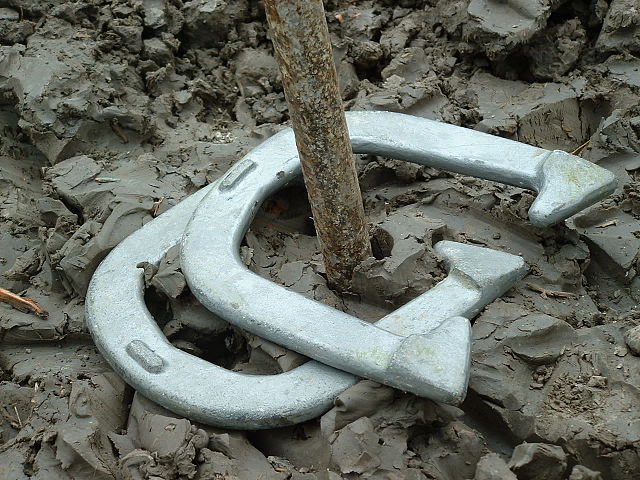
Horseshoes: A Place Value Game

[Feature photo above by Johnmack161 via Wikimedia Commons (CC BY 2.5).]

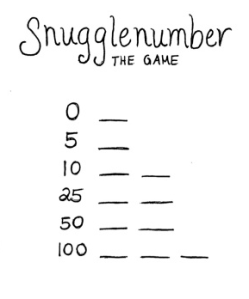
I first saw place value games on the old PBS Square One TV show (video below). Many teachers have posted versions of the game online, but Snugglenumber by Anna Weltman is by far the cutest variation. Anna kindly gave me permission to use the game in my upcoming Math You Can Play book series, and I added the following variation:

Horseshoes
snugglenumber

Math Concepts: place value, strategic thinking.
Players: two or more.
Equipment: one deck of playing cards, or a double deck for more than three players.

Separate out the cards numbered ace (one) through nine, plus cards to represent the digit zero. We use the queens (Q is round enough for pretend), but you could also use the tens and just count them as zero.

Shuffle well and deal eleven cards to each player. Arrange your cards in the snugglenumber pattern shown here, one card per blank line, to form numbers that come as close to each target number as you can get it.
Continue reading Horseshoes: A Place Value Game

Fraction Game: My Closest Neighbor

[Feature photo above by Jim Larrison, and antique playing cards below by Marcee Duggar, via Flickr (CC BY 2.0).]

I missed out on the adventures at Twitter Math Camp, but I’m having a great time working through the blog posts about it. I prefer it this way — slow reading is more my speed. Chris at A Sea of Math posted a wonderful game based on one of the TMC workshops. Here is my variation.

Math concepts: comparing fractions, equivalent fractions, benchmark numbers, strategic thinking.

Players: two to four.

Equipment: two players need one deck of playing cards, three or four players need a double deck.

Continue reading Fraction Game: My Closest Neighbor

Multiplication Models Card Game

multfrac-300Update: An expanded version of this post is featured in my book Multiplication & Fractions: Math Games for Tough Topics, available now at your favorite online book dealer.

Homeschooling parents know that one of the biggest challenges for any middle-elementary math student is to master the multiplication facts. It can seem like an unending task to memorize so many facts and be able to pull them out of mental storage in any order on demand.

Too often, we are tempted to stress the rote aspect of such memory work, which makes our children lose their focus on what multiplication really means. Before practicing the times table facts, make sure your student gets plenty of practice recognizing and using the common models for multiplication.

To help your children see what multiplication looks like in real life, explore the multitude of Multiplication Models collected at the Natural Math website. Or sign up for their Multiplication Explorers Online Course.

You may want to pick up this poster and use it for ideas as you play the Tell Me a (Math) Story game. Word problems are important for children learning any new topic in math, because they give children a mental “hook” on which to hang the abstract number concepts.

And for extra practice, you can play my free card game…

Click here to continue reading.

Maze Game: Land or Water?

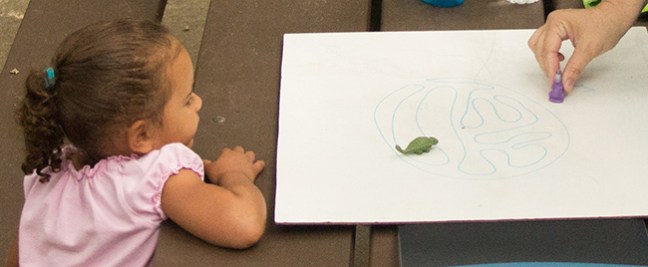
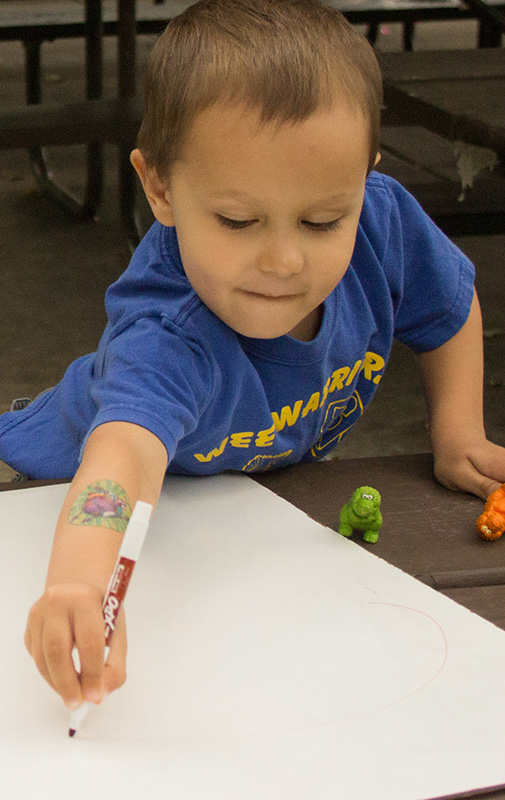
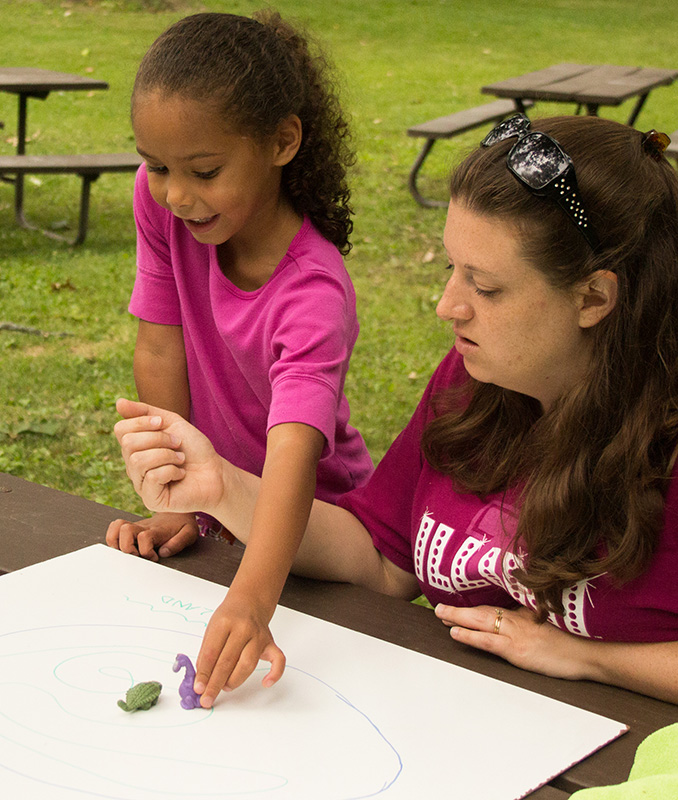
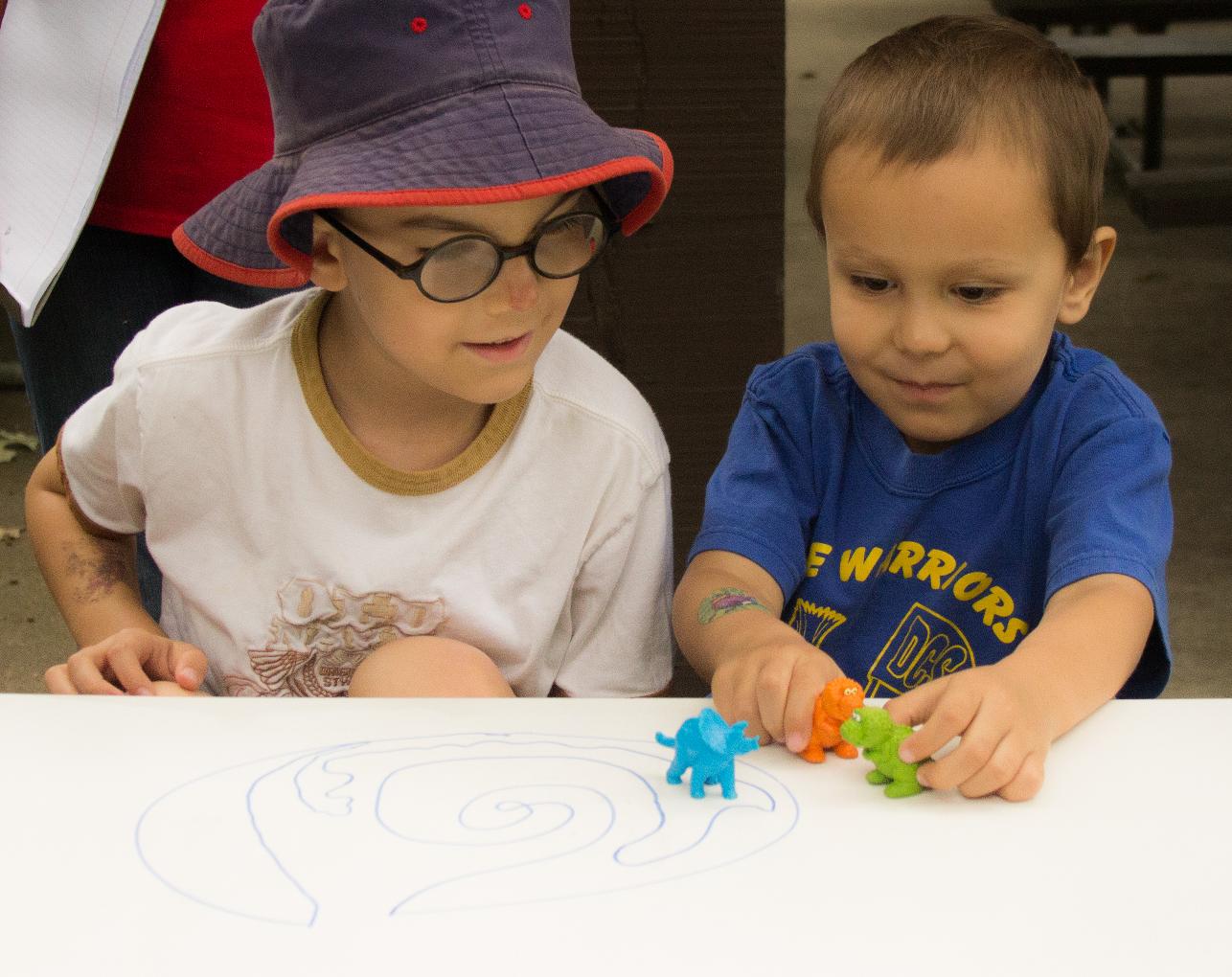
This was a fun activity from Moebius Noodles for our PK-1st grade Homeschool Math in the Park group. The children take turns making a maze and setting a dinosaur inside. Then the other dinosaurs (parents or siblings) try to guess whether their friend is on the land or in the water.

Draw the maze

Player #1

(1) First, draw a big circle on the white board. This is your lake.

(2) With a finger or a bit of cloth, erase a small section of the circle to create the opening for your maze.

(3) Starting at one edge of the opening, draw a random squiggle inside the circle. Make your squiggle end at the other edge of the opening.

Looks like Land

(4) Set your dinosaur anywhere inside the maze.

Player #2

(1) Now it’s your turn to guess. Is the dinosaur standing on the land? Is it swimming in the water?

(2) How will you figure out if you guessed right?

(3) Check by jumping across the lines of the maze. Each jump takes you across a boundary: Splash! (Into the water.) Thump! (Back on the land.) Splash! Thump! … Until you reach the dinosaur inside.

(4) Or go to the maze entrance and walk your dinosaur along the path. Can you find your way?

land or water

 
* * *

This blog is reader-supported.

If you’d like to help fund the blog on an on-going basis, then please join me on Patreon for mathy inspiration, tips, and an ever-growing archive of printable activities.

If you liked this post, and want to show your one-time appreciation, the place to do that is PayPal: paypal.me/DeniseGaskinsMath. If you go that route, please include your email address in the notes section, so I can say thank you.

Which I am going to say right now. Thank you!

“Maze Game: Land or Water?” copyright © 2013 by Denise Gaskins. All photos copyright © Denise Gaskins.

Princess in the Dungeon Game

Yet more fun from Rosie at Education Unboxed. I found these while looking for videos to use in my PUFM Subtraction post. Rosie says:

This is seriously embarrassing and I debated whether to put this video online or not because this is NOT my normal personality, but my girls made up this game and will play it for over an hour and ask for it repeatedly… so I figured someone out there might be able to use it with their kids, too.

If you know me, please don’t ever ask me to do this in public. I will refuse.

Princess in the Dungeon, Part 1 – Fractions with Cuisenaire Rods

http://vimeo.com/42739095

Continue reading Princess in the Dungeon Game

Game: Times Tac Toe

Photo by jma.work via flickr.

I’ve been working on a book of math games for homeschoolers and other teachers. I hope to get it published later this year, but the editing drags on. Would anybody like to draw the illustrations?

Meanwhile, here’s a 2-player game your students may enjoy…

Set Up

Print out a blank times table chart and place it between the players. Each player will need a colored marker, and the colors must be different enough to be easily distinguished.

Remove the jokers and kings from a deck of poker-style playing cards, but leave the jacks (= 11) and queens (= 12). Shuffle the deck, and place the stack face down as a draw pile.

Continue reading Game: Times Tac Toe

Game: Target Number (or 24)

[Photo by stevendepolo via Flickr (CC BY 2.0).]

Math concepts: addition, subtraction, multiplication, division, powers and roots, factorial, mental math, multi-step thinking
Number of players: any number
Equipment: deck of math cards, pencils and scratch paper, timer (optional)

Set Up

All players must agree on a Target Number for the game. Try to choose a number that has several factors, which means there will be a variety of ways to make it. Traditionally, I start my math club students with a target of 24.

Shuffle the deck, and deal four cards face down to each player. (For larger target numbers, such as 48 or 100, deal five or six cards to each player.) The players must leave the cards face down until everyone is ready. Set the remainder of the deck to one side.

Continue reading Game: Target Number (or 24)

Puzzle: Factoring Trinomials

Factoring Puzzle

My high school class ended the year with a review of multiplying and factoring simple polynomials. We played this matching game, and then I gave them a puzzle worksheet. I liked this idea, but I didn’t like the decoded answer. In my opinion, puzzles should give the student a “reward” for solving them — maybe a joke or riddle or something — but that answer seemed almost like nagging.

So I changed things around to make my own version:

Continue reading Puzzle: Factoring Trinomials