
[Photo by pfala.]
Thanks to John Cook’s article about factorials in the recent Mathematics and Multimedia Carnival, we’re adding new rules to the 2010 Mathematics Game.
Let’s play with multifactorials!
[Photo by pfala.]
Thanks to John Cook’s article about factorials in the recent Mathematics and Multimedia Carnival, we’re adding new rules to the 2010 Mathematics Game.
Let’s play with multifactorials!

Symbolic Logic Part I was published in 1896. When Lewis Carroll (Charles Lutwidge Dodgson) died two years later, Part II was lost. Because they couldn’t find the manuscript, many people doubted that he ever wrote Part II. But almost eighty years after his death, portions of Part II were recovered and finally published. The following puzzles are from the combined volume, Lewis Carroll’s Symbolic Logic, edited by William Warren Bartley, III.
These puzzles are called soriteses or polysyllogisms. Carroll began with a series of “if this, then that” statements. He rewrote them to make them more confusing, and then he mixed up the order to create a challenging puzzle.
Given each set of premises, what conclusion can you reach?

[Photo by MontyPython.]
You can get a good argument going in almost any group of people with the infamous Monty Hall problem:
Imagine you are on a TV game show, and the host lets you choose between three closed doors. One of the doors hides a fancy sports car, and if you pick that door, you win the car.
You pick door #1.
The host opens door #3 to reveal a goat. Then he gives you a chance to switch your door for the unopened door #2.
Should you switch?
What if you say you’re going to switch, and then the host offers to give you $5,000 instead of whatever is behind door #2?
Try the game for yourself at the Stay or Switch website.
Continue reading How to Start an Argument: The Monty Hall Problem
Mondays come every week. Bleh! Here are some puzzles I found this weekend, to brighten up your day…
[Photo by pfala.]
Did you know that playing games is one of the Top 10 Ways To Improve Your Brain Fitness? So slip into your workout clothes and pump up those mental muscles with the 2010 Mathematics Game!
Use the digits in the year 2010 to write mathematical expressions for the counting numbers 1 through 100.
- All four digits must be used in each expression. You may not use any other numbers except 2, 0, 1, and 0.
- You may use the arithmetic operations +, -, x, ÷, sqrt (square root), ^ (raise to a power), and ! (factorial). You may also use parentheses, brackets, or other grouping symbols.
- You may use a decimal point to create numbers such as .1, .02, etc.
- Multi-digit numbers such as 20 or 102 may be used, but preference is given to solutions that avoid them.
Bonus Rule
You may use the overhead-bar (vinculum), dots, or brackets to mark a repeating decimal.[Note to teachers: This rule is not part of the Math Forum guidelines. It makes a significant difference in the number of possible solutions, however, and it should not be too difficult for high school students or advanced middle schoolers.]
 [Photo by jimmiehomeschoolmom.]
One of the things I meant to do with my elementary math class (the one that got canceled due to low enrollment):
And then we would play around with Tangram puzzles, and perhaps make up a few of our own.
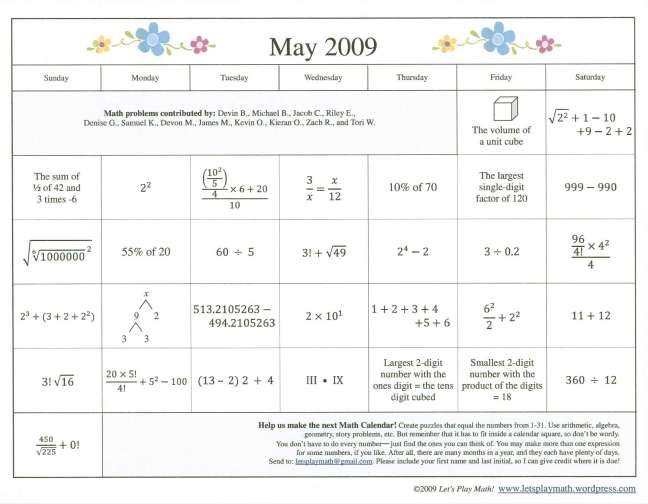
April showers have ushered in May flowers — and a second Math Calendar, with daily puzzles from my homeschool co-op students. Get your copy here:


My high school class ended the year with a review of multiplying and factoring simple polynomials. We played this matching game, and then I gave them a puzzle worksheet. I liked this idea, but I didn’t like the decoded answer. In my opinion, puzzles should give the student a “reward” for solving them — maybe a joke or riddle or something — but that answer seemed almost like nagging.
So I changed things around to make my own version:
[Photo by reubenaingber.]
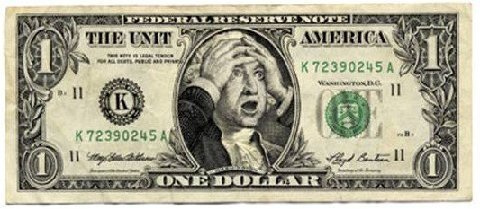
If you collected stacks of $100 bills, could you fit a trillion dollars into your bedroom?
In your house?
In a warehouse?
If you spent a dollar a second, how long would it take to spend a trillion dollars?
[HT: Justin Taylor at Between Two Worlds.]

[Photo by Amanda M Hatfield.]
Have you made a resolution to exercise your mental muscles this year? Then please join us for the 2009 Mathematics Game. Here are the rules:
Use the digits in the year 2009 and the operations +, -, x, ÷, sqrt (square root), ^ (raise to a power), and ! (factorial) — along with parentheses, brackets, or other grouping symbols — to write expressions for the counting numbers 1 through 100.
- All four digits must be used in each expression.
- Only the digits 2, 0, 0, 9 may be used.
- The decimal point may be used, as in .9, .02, etc.
- Multi-digit numbers such as 29 or 902 may be used, but preference is given to solutions that avoid them.
By definition: 
[See Dr. Math’s Why does 0 factorial equal 1?]
For this game we will accept: 
[See the Dr. Math FAQ 0 to the 0 power.]
 Denise Gaskins' Let's Play Math