Hat tip to Dan at mathrecreation.
Algebra: A Problem in Translation
[Photo by *Irish.]
In my post Elementary Problem Solving: The Tools, I introduced word algebra as a way to help students think their way through a story problem. In the next two posts, I showed how the tool worked with simple word problems.
Now, before I move on to focus exclusively on bar diagrams, I would like to show how word algebra can help a student solve a typical first-year algebra puzzle.
A homeschooling friend who avoided algebra in high school, trying to help her son cope with a subject she never understood, posted: “Help! Our answer is different from the book’s.” Here is the homework problem:
Josh earned $72 less than his sister who earned $93 more than her mom. If they earned a total of $504, how much did Josh earn?
How to Solve Math Problems
[Photo by Aaron Escobar. This post is a revision and update of How to Solve Math Problems from October, 2007.]

What can you do when you are stumped by a math problem? Not just any old homework exercise, but one of those tricky word problems that can so easily confuse anyone?
The difference between an “exercise” and a “problem” will vary from one person to another, even within a single class. Even so, this easy to remember, 4-step approach can help students at any grade level. In my math classes, I give each child a copy to keep handy:
[Note: Page 1 is the best for quick reference, especially with elementary to middle school children. Page 2 lists the steps in more detail, for the teacher or for older students.]
Kids’ Project: More Math Calendars?
 [Photo by Kuzeytac.]
Several people enjoyed the April calendar and asked if there would be a May version. Unfortunately, my homeschool co-op classes are out until next fall, so I don’t have enough kids to make up problems for me. But if your children would like to send in some puzzles, I will be glad to put another calendar together. If we get enough participation, we could have calendars every month for the rest of the year!
Free: Calculus Student’s Best Friend
Considering how many fools can calculate, it is surprising that it should be thought either a difficult or a tedious task for any other fool to learn how to master the same tricks… Being myself a remarkably stupid fellow, I have had to unteach myself the difficulties, and now beg to present to my fellow fools the parts that are not hard. Master these thoroughly, and the rest will follow. What one fool can do, another can.
For years, I have recommended Calculus Made Easy as summer reading (and future reference) for high school or college students headed into a calculus course — and for the parents of those students, who may have studied calculus in ages past and now need to dredge out the dust bunnies of memory so they can help with homework.
The original book (second edition) is now out of copyright and available for free online:
- Calculus Made Easy [pdf, 11.4 MB]
[Hat tip to Sam and Michael for finding the Scribd version, which set me off searching for a clearer copy.]
Puzzle: Factoring Trinomials


My high school class ended the year with a review of multiplying and factoring simple polynomials. We played this matching game, and then I gave them a puzzle worksheet. I liked this idea, but I didn’t like the decoded answer. In my opinion, puzzles should give the student a “reward” for solving them — maybe a joke or riddle or something — but that answer seemed almost like nagging.
So I changed things around to make my own version:
Math Game: Logarithm War
[Graph created at Draw Function Graphs.]
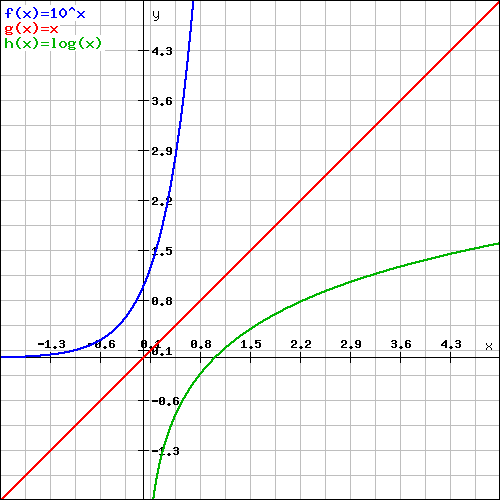
Kate at f(t) took my popular Math War game to a new level by making a set of Logarithm War cards. Cool! Download a deck for yourself:
Update
Logs and Trig War—Jim Pai extended Kate’s logarithm war to include trig functions. Double the cards, double the fun! Download from Jim’s blog: War: what is it good for?
MathNotations Contest for Middle-High School
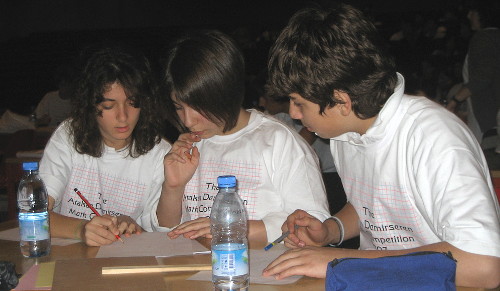
[Photo by ccarlstead.]
Can you can put together a team of 2-6 middle or high school students for an afternoon of mathematical play? If so, then Dave at MathNotations is running a math competition you just have to check out.
Teachers register by email on or before Thursday, January 29, and will receive the six thought-provoking contest problems and official answer form by return email. Hold the contest at your convenience on Tuesday, February 3, allowing your team up to 90 minutes to complete and electronically submit their answers.
Continue reading MathNotations Contest for Middle-High School
Math Club: Counting 101

[Fature photo above by ThunderChild tm.]
The last couple of weeks, in Math Club, we’ve been learning to count. My new set of MathCounts students have never heard of combinatorics, so we started at the very beginning:
- Counting and Probability I by Keone Hon
- Counting and Probability by Jason Batterson
Writing to Learn Math II

[Photo by Andy Hay.]
In addition to all the funny Google searches, I get plenty of normal inquiries about math topics. People come here looking for help with fractions, word problems, and math club activities — no surprise, those — but I would never have predicted the popularity of the search topic “writing in math class.”
Last year, I compiled a variety of math journal resources, but I’ve found many more since then, especially for older (high school and college) students. So if you’re looking for new ways to get your math students writing…
 Denise Gaskins' Let's Play Math