MathCounts: No More Homeschool Teams

MATHCOUNTSIf you’ve heard rumors about the new ruling, here is the official take.

I try to avoid ranting on this blog, but I’m deeply disappointed. My students always enjoyed the team aspect of working/suffering together. I don’t know if any of them will be willing to participate as individuals.

Update: MathCounts: Grandfather Clause for Existing Homeschool Teams

How to Start an Argument: The Monty Hall Problem


[Photo by MontyPython.]

You can get a good argument going in almost any group of people with the infamous Monty Hall problem:

Imagine you are on a TV game show, and the host lets you choose between three closed doors. One of the doors hides a fancy sports car, and if you pick that door, you win the car.

You pick door #1.

The host opens door #3 to reveal a goat. Then he gives you a chance to switch your door for the unopened door #2.

Should you switch?

What if you say you’re going to switch, and then the host offers to give you $5,000 instead of whatever is behind door #2?

Try the game for yourself at the Stay or Switch website.

Continue reading How to Start an Argument: The Monty Hall Problem

Probability and Baby Blues


[Photo by audi_insperation.]

[In The Birthday Surprise, Alex discovered her family was expecting a new member…]

What will the baby look like, Alex wondered. “Dad, is there any way to tell whether the baby will have blue eyes like I do, or brown like the rest of the family?”

Dr. Jones shuffled the papers on his desk and found a blank page. “Over 100 years ago, the Austrian monk Gregor Mendel studied genetics, or how various traits are passed down from one generation to another.” He began to draw a diagram as he talked.

Continue reading Probability and Baby Blues

Rate Puzzle: How Fast Does She Read?


[Photo by Arwen Abendstern.]

If a girl and a half
can read a book and a half
in a day and a half,
then how many books can one girl read in the month of June?

Kitten reads voraciously, but she decided to skip our library’s summer reading program this year. The Border’s Double-Dog Dare Program was a lot less hassle and had a better prize: a free book! Of course, it didn’t take her all summer to finish 10 books.

How fast does Kitten read?

Continue reading Rate Puzzle: How Fast Does She Read?

Hobbit Math: Elementary Problem Solving 5th Grade

[Photo by OliBac. Visit OliBac’s photostream for more.]

The elementary grades 1-4 laid the foundations, the basics of arithmetic: addition, subtraction, multiplication, division, and fractions. In grade 5, students are expected to master most aspects of fraction math and begin working with the rest of the Math Monsters: decimals, ratios, and percents (all of which are specialized fractions).

Word problems grow ever more complex as well, and learning to explain (justify) multi-step solutions becomes a first step toward writing proofs.

This installment of my elementary problem solving series is based on the Singapore Primary Mathematics, Level 5A. For your reading pleasure, I have translated the problems into the world of J.R.R. Tolkien’s classic, The Hobbit.

UPDATE: Problems have been genericized to avoid copyright issues.

Continue reading Hobbit Math: Elementary Problem Solving 5th Grade

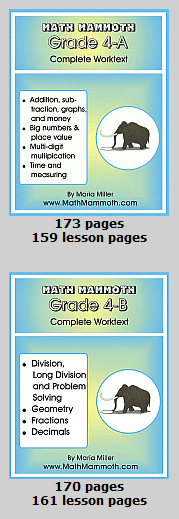
Review: Math Mammoth

When Maria of Homeschool Math Blog asked if I would review her Math Mammoth curriculum, I jumped at the chance. I’ve always enjoyed her blog posts, and I liked the worksheets I had seen on her website. (Maria gives away more than 300 pages absolutely free!)

She sent me her then-new 4th grade worktexts, and Kitten and I dug in.

Well, that was longer ago than I care to admit. But of course, it takes quite a bit of daily use before one can be absolutely sure of one’s opinion about a homeschool program — or at least, it does for me. Too many times a homeschool resource will look great in the catalog, and we’ll start it with high hopes only to bog down in the day-to-day grind and abandon it after a few weeks or months. So I wanted to give Math Mammoth a thorough workout before I wrote this review.

And all excuses aside, I really am a pro at crastinating

My aim is to help parents and teachers teach math so our children and students can really understand what is going on. I’ve strived to explain the concepts so that both the teacher and the student can “get it” by reading the explanations in the books.

— Maria Miller
author of Math Mammoth worktexts
and Homeschool Math Blog

Continue reading Review: Math Mammoth

Game: Target Number (or 24)

[Photo by stevendepolo via Flickr (CC BY 2.0).]

Math concepts: addition, subtraction, multiplication, division, powers and roots, factorial, mental math, multi-step thinking
Number of players: any number
Equipment: deck of math cards, pencils and scratch paper, timer (optional)

Set Up

All players must agree on a Target Number for the game. Try to choose a number that has several factors, which means there will be a variety of ways to make it. Traditionally, I start my math club students with a target of 24.

Shuffle the deck, and deal four cards face down to each player. (For larger target numbers, such as 48 or 100, deal five or six cards to each player.) The players must leave the cards face down until everyone is ready. Set the remainder of the deck to one side.

Continue reading Game: Target Number (or 24)

Prime Numbers Are like Monkeys

[Photo by mape_s.]

I’m afraid that Math Club may have fallen victim to the economy, which is worse in our town than in the nation in general. Homeschooling families have tight budgets even in the best of times, and now they seem to be cutting back all non-essentials. I assumed that last semester’s students would return, but I should have asked for an RSVP.

Still, Kitten and I had a fun time together. We played four rounds of Tens Concentration, since I had spread out cards on the tables in the library meeting room before we realized that no one was coming. Had to pick up the cards one way or another, so we figured we might as well enjoy them! She won the first two rounds, which put her in a good mood for our lesson.

I had written “Prime numbers are like monkeys!” on the whiteboard, and Kitten asked me what that meant. That was all the encouragement I needed to launch into my planned lesson, despite the frustrating dearth of students. The idea is taken from Danica McKellar’s book Math Doesn’t Suck.

Continue reading Prime Numbers Are like Monkeys

2010 Mathematics Game


[Photo by pfala.]

Did you know that playing games is one of the Top 10 Ways To Improve Your Brain Fitness? So slip into your workout clothes and pump up those mental muscles with the 2010 Mathematics Game!

Here are the rules:

Use the digits in the year 2010 to write mathematical expressions for the counting numbers 1 through 100.

  • All four digits must be used in each expression. You may not use any other numbers except 2, 0, 1, and 0.
  • You may use the arithmetic operations +, -, x, ÷, sqrt (square root), ^ (raise to a power), and ! (factorial). You may also use parentheses, brackets, or other grouping symbols.
  • You may use a decimal point to create numbers such as .1, .02, etc.
  • Multi-digit numbers such as 20 or 102 may be used, but preference is given to solutions that avoid them.

Bonus Rule
You may use the overhead-bar (vinculum), dots, or brackets to mark a repeating decimal.

[Note to teachers: This rule is not part of the Math Forum guidelines. It makes a significant difference in the number of possible solutions, however, and it should not be too difficult for high school students or advanced middle schoolers.]

Continue reading 2010 Mathematics Game