Game: Target Number (or 24)

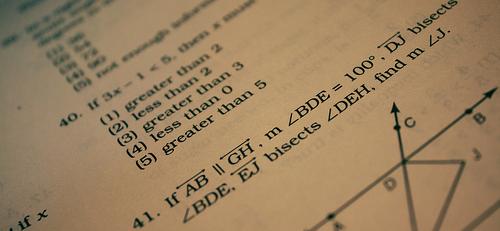
[Photo by stevendepolo via Flickr (CC BY 2.0).]

Math concepts: addition, subtraction, multiplication, division, powers and roots, factorial, mental math, multi-step thinking
Number of players: any number
Equipment: one deck of playing cards (face cards and jokers removed), pencils and scratch paper, timer (optional)

Set Up

All players must agree on a Target Number for the game. Try to choose a number that has several factors, which means there will be a variety of ways to make it. Traditionally, I start my math club students with a target of 24.

Shuffle the deck, and deal four cards face down to each player. (For larger target numbers, such as 48 or 100, deal five or six cards to each player.) The players must leave the cards face down until everyone is ready. Set the remainder of the deck to one side.

Continue reading Game: Target Number (or 24)

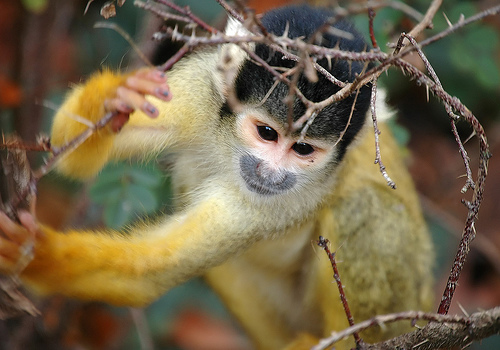
Prime Numbers Are like Monkeys

[Photo by mape_s.]

I’m afraid that Math Club may have fallen victim to the economy, which is worse in our town than in the nation in general. Homeschooling families have tight budgets even in the best of times, and now they seem to be cutting back all non-essentials. I assumed that last semester’s students would return, but I should have asked for an RSVP.

Still, Kitten and I had a fun time together. We played four rounds of Tens Concentration, since I had spread out cards on the tables in the library meeting room before we realized that no one was coming. Had to pick up the cards one way or another, so we figured we might as well enjoy them! She won the first two rounds, which put her in a good mood for our lesson.

I had written “Prime numbers are like monkeys!” on the whiteboard, and Kitten asked me what that meant. That was all the encouragement I needed to launch into my planned lesson, despite the frustrating dearth of students. The idea is taken from Danica McKellar’s book Math Doesn’t Suck.

Continue reading Prime Numbers Are like Monkeys

2010 Mathematics Game


[Photo by pfala.]

Did you know that playing games is one of the Top 10 Ways To Improve Your Brain Fitness? So slip into your workout clothes and pump up those mental muscles with the 2010 Mathematics Game!

Here are the rules:

Use the digits in the year 2010 to write mathematical expressions for the counting numbers 1 through 100.

  • All four digits must be used in each expression. You may not use any other numbers except 2, 0, 1, and 0.
  • You may use the arithmetic operations +, -, x, ÷, sqrt (square root), ^ (raise to a power), and ! (factorial). You may also use parentheses, brackets, or other grouping symbols.
  • You may use a decimal point to create numbers such as .1, .02, etc.
  • Multi-digit numbers such as 20 or 102 may be used, but preference is given to solutions that avoid them.

Bonus Rule
You may use the overhead-bar (vinculum), dots, or brackets to mark a repeating decimal.

[Note to teachers: This rule is not part of the Math Forum guidelines. It makes a significant difference in the number of possible solutions, however, and it should not be too difficult for high school students or advanced middle schoolers.]

Continue reading 2010 Mathematics Game

Elementary Problem Solving: Review

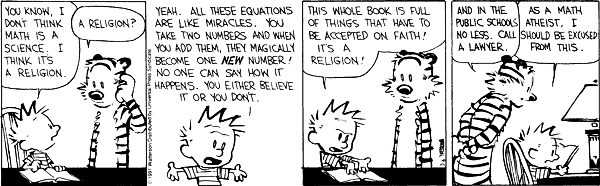
[Bill Watterson identifies the trouble with math problems, through the eyes of Calvin and Hobbes.]

It’s time to revive and (hopefully!) finish my long-neglected series on solving word problems in elementary mathematics. I’ve been having fun making up the problems, so now I just have to write the posts. Coming up soon:

Since it has been more than two years since the last entry, however, I wanted to take a few minutes to recap our progress so far and to refer new readers back to the original posts:

Continue reading Elementary Problem Solving: Review

Do Your Students Understand Division?

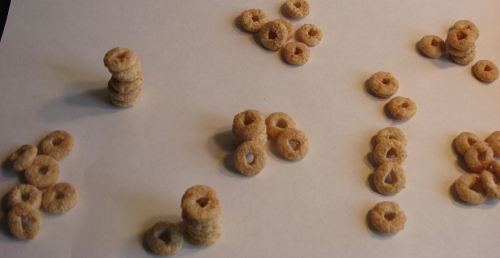
Cheerios by sixes
[I couldn’t find a good picture illustrating “division.” Niner came to my rescue and took this photo of her breakfast.]

I found an interesting question at Mathematics Education Research Blog. In the spirit of Liping Ma’s Knowing and Teaching Elementary Mathematics, Finnish researchers gave this problem to high school students and pre-service teachers:

We know that:
498 \div 6 = 83
How could you use this relationship (without using long-division) to discover the answer to:
491\div6=?
[No calculators allowed!]

The Finnish researchers concluded that “division seems not to be fully understood.” No surprise there!

Check out the pdf report for detailed analysis.

Continue reading Do Your Students Understand Division?

How to Solve Math Problems

[Photo by Aaron Escobar. This post is a revision and update of How to Solve Math Problems from October, 2007.]

HowToSolveIt2

What can you do when you are stumped by a math problem? Not just any old homework exercise, but one of those tricky word problems that can so easily confuse anyone?

The difference between an “exercise” and a “problem” will vary from one person to another, even within a single class. Even so, this easy to remember, 4-step approach can help students at any grade level. In my math classes, I give each child a copy to keep handy:

[Note: Page 1 is the best for quick reference, especially with elementary to middle school children. Page 2 lists the steps in more detail, for the teacher or for older students.]

Continue reading How to Solve Math Problems

Can You Read the Flu Map?

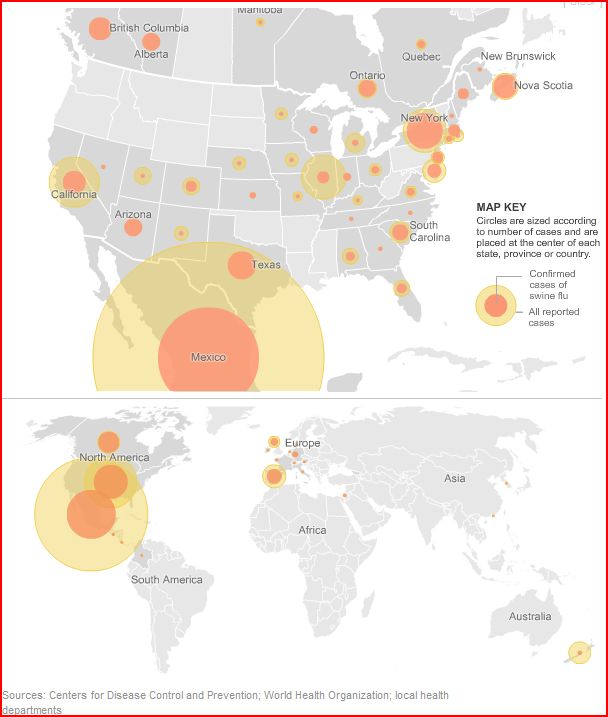
swine-flu-map-with-circles
[Map as of early afternoon on May 4th, found at the NY Times.]

Compare the dark circles (confirmed cases) for Mexico, New York and Nova Scotia in the top part, or Mexico and the U.S. in the lower part of the map. It’s easy to see which has more cases of the flu — but how many more? Which would you guess is the closest estimate:

Mexico : New York : Nova Scotia

  • = 7:3:2 or 20:5:3 or 16:2:1?

U.S. : Mexico

  • = 1:2 or 2:5 or 3:7?

Continue reading Can You Read the Flu Map?

Kids’ Project: More Math Calendars?

tulips-by-kuzeytac[Photo by Kuzeytac.]

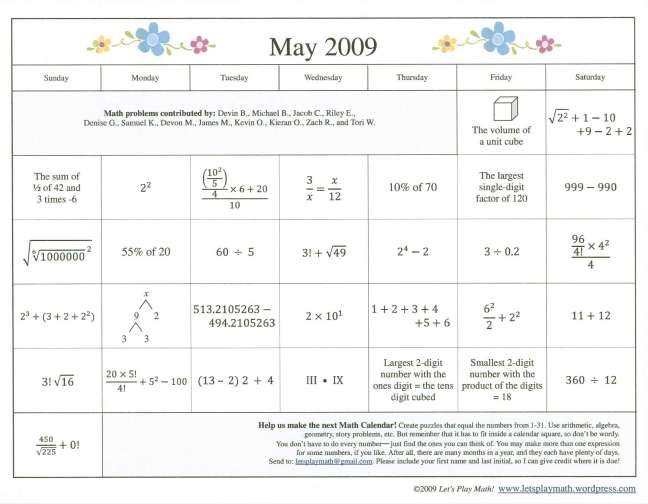
Several people enjoyed the April calendar and asked if there would be a May version. Unfortunately, my homeschool co-op classes are out until next fall, so I don’t have enough kids to make up problems for me. But if your children would like to send in some puzzles, I will be glad to put another calendar together. If we get enough participation, we could have calendars every month for the rest of the year!

Continue reading Kids’ Project: More Math Calendars?

Buddy-Style Math: Doing Homework Without Tears

My daughter Kitten strongly dislikes math when forced to do it on her own, so I am trying to get back into the habit of doing “Buddy-Style Math” with her. We take turns working the problems in her workbook: mine, hers, mine, hers, and so on down the page. We work each problem out loud, explaining how we got the answer and checking each other as we go.

In a way, it is like Charlotte Mason-style narration applied to math, since my daughter has to process her thoughts in order to explain how she worked the problem, which fixes the math concepts more deeply in her mind.

Continue reading Buddy-Style Math: Doing Homework Without Tears