How to Conquer the Times Table, Part 2

Photo of Eeva times 6, by Eric Horst, via flickr.

The question is common on parenting forums:

My daughter is in 4th grade. She has been studying multiplication in school for nearly a year, but she still stumbles over the facts and counts on her fingers. How can I help her?

Many people resort to flashcards and worksheets in such situations, and computer games that flash the math facts are quite popular with parents. I recommend a different approach: Challenge your student to a joint experiment in mental math. Over the next two months, without flashcards or memory drill, how many math facts can the two of you learn together?

We will use the world’s oldest interactive game — conversation — to explore multiplication patterns while memorizing as little as possible.

Continue reading How to Conquer the Times Table, Part 2

Square One TV: The Mathematics of Love

The Engineer was away on a business trip, and Kitten and I were in the mood to veg out on YouTube, so I hunted for some golden oldies. We used to watch Square One TV faithfully, back when my eldest was in first grade. I can’t believe they haven’t released this show on DVD!

We found recordings of my two favorite songs (“Nine, Nine, Nine” and “8% of My Love”), but the picture quality was horrible. This video was the runner-up:

How to Conquer the Times Table, Part 1

Photo of Evil Erin times 5 (and dog times 2), via flickr.

Perhaps the biggest challenge for any middle-elementary math student is to master the multiplication facts. It can seem like an unending task to memorize so many facts and be able to pull them out of mental storage in any order on demand. Too often, the rote aspect of such memory work overwhelms students, eclipsing their view of the principles behind the math. Yet rote memory is not enough: A student may be able to recite the times tables perfectly and still be reduced to counting on fingers in the middle of a long division problem.

We will use the world’s oldest interactive game — conversation — to learn the multiplication facts one bite at a time. But first, let’s take some time to think about what multiplication really means.

Continue reading How to Conquer the Times Table, Part 1

More Than One Way to Solve It

More-Than-One-Way

Photo by Eirik Newth via flickr.

In a lazy, I-don’t-want-to-do-school mood, Princess Kitten was ready to stop after three math problems. We had gotten two of them correct, but the last one was counting the ways to paint a cube in black and white, and we forgot to count the solid-color options.

For my perfectionist daughter, one mistake was excuse enough to quit. She leaned her head against me as we sat together on the couch and said, “We’re done. Done, done, done.” If she could, she would have started purring — one of the most manipulative noises known to humankind. I’m a soft touch. Who can work on math when there’s a kitten to cuddle?

by tanjila ahmed via flickr

Still, I managed to squeeze in one more puzzle. I picked up my whiteboard marker and started writing:

DONE
DOEN
DNOE
DENO
DNEO
ONED
ODNE

Continue reading More Than One Way to Solve It

The (Mathematical) Trouble with Pizza

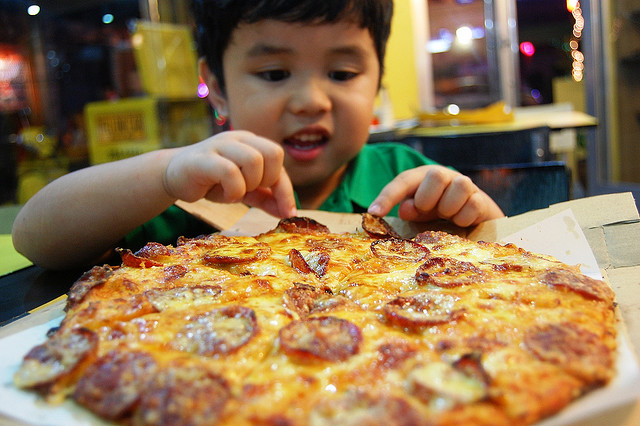
Photo by George Parrilla via flickr.

Kitten complained that some math programs keep repeating the same kind of problems over and over, with bigger numbers: “They don’t get any harder, they just get longer. It’s boring!”

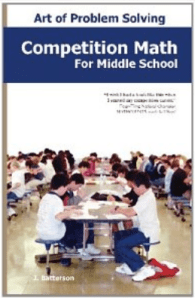
So we pulled out the Counting lessons in Competition Math for Middle School. [Highly recommended book!] Kitten doesn’t like to compete, but she enjoys learning new ideas, and Batterson’s book gives her plenty of those, well organized and clearly explained.

Today’s topic was the Fundamental Counting Principle. It was review, easy-peasy. The problems were too simple, until…

Pizzas at Mario’s come in three sizes, and you have your choice of 10 toppings to add to the pizza. You may order a pizza with any number of toppings (up to 10), including zero. How many choices of pizza are there at Mario’s?

[The book said 9 toppings, but I was skimming/paraphrasing aloud and misread.]

  • Can you figure out the answer?

Continue reading The (Mathematical) Trouble with Pizza

Arithmetic Village Books

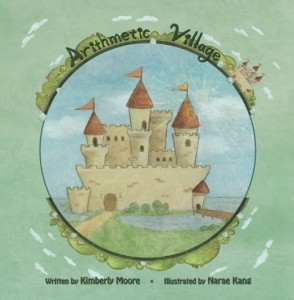
Thanks to the generosity of author Kimberly Moore, I am giving away a complete set of the beautiful Arithmetic Village picture books. You can read the first book free online.

When you think of math do you think of a light-hearted fairy tale?

No? Then come and meet some of the delightful characters who live in Arithmetic Village.

Polly Plus collects jewels slowly and methodically, Linus Minus is carefree and loses his. Tina Times and King David Divide… well you’ll see.

The first book offers the overview of the math concepts. These are then demonstrated through the lives of each character. The books are designed to be supported by a manipulative kit [homemade: see video below] with 100 jewels, 10 golden bags, and a treasure chest…

— Kimberly Moore
Proposal: Arithmetic Village

My fantasy-loving daughter Kitten would have been thrilled with this math program when she was little, just as this 6yo girl was. But it’s not just for girls — here is a thorough review by a homeschool mom of two boys.

Visit the Arithmetic Village website to read more about the books and explore the activity pages (links under each topic in the main page menu). Or check out Kim’s YouTube videos for activity ideas.

Continue reading Arithmetic Village Books

Hyperbolic Crochet Coral Reef

Wow! And to think, I was proud of myself for finishing a crochet afghan. Once.

For More Details

Try It Yourself

Chain several. Leave straight to work in rows, or connect into a loop. Single crochet until your patience runs out, increasing every nth stitch (add an extra sc in the same place). Experiment with different colors and patterns. This pdf will give you more ideas.

The more frequently you increase, the frillier your hyperbolic plane will be, while a less-frequent increase makes it easier for students to see the structure. Daina Taimina recommends a 12:13 ratio (increase after every 12th stitch) for classroom use.

Hat tip: 2010 MAA Found Math Gallery, Week 45, and authentic arts by jenny hoople for the pdf.