 To wrap up our week of exploring the resources from Word Problems from Literature, let’s talk about getting students to write their own math.
Check in on the Kickstarter
First up, I’m sharing an excerpt from the Word Problems Student Workbook. The “Story Problem Challenge” is one of my favorite math club activities.
Following that, you’ll find an amazing online mathemagical adventure for middle school: The Arithmetiquities. It’s great fun, and a great inspiration for students to create their own math stories.
Have fun writing math with your kids!
The Story Problem Challenge
What do you get when you cross a library book or favorite movie with a math worksheet? A great alternative to math homework!
The rules are simple:
(1) Choose a worksheet calculation to be the basis for your word problem.
(2) Solve the calculation.
(3) Consider where these numbers could make sense in your book or movie universe. How might the characters use math? What sort of things would they count or measure? Do they use money? Do they build things, or cook meals, or make crafts? Do they need to keep track of how far they have traveled? Or how long it takes to get there?
(4) Write your story problem.
To make the game easier, you may change the numbers to make a more realistic problem. But you must keep the same type of calculation. For example, if your worksheet problem was 18÷3, you could change it to 18÷6 or 24÷3 or even 119÷17 to fit your story, but you can’t make it something like 18−3.
Remember that some quantities are discrete and countable, such as hobbits and fireworks. Other quantities are continuous, such as a barrel of wine or a length of fabric. Be sure to consider both types when you are deciding what to use in your problem.
Then share your problem with friends, and you try their problems. Can you stump each other?
A Note about Copyright and Trademarks
Old books are in the public domain, so you can always use characters like Robin Hood, Sherlock Holmes, or Winnie-the-Pooh (but not the newer Disney version with the red jacket). But most books and movies are the protected intellectual property of their authors or estates, or of the company who bought those rights.
When you write problems for your own private use, feel free to use your favorite characters from any story. That’s like fan fiction, secret, just for your own pleasure.
But if you decide to share your creation beyond your own home or classroom, then be sure to “genericize” it first. Change or remove the proper names, using general descriptions instead.
For example, if you love the Harry Potter series, you might want to use Harry or Hermione in your story problems. Instead, write about “the boy wizard destined to fight an evil sorcerer.” Or “the bright young witch who can master any spell.”
Or if you like the Star Wars movies, you might write about “an interstellar justice warrior with an energy sword.” Or “an alien master of martial arts training a cocky but inexperienced apprentice.”
We’d love to add your story to the Student Math Makers Gallery.
The Arithmetiquities
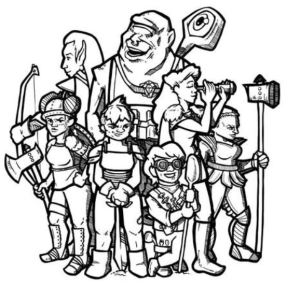 When the world of Sfera is threatened by the machinations of a malevolent sorcerer, it will be up to a band of unlikely heroes to become the brightest light in the darkness.
The adventurers fan out across the land to find and retrieve the Arithmetiquities, a set of ancient mathemagical artifacts.
The Arithmetiquities is a fantasy adventure story told through a sequence of 36 mathematical puzzles.
Join the Adventure
“Though it is still before sunrise, Lumparland Harbor is already bustling. Sailing ships moor at the misty docks, bringing travelers and goods to the seaside town. Three dwarves disembark from different ships, each adventurer returning home from some faraway locale. The three women gather at the end of the pier.
“The strangers discover that they all live along the main road that leads from the harbor, so they decide to split the cost of a wagon. Egga lives 10 miles away, Floora lives 20 miles away, and Greeta lives 30 miles away. The wagon ride costs $1.50 per mile regardless of the number of passengers.
“How much should each of the adventurers pay so that each one has a fair fare?”
—Jason Ermer, “Lumparland Harbor,” The Arithmetiquities Chapter I
This blog is reader-supported.
If you’d like to help fund the blog on an on-going basis, then please head to my Patreon page.
If you liked this post, and want to show your one-time appreciation, the place to do that is PayPal: paypal.me/DeniseGaskinsMath. If you go that route, please include your email address in the notes section, so I can say thank you.
Which I am going to say right now. Thank you!
“Playful Math: Getting Students To Write Their Own” copyright © 2022 by Denise Gaskins. Image at the top of the post copyright © Hannah Olinger via Unsplash.com.




 Word problems are commonplace in mathematics classrooms, and yet they regularly confound students and lead to frustrated teachers saying things like:
 Discover Farrar Williams’s book Numberless Math Problems: A Modern Update of S.Y. Gillian’s Classic Problems Without Figures, available in ebook or paperback.
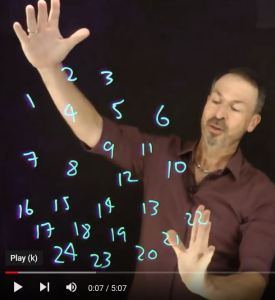
 In this 4-video series, Tanton presents five key principles for brilliant mathematical thinking, along with loads and loads of examples to explain what he means by each of them. He says it’s “a call for parents and teachers to be mindful of the life thinking we should foster, encourage, promote, embrace and reward — even in a math class!”
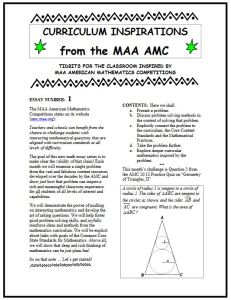 Essays and videos showing how to approach math puzzles in a way that a) is relevant and connected to the curriculum, and b) revels in deep, joyous, mulling and flailing, reflection, intellectual play and extension, insight, and grand mathematical delight.
 Here are some essays illustrating astounding tidbits of mathematical delight. And here are some purely visual puzzles to surprise.
 Denise Gaskins' Let's Play Math