Moebius Noodles Photo Game

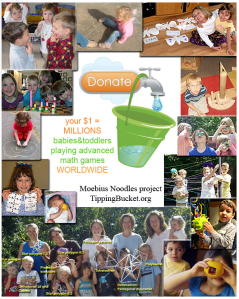
Hooray! Moebius Noodles tipped the bucket. Thank you to everyone who chipped in!

Now the Fun Begins

The first Moebius Noodles game is a celebration of the Möbius strip. To play:

  1. Post a photo with a Möbius strip anywhere online.
  2. Notify Maria: droujkova@gmail.com. She’ll add your picture to her Moebius Noodles slide show, with a link to your site, blog or Twitter.

And for dinner tonight, try Möbius Marinara!

Support Moebius Noodles, Update

Would you love to introduce your preschoolers to the mind-stretching wonder of math? Check out Moebius Noodles, an open community of mathematical resources for parents and educators of young children.

Moebius Noodles activities and games use stuff you already have around the house to explore symmetry, fractals, functions, transformations, topology, and more, in a way that is accessible to babies and toddlers (and their parents!) and easily adapted to include older siblings.

Even a small donation will help this amazing project get off the ground — and Maria is offering a variety of “secret rewards” (like free books, or a secret-message game designed especially for your child) to those who chip in now.

Have Little Ones? Try Moebius Noodles!

Moebius Noodles Fundraiser Badge

Would you like to do math with your babies and toddlers — real math, not just counting and simple shapes — but don’t know how? For the last few years, Maria Droujkova has been teaching parents to do advanced, fun math with young children. I had the chance to lurk on a discussion group this summer and thoroughly enjoyed it. Now she is taking the next step — and you are invited to join in the fun!

The Moebius Noodles project includes:

  • Cool math concepts.
    Symmetry, fractals, coordinate planes, functions, transformations, topology, and more.
  • Math that grows with your child.
    Games and activities are adaptable to a wide range of ages, from babies to teens.
  • Math your child owns.
    Plenty of variations and suggestions to help kids bring math into their own worlds.
  • Active and open support group.
    A community of parents who share stories and photos, discuss examples, modify games, and ask and answer questions.
  • Math therapy for parents.
    For those who feared and disliked math in school, this project offers a second chance as you experience the math-rich world around you through playing with your child.

Maria is offering a variety of “Secret Rewards” (including free copies of the Moebius Noodles book) to those who chip in toward the project. Check out her Moebius Noodles blog post for more information.

Arithmetic Village Books

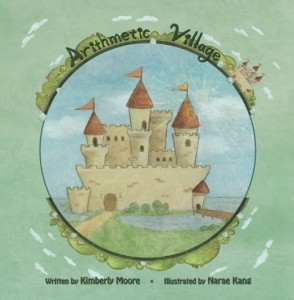
Thanks to the generosity of author Kimberly Moore, I am giving away a complete set of the beautiful Arithmetic Village picture books. You can read the first book free online.

When you think of math do you think of a light-hearted fairy tale?

No? Then come and meet some of the delightful characters who live in Arithmetic Village.

Polly Plus collects jewels slowly and methodically, Linus Minus is carefree and loses his. Tina Times and King David Divide… well you’ll see.

The first book offers the overview of the math concepts. These are then demonstrated through the lives of each character. The books are designed to be supported by a manipulative kit [homemade: see video below] with 100 jewels, 10 golden bags, and a treasure chest…

— Kimberly Moore
Proposal: Arithmetic Village

My fantasy-loving daughter Kitten would have been thrilled with this math program when she was little, just as this 6yo girl was. But it’s not just for girls — here is a thorough review by a homeschool mom of two boys.

Visit the Arithmetic Village website to read more about the books and explore the activity pages (links under each topic in the main page menu). Or check out Kim’s YouTube videos for activity ideas.

Continue reading Arithmetic Village Books

Review: Math Mammoth

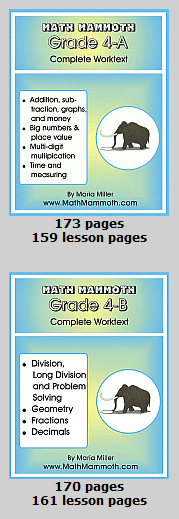
When Maria of Homeschool Math Blog asked if I would review her Math Mammoth curriculum, I jumped at the chance. I’ve always enjoyed her blog posts, and I liked the worksheets I had seen on her website. (Maria gives away more than 300 pages absolutely free!)

She sent me her then-new 4th grade worktexts, and Kitten and I dug in.

Well, that was longer ago than I care to admit. But of course, it takes quite a bit of daily use before one can be absolutely sure of one’s opinion about a homeschool program — or at least, it does for me. Too many times a homeschool resource will look great in the catalog, and we’ll start it with high hopes only to bog down in the day-to-day grind and abandon it after a few weeks or months. So I wanted to give Math Mammoth a thorough workout before I wrote this review.

And all excuses aside, I really am a pro at crastinating

My aim is to help parents and teachers teach math so our children and students can really understand what is going on. I’ve strived to explain the concepts so that both the teacher and the student can “get it” by reading the explanations in the books.

— Maria Miller
author of Math Mammoth worktexts
and Homeschool Math Blog

Continue reading Review: Math Mammoth

Mental Math: Addition

[Photo by woodleywonderworks.]

The question came from a homeschool forum, though I’ve reworded it to avoid plagiarism:

My student is just starting first grade, but I’ve been looking ahead and wondering: How will we do big addition problems without using pencil and paper? I think it must have something to do with number bonds. For instance, how would you solve a problem like 27 + 35 mentally?

The purpose of number bonds is that students will be comfortable taking numbers apart and putting them back together in their heads. As they learn to work with numbers this way, students grow in understanding — some call it “number sense” — and develop a confidence about math that I often find lacking in children who simply follow the steps of an algorithm.

[“Algorithm” means a set of instructions for doing something, like a recipe. In this case, it means the standard, pencil and paper method for adding numbers: Write one number above the other, then start by adding the ones column and work towards the higher place values, carrying or “renaming” as needed.]

For the calculation you mention, I can think of three ways to take the numbers apart and put them back together. You can choose whichever method you like, or perhaps you might come up with another one yourself…

Continue reading Mental Math: Addition
Cute Math Facts for Visual Thinkers

numberwalk[Photo by angela7dreams.]

A forum friend posted about her daughter’s adventure in learning the math facts:

“She loves stories and drawing, so I came up with the Math Friends book. She made a little book, and we talked about different numbers that are buddies.”

Continue reading Cute Math Facts for Visual Thinkers

Writing to Learn Math II

[Photo by Andy Hay.]

In addition to all the funny Google searches, I get plenty of normal inquiries about math topics. People come here looking for help with fractions, word problems, and math club activities — no surprise, those — but I would never have predicted the popularity of the search topic “writing in math class.”

Last year, I compiled a variety of math journal resources, but I’ve found many more since then, especially for older (high school and college) students. So if you’re looking for new ways to get your math students writing…

Continue reading Writing to Learn Math II