Only by Thinking

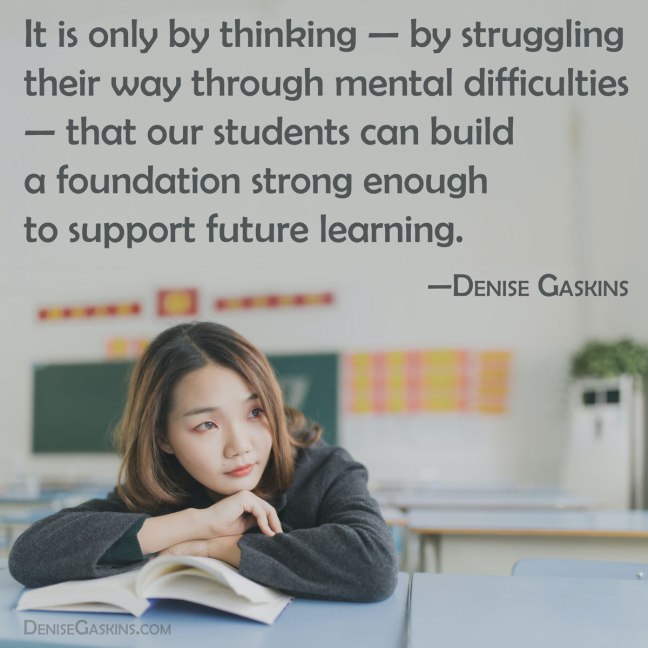
The full quote, as it appears in my new book:

When we give students a rule, we give them permission not to think. All they need to do is remember our instructions.

But it is only by thinking — by struggling their way through mental difficulties — that our students can build a foundation of mathematical knowledge strong enough to support future learning.

—Denise Gaskins
Prealgebra & Geometry: Math Games for Middle School

 
* * *

Excerpted from my upcoming book, Prealgebra & Geometry: Math Games for Middle School, scheduled for publication in early 2021. Sign up for my newsletter to get updates.

This blog is reader-supported.

If you’d like to help fund the blog on an on-going basis, then please join me on Patreon for mathy inspiration, tips, and an ever-growing archive of printable activities.

If you liked this post, and want to show your one-time appreciation, the place to do that is PayPal: paypal.me/DeniseGaskinsMath. If you go that route, please include your email address in the notes section, so I can say thank you.

Which I am going to say right now. Thank you!

“Only by Thinking” copyright © 2020 by Denise Gaskins. Image at the top of the post copyright © Sean Kong on Unsplash.

Homeschooling Tip #1: Start with Play

For children, learning always begins with play. This is how they wrap their minds around new ideas and make them their own.

“There should be no element of slavery in learning. Enforced exercise does no harm to the body, but enforced learning will not stay in the mind. So avoid compulsion, and let your children’s lessons take the form of play.”

—Plato, The Republic

If we want our children to enjoy learning math, our first job is to establish an attitude of playfulness.

This is especially important for anyone working with a discouraged child or a child who is afraid of math. The best way to help a discouraged child is to put away the workbook. Try something different, fun, and challenging.

Continue reading Homeschooling Tip #1: Start with Play

How to Homeschool Math

Far too many people find themselves suddenly, unexpectedly homeschooling their children. This prompts me to consider what advice I might offer after more than three decades of teaching kids at home.

Through my decades of homeschooling five kids, we lived by two rules:

Do math. Do reading.

As long as we hit those two topics each day, I knew the kids would be fine. Do some sort of mathematical game or activity. Read something from that big stack of books we collected at the library.

Conquer the basics of math and reading, then everything else will fall into place.

Continue reading How to Homeschool Math

FAQ: Math with Young Children

The question came up again:

“What is the best curriculum for my children? They are four and six years old, and I’m afraid of letting them fall behind.”

I remember being a young parent, eager to start homeschooling. I used to get mad (without letting it show, like a true introvert) when people told me, “They are young. Just let them play.”

Now I see the wisdom in it.

The most important thing for your children right now, by far, is for them to enjoy learning. The joy of learning is a child’s natural state. As a parent, your primary job is to keep yourself from stomping it out.

But our parental fears can push us into joy-trampling before we realize it.

And our own experience of school makes it hard for us to see how much of our children’s play really is learning. We expect education to look like schoolwork, but natural learning looks nothing like that.

Continue reading FAQ: Math with Young Children

Play Math with Your Kids for Free

One of the most common questions I get from parents who want to help their children enjoy math is, “Where do we start?”

My favorite answer: “Play games!”

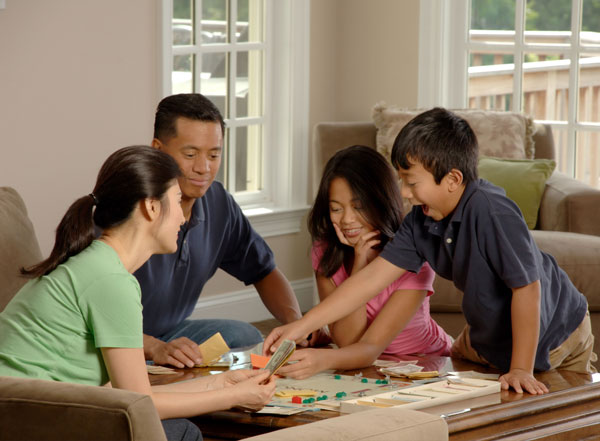
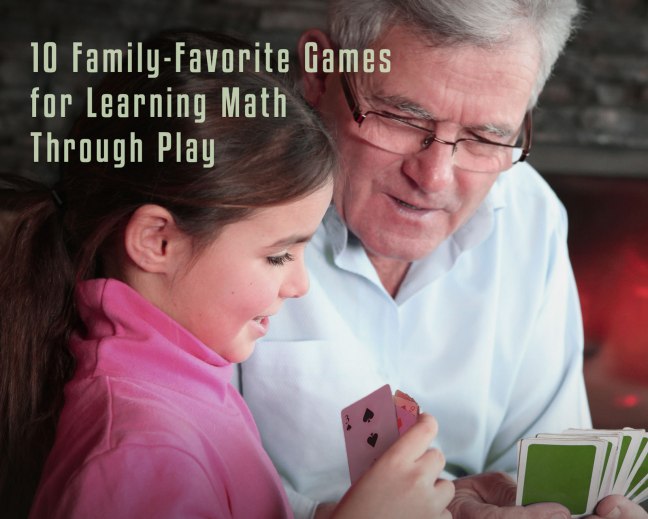
And as the world slowly recovers from the pandemic crisis, it’s even more important for families to play together. So my publisher agreed to make my ebook Let’s Play Math Sampler: 10 Family-Favorite Games for Learning Math Through Play free for the duration.

Continue reading Play Math with Your Kids for Free

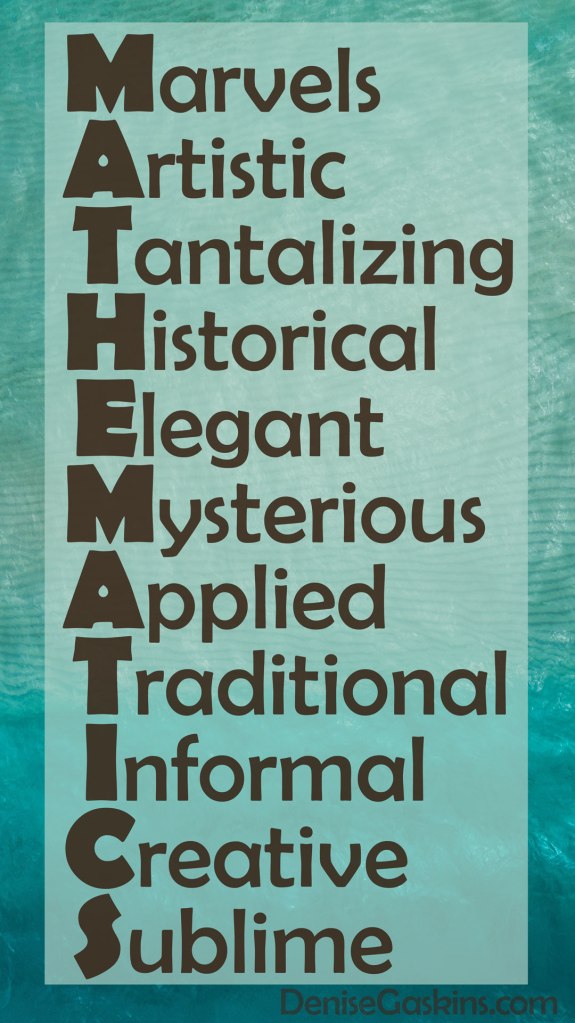
Mathematics: An Acrostic

What Is Your Child’s Experience of Math?

If your children made an acrostic for the word “Mathematics,” what would they include?

Would they think of adjectives like artistic, mysterious, or sublime?

Or would they focus on words like answers, maddening, and stress?

I love taking a playful approach to mathematics. Puzzles, games and art projects lay down a foundation of wonder and enjoyment. This creates a strong, positive base to support our kids through the inevitable difficulties of learning an abstract subject like math.

There are many rich math resources these days! So different from back when I started homeschooling. If you need ideas to help you transform your child’s experience of math, check out my Free Math on the Internet pages.

Internet Math Resources

In fact, I have a huge folder of even more bookmarks and links that I hope to add to my resource pages, whenever I find the time…

Does your family have a favorite way to play with math?

 
* * *

This blog is reader-supported.

If you’d like to help fund the blog on an on-going basis, then please join me on Patreon for mathy inspiration, tips, and an ever-growing archive of printable activities.

If you liked this post, and want to show your one-time appreciation, the place to do that is PayPal: paypal.me/DeniseGaskinsMath. If you go that route, please include your email address in the notes section, so I can say thank you.

Which I am going to say right now. Thank you!

“Mathematics: An Acrostic” copyright © 2019 by Denise Gaskins. Image at the top of the post copyright © Ishan via Unsplash.
Get Your Weekly KenKen Puzzles for Kids

KenKen6x6

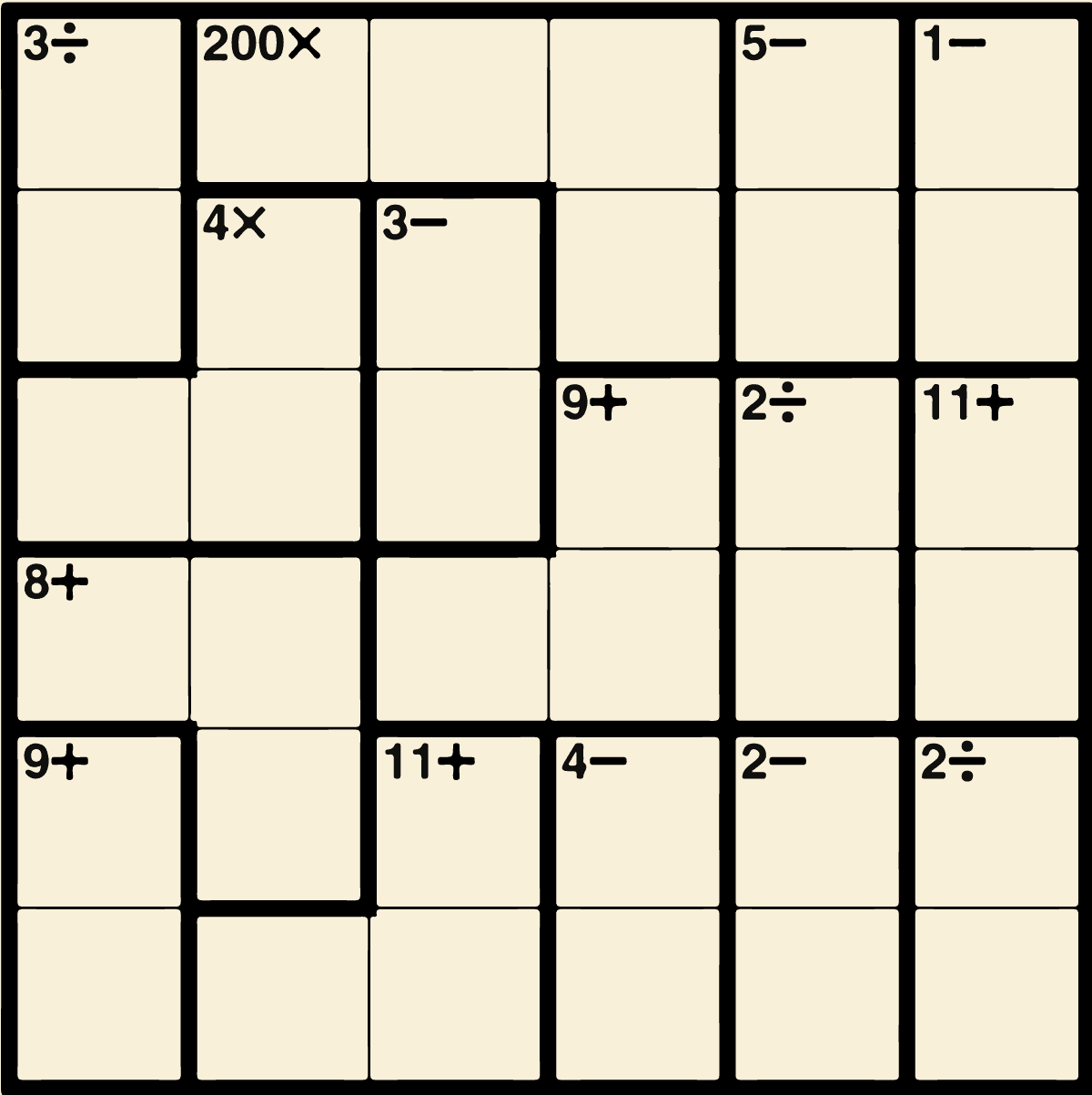
KenKen arithmetic puzzles build mental math skills, logical reasoning, persistence, and mathematical confidence.

Free via email every Friday during the school year.

What a great way to prepare your children for success in math!

Sign up anytime:

Click Here for KenKen Classroom Newsletter

How to Play

For easy printing, right-click to open the image above in a new tab.

Place the numbers from 1 to 6 into each row and column. None of the numbers may repeat in any row or column. Within the black “cages,” the numbers must add, subtract, multiply, or divide to give the answer shown.

How to Talk Math With Your Kids

A friend shared this video, and I loved it! From Kent Haines, a father who happens to also be a math teacher…

“I hope that this video helps parents find new ways of interacting with their kids on math topics.”

Kent Haines

More from Kent Haines

Advice and Examples of Talking Math with Kids

Danielson-Talking Math

If you enjoyed Kent’s video, you’ll love Christopher Danielson’s book and blog.

It’s a short book with plenty of great stories, advice, and conversation-starters. While Danielson writes directly to parents, the book will also interest grandparents, aunts & uncles, teachers, and anyone else who wants to help children notice and think about math in daily life.

“You don’t need special skills to do this. If you can read with your kids, then you can talk math with them. You can support and encourage their developing mathematical minds.
 
“You don’t need to love math. You don’t need to have been particularly successful in school mathematics. You just need to notice when your children are being curious about math, and you need some ideas for turning that curiosity into a conversation.
 
“In nearly all circumstances, our conversations grow organically out of our everyday activity. We have not scheduled “talking math time” in our household. Instead, we talk about these things when it seems natural to do so, when the things we are doing (reading books, making lunch, riding in the car, etc) bump up against important mathematical ideas.
 
“The dialogues in this book are intended to open your eyes to these opportunities in your own family’s life.”

— Christopher Danielson
Talking Math with Your Kids

 
* * *

This blog is reader-supported.

If you’d like to help fund the blog on an on-going basis, then please join me on Patreon for mathy inspiration, tips, and an ever-growing archive of printable activities.

If you liked this post, and want to show your one-time appreciation, the place to do that is PayPal: paypal.me/DeniseGaskinsMath. If you go that route, please include your email address in the notes section, so I can say thank you.

Which I am going to say right now. Thank you!

“How to Talk Math With Your Kids” copyright © 2017 by Denise Gaskins. “Kids Talk” photo (top) by Victoria Harjadi via Flickr (CC BY 2.0). “Parent Rules” by Kent Haines.

Math Humor and Copywork

Homeschool Memories…

The more years we spent homeschooling, the more I appreciated Charlotte Mason’s work and tried to incorporate her ideas into our laid-back, eclectic, not-quite-unschooling program.

We never fit the typical Charlotte Mason mold. Mosquitos and natural laziness limited our nature walks, and our version of narration was much too informal.

But those are just techniques, methods.

What really interests me in Mason’s writing is the philosophy behind the methods. Two points resonated: That we must respect our children as persons in their own right. And that we must provide a generous, wide-ranging feast to their minds.

Striving to live out those principles had a profound influence on our day-to-day homeschooling.

Continue reading Math Humor and Copywork