Thou Surly Bat-Fowling Hugger-Mugger!

Here is another highlight from my “To blog about it someday” folder: the Shakespearean Insulter. What fun!

There’s no room for faith, truth, nor honesty in this bosom of thine.
It is all filled up with guts and midriff.

Taken from: Henry IV, part I

And if you are interested in actually studying the bard, here are some links you may enjoy:

Shakespeare. Yes, again. And again.
Advice on teaching Shakespeare to children.

Bardolatry
Many links to teaching advice, book recommendations, and more.

Folger Shakespeare Library

Shakespeare for Kids

There is no reason to put off Shakespeare until your student reaches high school. My then-kindergardener enjoyed the Trevor Nunn version of Twelfth Night so much that she wanted to get her hair cut, “So I can pretend to be a boy.” This is homeschooling at its best: each of us learning at our own level — and loving it.
Happy Birthday, Sweet 17!

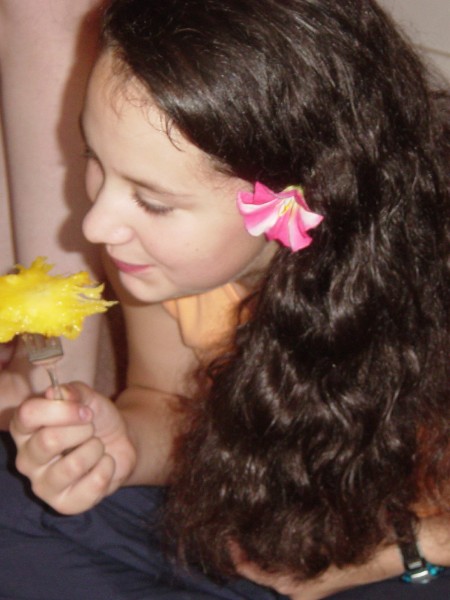
Beach partyI described in a previous post our family tradition of hiding one present on each child’s birthday. Today’s hidden present rhyme was more successful than recent ones — the birthday girl was temporarily stumped and needed a hint from her older sister. Can you guess where they found the gift?

As always, the outside of the envelope is the same:

I’m your last present.
Can you find me?
I’m hiding some place
That you can’t see…

Continue reading Happy Birthday, Sweet 17!

Improper Fractions: A Mathematical Trauma

Feature photo (above) by Jimmie via flickr. Photo (right) by Old Shoe Woman via Flickr.

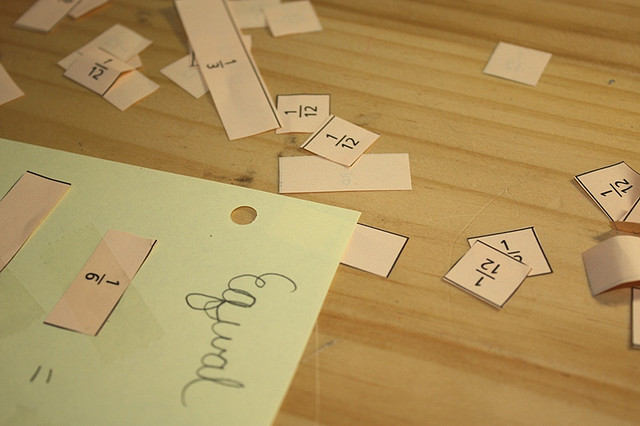
Nearing the end of Miquon Blue today, my youngest daughter encountered fractions greater than one. She collapsed on the floor of my bedroom in tears.

The worksheet started innocently enough:

\frac{1}{2} \times 8=\left[ \quad \right]

Continue reading Improper Fractions: A Mathematical Trauma

Story Problem Challenge Revisited

Well, I didn’t get any takers with the last story problem challenge. But school is in full session now, and we’re doing story problems in Math Club this Friday, so I thought I’d try again.

Here’s the challenge: Can you and your students make up some original math problems?

In Math Club, we always start by reading part of the book Math by Kids for inspiration. I can’t print those stories here, however, because of copyright rules, so I’ll share some of the stories my past students have made, arranged in roughly increasing order of difficulty. After you solve a couple of these problems with your children, encourage them to try making some of their own.

And please, share their gems with us!

Update

The problems below are now available as a printable handout: Story Problem Challenge.

Continue reading Story Problem Challenge Revisited

Number Bonds = Better Understanding

[Rescued from my old blog.]

number bondsA number bond is a mental picture of the relationship between a number and the parts that combine to make it. The concept of number bonds is very basic, an important foundation for understanding how numbers work. A whole thing is made up of parts. If you know the parts, you can put them together (add) to find the whole. If you know the whole and one of the parts, you take away the part you know (subtract) to find the other part.

Number bonds let children see the inverse relationship between addition and subtraction. Subtraction is not a totally different thing from addition; they are mirror images. To subtract means to figure out how much more you would have to add to get the whole thing.

Continue reading Number Bonds = Better Understanding

Why Am I Always the Straight Man?

[Rescued from my old blog.]

Teen dd looks up from her Geometry book. “Hey, Mom, guess what? I finally figured out how palm reading works.”

Now there’s a career choice I really want to encourage, right?

With some tredpidation, I ask, “Um… How?”

“When you look at your hand,” she explains, “and it’s all covered with scars, then you know it’s time to declaw the cat!”

Finding the Limit

[Rescued from my old blog.]

Eldest dd had her first calculus lesson last night: derivatives. The teacher found the speed of a car at a given point by using the distance function, calculating the average speed over shorter and shorter time intervals. Dd summarized the lesson for me:

“If you want to divide by zero, you have to sneak up on it from behind.”

Of course, she understands you can’t really divide by zero, but I thought her tongue-in-cheek comment was a pretty good description of the process of finding the limit as delta-t approached zero.

Kids Do the Craziest Things

[Rescued from my old blog.]

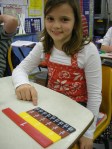
My youngest daughter wanted to do Singapore math today. Miquon Red is her main math text this quarter, but we add a bit of Singapore Primary Math 1B whenever she’s in the mood. We turned to the lesson on subtracting with numbers in the 30-somethings. The first problem was pretty easy for her:

30 – 7 = []

I reminded her that she already knows 10 – 7. She agreed, “10 take away 7 is 3.” Then her eyes lit up. “So it’s 23! Because there are two tens left.”

Continue reading Kids Do the Craziest Things